

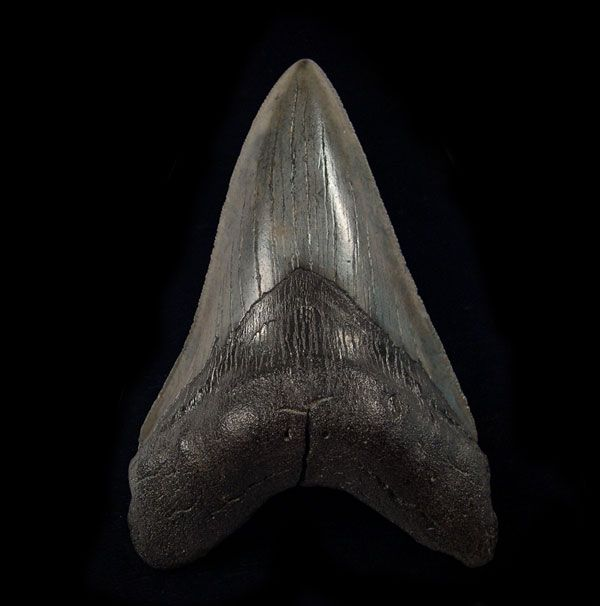
In our work, we often see how Florida captivates fossil enthusiasts with its remarkable megalodon discoveries. As we guide collectors and share our services, we know there is always curiosity about where to find megalodon teeth in Florida, and why some places reveal massive, intact teeth while others only provide broken fragments.
This difference is not random. It is shaped by the way erosional exposure, deep burial, and sediment dynamics influence whether a tooth survives whole or ends up reduced to fragments.
When the Earth Unwraps Its Fossil Treasures
Exposed fossil layers can feel like a gift from the earth, yet they often come with drawbacks. Rivers cutting through land, shifting coastlines, and natural uplift can bring megalodon teeth closer to the surface, where they become visible and collectible. However, exposure does not mean preservation. Once a tooth is freed from its protective sediment, it is immediately vulnerable.
Waves grind it against sand, gravel scrapes enamel away, and roots can separate with repeated movement. The result is often a collection of incomplete crowns, broken tips, or enamel fragments rather than impressive whole specimens. Erosional activity may increase the number of fossils available at a site, but the quality of those fossils is often compromised.
Buried Deep and Waiting in Silence
The opposite scenario unfolds when megalodon teeth remain safely buried. Layers of sediment act like a protective blanket, keeping fossils secure from the destructive forces at the surface. Deep burial helps slow or even prevent wear, allowing enamel, serrations, and roots to stay remarkably intact. These fossils may wait for millions of years, perfectly preserved beneath the ground.
The challenge, however, is that such teeth often remain hidden. Unless erosion or excavation eventually intersects the fossil layer, they may never be revealed. In this balance between protection and accessibility lies the reason why some Florida sites offer large, pristine specimens while others produce little more than fragments.
The Push and Pull of Sediment Dynamics
Even when a tooth is buried, sediment dynamics can determine its long-term condition. In high-energy environments, strong currents and heavy wave action create constant movement. Fossils caught in this cycle are tumbled repeatedly, their surfaces scraped against sand and gravel. Over time, edges wear down, serrations disappear, and roots fracture. Large teeth can quickly become broken remnants when subjected to such relentless activity.
In contrast, low-energy environments offer a gentler fate. Settings such as bays, lagoons, or calm marine areas allow fossils to settle with minimal disturbance. Here, teeth are not battered by constant motion, giving them a better chance to remain intact until they are exposed again. The speed of burial adds another layer of importance. When sediment covers a tooth quickly, it can be locked safely into place before currents or scavengers disturb it. Slow burial leaves teeth exposed for longer periods, increasing the risk of damage.
Some Florida sites even experience repeated cycles of exhumation and redeposition. Teeth may be unearthed, carried by currents, and then buried again, only to be shifted once more. Each cycle of movement strips away a little more of their structure. A tooth that was once complete may, after several episodes of reworking, be reduced to little more than a fragment. This explains why those searching for where to find megalodon teeth in Florida sometimes encounter pristine specimens in one location while nearby sites reveal nothing but broken pieces.
Florida’s Contrasting Fossil Grounds
Florida itself provides an excellent illustration of these forces. Along riverbanks and eroding coastal terraces, teeth can be plentiful, but they often show the scars of constant exposure. Roots are worn, tips are missing, and serrations are eroded. Inland regions, on the other hand, or sites where thicker sediment blankets the fossil layers, tell a different story. When these protective layers are eventually breached, the teeth that emerge are often large, whole, and remarkably preserved.
The story does not end there. Florida’s climate and coastal geography add another twist. Hurricanes, heavy storms, and shifting shorelines constantly alter which fossil layers are exposed or concealed. A site that once produced intact specimens may, after a storm season, begin to yield fragments instead. The contrast between localities often comes down to this delicate interplay of exposure, protection, and changing sedimentary conditions.
The Making of a Giant Find
For a megalodon tooth to remain whole, several factors must align. It must be buried quickly enough to avoid early disturbance, yet not remain so deeply hidden that it never reemerges. It needs the protection of stable sediment and the calm of a low-energy environment.
Finally, it must be uncovered at a moment when erosion reveals it without destroying it in the process. When these conditions come together, a fossil hunter may hold in their hand a six-inch relic of prehistory, as sharp and striking as the day it was shed. When they do not, the result is more likely to be a handful of fragments.
Conclusion: The Story Written in Stone
The contrast between Florida sites that yield large, intact megalodon teeth and those that deliver fragments highlights the power of geological processes. Erosional exposure, depth of burial, and sediment dynamics work together to determine whether a fossil survives the ages or breaks apart along the way. Some sites balance these forces in a way that preserves impressive whole specimens, while others expose fossils to relentless wear that reduces them to pieces.
As one collector once said, “Every fossil is a storyteller. Some whisper their history in fragments, while others shout it whole.” For those who wonder about where to find megalodon teeth in Florida, the answer lies in recognizing the forces that shape each site. Whether a discovery is a magnificent complete tooth or a fragment of one, every piece carries within it the history of oceans long gone and the remarkable journey of survival through time.






