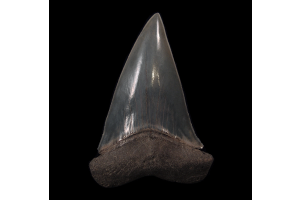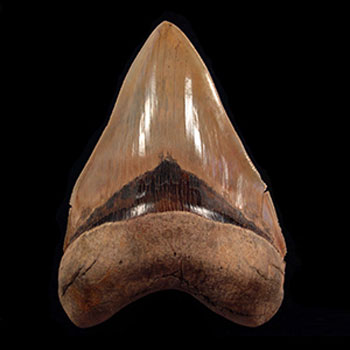
Few creatures in Earth’s history can rival the Megalodon in sheer awe and power. This prehistoric giant was not merely a large shark but an oceanic force that rewrote the rules of marine predation. Its colossal teeth, each one larger than many modern sharks’ entire jaws, defined its supremacy. These massive teeth were evolutionary marvels, tools of devastation that enabled Megalodon to dominate the seas in a way no other predator could.
To understand why this Megalodon Shark tooth earned the title of the ocean’s ultimate predator, one must look closely at how its teeth shaped its hunting strategy, bite force, and ecological impact.
The Size That Commands Respect
Megalodon’s sheer magnitude sets it apart from any marine predator known to us. Stretching as long as 60 feet and tipping the scales at up to 75 tons, it was more than twice the length of today’s Great White shark and far heavier. The enormous size alone positioned the Megalodon at the top of the oceanic food chain, but it was the function and form of its teeth that cemented its role as the apex predator.
Each tooth was a testament to power, giant, triangular, and serrated to perfection. Unlike the slender, needle-like teeth of many sharks designed to grip slippery prey, Megalodon’s teeth were built for cutting through thick flesh and crushing bone. Their size and serrated edges created an unparalleled combination of slicing and crushing ability, capable of incapacitating even the most formidable marine mammals.
Anatomy of a Killing Machine: The Teeth
Megalodon’s teeth were evolutionary masterpieces crafted for dominance. Measuring up to 7 inches long, these teeth were several times larger than those of the Great White shark, which max out around 3 inches. The serrations along the edges acted like serrated steak knives, designed to maximize damage with each bite.
Beyond size, the teeth were structured to withstand incredible forces. Scientists estimate Megalodon’s bite force reached up to 18 tons per square inch, an almost unimaginable figure in the animal kingdom. This immense force was enough to crush the bones of giant whales, which formed a significant part of its diet. For comparison, the Great White’s bite force, while impressive, maxes out around 1.8 tons per square inch, making Megalodon’s bite roughly ten times more powerful.
This combination of size, sharpness, and biting power made Megalodon a fearsome predator capable of delivering devastating blows that few creatures could survive.
How Megalodon’s Teeth Shaped Its Hunting Strategy
The design and strength of Megalodon tooth for sale weren’t just for show, they dictated how this predator hunted. Unlike sharks that chase down smaller fish or scavenge, Megalodon targeted large prey, including ancient whales, large fish, and possibly even other sharks. The fossil record suggests a calculated approach to hunting, where Megalodon used its teeth to first disable and then kill.
One widely supported theory is that Megalodon bit off the fins of large prey, such as whales, to immobilize them. Severing the fins made escape impossible, rendering the victim vulnerable. With the prey effectively trapped, Megalodon would then unleash powerful bites targeting the body, slicing through flesh and crushing bone with lethal efficiency.
This hunting method would have minimized struggle and energy expenditure, essential for a predator of such enormous size. Fossilized whale bones bearing healed bite marks reveal encounters with Megalodon survivors, showing the predator’s impact on even the largest marine mammals.
The Jaw: More Than Just Teeth
Megalodon’s teeth were part of a larger weapon system, its jaw. These jaws could open wide enough to swallow two adult humans side-by-side, a testament to their enormous scale. The jawbones were robust and supported by massive muscles, enabling the Megalodon to generate an incredible bite force. The teeth were arranged in multiple rows, typically around 276, ensuring that the shark was never without a deadly weapon. As older teeth were lost or worn down, new ones from the rows behind moved forward, maintaining a consistently sharp and powerful bite.
The jaw’s engineering was a marvel of nature’s design, maximizing force and efficiency to allow Megalodon to tear through the thick hides and bones of its prey. It wasn’t just a hunter but a crushing machine engineered to dominate.
Ecological Role: Apex Predator of Ancient Oceans
Megalodon’s massive teeth allowed it to fill a critical role in its ecosystem as the apex predator. By preying on large marine mammals, including early whales, it helped maintain balance in the ocean’s food web. Its presence likely influenced the behavior and evolution of prey species, driving adaptations in speed, size, and defense mechanisms.
In this role, Megalodon was not just a solitary hunter but an essential player in shaping marine biodiversity. Its extinction around 2.6 million years ago marked a major shift in ocean ecosystems, creating a void that other predators, including modern sharks and whales, eventually filled.
Fossilized Teeth: Windows into the Past
Megalodon tooth for sale are some of the most iconic and abundant fossils from the prehistoric oceans. Found worldwide—from the Americas to Africa and Australia—these fossilized teeth provide critical insights into the shark’s size, diet, and hunting strategies.
The remarkable preservation of these teeth, often discovered by fossil hunters and scientists alike, reveals details about the shark’s life. Wear patterns show how the teeth were used in hunting and feeding, while bite marks on fossil bones offer direct evidence of their interactions with prey.
Each tooth tells a story of a predator at the peak of evolutionary design, offering clues about a world long vanished but still fascinating us today.
Why Megalodon’s Teeth Matter
Megalodon’s extinction left a void in the ocean’s predator hierarchy, but its teeth remain powerful symbols of prehistoric life. These fossils inspire scientists to learn about ancient ecosystems and the evolutionary pressures that shape life.
For enthusiasts and collectors, Megalodon teeth represent a tangible connection to Earth’s distant past, a reminder of a creature so massive and powerful that it defined its era. Understanding how these teeth function provides insight into how nature crafts apex predators and the role they play in maintaining ecological balance.
Conclusion: Teeth That Commanded the Seas
Megalodon’s massive teeth were far more than just tools, they were weapons of unparalleled power and precision, integral to making this shark the ocean’s ultimate predator. Their extraordinary size, combined with lethal serrations and jaw-crushing bite force, allowed Megalodon to hunt and dominate ancient seas like no other creature.
Today, those Megalodon Shark tooth remain one of the clearest reminders of a time when the ocean was ruled by a titan, an apex predator perfected by millions of years of evolution. In every fossilized tooth lies the story of power, survival, and the enduring legacy of the greatest shark to ever swim the Earth’s waters.
Fascinated by the mighty Megalodon and its prehistoric reign? Dive deeper into the world of ancient sharks and explore our exclusive collection of fossilized Megalodon teeth. Whether you’re a collector, a science enthusiast, or simply curious, uncover the stories these giant teeth tell about life in the ancient oceans.
Start your journey into the depths of prehistoric seas to and browse our Megalodon fossil collection and bring a piece of the ultimate predator home!