

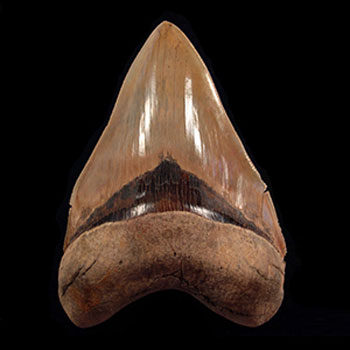
Long before humans walked the Earth, an apex predator ruled the oceans, a giant so formidable that even whales would have been on its menu. This was the Megalodon (Otodus megalodon), a prehistoric shark believed to be the largest marine predator in history. Today, this colossal creature is extinct, yet its legacy survives, not in living descendants, but in the form of fossilized teeth that continue to capture the imagination of scientists, collectors, and enthusiasts alike.
The fascination with Megalodon shark teeth is more than about size, rarity, or scientific value. These ancient relics are windows into a world that existed millions of years ago, telling us about an ocean dominated by giants and the evolutionary history of sharks.
But what is it about these fossilized teeth that still ignites such curiosity and awe?
1. A Glimpse Into Prehistoric Power
The Megalodon is estimated to have grown up to 60 feet in length, dwarfing today’s Great White Shark. Its teeth, heart-shaped with finely serrated edges, were perfectly adapted for slicing through the flesh and bone of large marine mammals. Some specimens measure over 7 inches, making them the largest known shark teeth to ever exist.
Holding one of these teeth is the closest we can get to touching the apex of ancient oceanic power. It’s not just a fossil, it’s evidence of a predator that could bite down with a force exceeding per square inch. This sheer physical dominance makes each tooth a symbol of ultimate marine mastery.
2. The Mystery of Their Extinction
One reason Megalodon teeth intrigue us is the mystery of the shark’s disappearance. The Megalodon thrived for millions of years before vanishing years ago. Scientists propose several theories, climate change, decline in prey populations, or competition from smaller, faster predators like the early Great White.
Every Megalodon tooth found today is a piece of that puzzle. When paleontologists analyze the wear patterns, serrations, or mineral content of these teeth, they gather clues about the shark’s diet, hunting grounds, and even migration patterns. In this sense, each tooth is both a collectible and a research tool, linking modern science to ancient mysteries.
3. The Global Hunt for Ocean Treasures
One of the most fascinating aspects of Megalodon teeth is their worldwide distribution. These sharks roamed oceans across the globe, and their fossilized teeth have been found on nearly every continent. Some of the most prized specimens come from coastal waters off the United States — particularly North Carolina, South Carolina, Georgia, Florida, and California.
Megalodons were too large to hunt in shallow, nearshore waters, but they thrived in deeper, warmer seas. Over millions of years, as sea levels shifted, their teeth settled into seabeds and riverbeds, eventually fossilizing. Modern divers and fossil hunters can still retrieve them, sometimes even in remarkable condition, from areas where prehistoric coastlines once existed.
4. Nature’s Perfect Preservation
Shark skeletons are made mostly of cartilage, which decomposes quickly after death. However, teeth are composed of dentin covered with a hard enamel coating, which allows them to survive in sedimentary layers for millions of years. Over time, minerals replace the organic material, preserving the tooth in exquisite detail.
This process of fossilization ensures that when a Megalodon tooth surfaces, it’s a remarkably well-preserved piece of prehistoric history. The serrated edges, enamel coloration, and root structure often remain intact, making them not only scientifically valuable but also visually stunning.
5. Collectors’ Crown Jewels
For fossil collectors, owning a Megalodon tooth is akin to having a crown jewel. The value of these fossils depends on factors such as size, condition, coloration, and provenance. A massive, intact tooth over six inches long can fetch thousands of dollars, especially if it comes from a rare location or displays exceptional preservation.
Collectors often see them as centerpiece items, conversation starters that instantly draw attention. Beyond monetary worth, they carry an intrinsic value as tangible connections to an Earth that looked entirely different from today.
6. Connection to the Great White Shark
The Megalodon is often compared to the modern Great White Shark. While once believed to be its direct ancestor, current evidence suggests they share a more distant evolutionary relationship. Nevertheless, the similarities in tooth shape and hunting style spark curiosity about how such a massive predator influenced the evolution of today’s sharks.
For many enthusiasts, studying Megalodon shark teeth isn’t just about looking back, it’s about understanding how apex predators adapt, survive, and sometimes disappear in the face of changing oceans.
7. Adventure and Discovery
There’s something undeniably thrilling about finding a Megalodon tooth yourself. Whether combing through riverbeds in South Carolina or diving off Florida’s coast, the hunt itself is part of the fascination. Every fossil hunter dreams of unearthing a massive, perfectly preserved specimen.
For some, the appeal lies in the Indiana Jones–like adventure, a mix of history, science, and exploration. For others, it’s the quiet satisfaction of holding a piece of nature’s history in their hands.
8. A Symbol of Resilience and Change
Megalodon teeth also serve as silent reminders of the planet’s capacity for change. Here was a creature that ruled the oceans for millions of years, yet even it succumbed to environmental pressures. These fossils tell a story not just of dominance, but of fragility, that no species, no matter how powerful, is immune to extinction.
In this way, they resonate beyond science. They become symbols of adaptability, resilience, and the importance of environmental balance.
9. An Enduring Fascination
Ultimately, Megalodon teeth fascinate us because they bridge the gap between imagination and reality. They’re physical proof of a creature that sounds almost mythical in scale and strength, yet undeniably existed. Unlike dinosaur bones that often require museum-grade restoration, Megalodon teeth are accessible; you can hold one, examine it, and even own it.
This accessibility makes them one of the most popular fossils among both professional paleontologists and casual collectors. They allow us to personally connect with a chapter of Earth’s history that feels both impossibly distant and thrillingly close.
Conclusion
Millions of years after the Megalodon disappeared, its teeth still inspire awe. They are at once scientific specimens, collectors’ items, and symbols of prehistoric majesty. They represent the thrill of discovery, the power of ancient life, and the ongoing story of our planet’s oceans.
Whether displayed in a museum, treasured in a private collection, or freshly pulled from a riverbed by an excited diver, our fossils of Megalodon tooth for sale remind us that some relics of the past never lose their power to captivate.
If you’ve ever dreamed of holding a piece of prehistoric history in your hands, now is the time. Explore our carefully curated selection of authentic Megalodon teeth and bring home a fossil that has journeyed through millions of years to reach you.






