

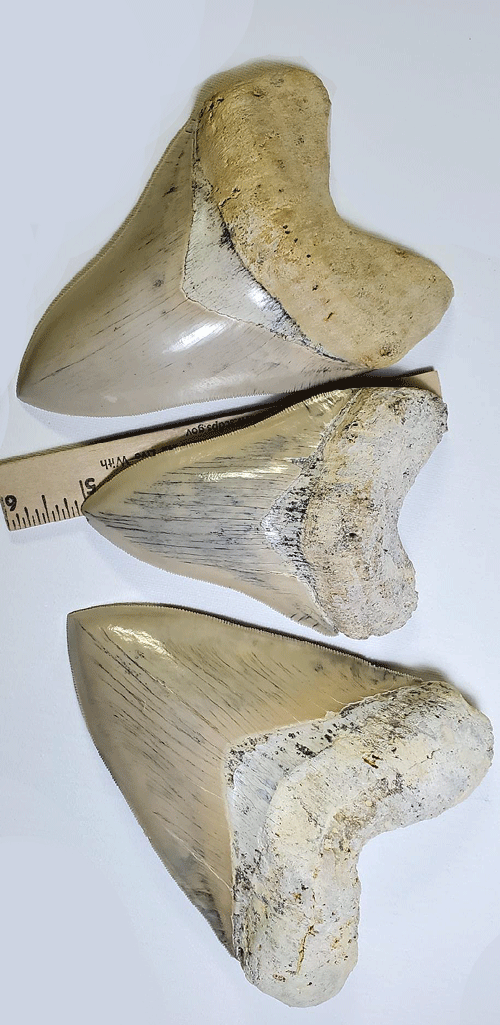
Long before humans ever walked the Earth, oceans were home to creatures of staggering size and strength. Among them, the megalodon reigned as a giant whose bite could crush bone with ease and whose presence kept the ancient seas in balance. Though its massive body vanished from the oceans millions of years ago, its legacy survives in rare treasures from the deep.
One such treasure, a megalodon tooth fossil, is more than a piece of hardened mineral—it is a tangible chapter of Earth’s story, preserved in stone. When held in the hand, it feels like a fragment of another era, weighed down by the passage of time. These fossils don’t merely sit in a display; they invite questions, spark curiosity, and remind us that the world we see today is built on layers of history far older than humanity itself.
Stepping into the story of these relics is like following a trail back through the ages—one that begins in the dark depths of ancient oceans and emerges in the hands of modern-day explorers and collectors.
The Ocean’s Long-Lost Predator
The megalodon was not just another predator—it was the dominant marine hunter of its time. Estimates suggest it could grow up to 50–60 feet in length, with jaws spanning nearly three meters. Its teeth alone could reach over seven inches, each serrated like a natural saw blade, built for gripping and slicing through prey.
This giant ruled Earth’s oceans for more than 13 million years before vanishing around 3.6 million years ago. The reasons for its disappearance remain a topic of debate, with theories ranging from cooling oceans to competition from other marine predators such as early great white sharks. Whatever the cause, the megalodon left behind a legacy that still captures the imagination—a reminder that nature’s dominance is never permanent.
How a Tooth Becomes a Fossil
Fossilization is nature’s slow art form. When a megalodon lost a tooth—a natural occurrence during feeding—it would fall to the seafloor. If conditions were right, it became buried beneath layers of sediment, shielded from scavengers and decay. Over millions of years, minerals from surrounding sediment replaced the tooth’s organic material, hardening it into stone.
The process also created the variety of colors we see today—rich blacks, earthy browns, warm reds, or soft grays—depending on the minerals present in the surrounding seabed. This is why no two fossilized teeth are identical. Each carries its own geological fingerprint, shaped by where it rested and how long it remained in that location.
Identifying the Genuine Article
In a world where authentic fossils coexist with replicas, knowing how to distinguish between them is essential. While replicas can look convincing, there are telltale signs of authenticity:
● Weight – Fossils are denser than modern teeth because minerals have replaced the organic material, making them surprisingly heavy for their size.
● Texture – A genuine fossil often feels slightly rough or grainy; fakes are usually too smooth.
● Serrations – On real teeth, the serrations along the edges appear sharp yet uneven, whereas replicas tend to have uniform edges.
● Natural Wear – Chips, cracks, or slight erosion are natural signs of age.
Examining a specimen under good lighting and even feeling its edges can provide valuable clues.
Where in the World They Are Found
These fossils aren’t exclusive to one corner of the planet. Megalodon teeth have been discovered on every continent except Antarctica, in areas that were once submerged under ancient seas. The southeastern United States, parts of South America, European riverbeds, and certain African coastal regions have yielded exceptional finds.
Some divers search submerged fossil beds in warm coastal waters, while others hunt for treasures along inland riverbanks and cliffs, where erosion reveals long-buried fossils. Regardless of where they are found, each discovery connects its finder to a world that no longer exists above the waves.
The Collector’s Fascination
Why do people feel drawn to such fossils? For many, it’s the sheer scale of history they represent. Holding something that predates humanity by millions of years creates a quiet sense of awe. For others, these fossils serve as a bridge between science and imagination—an object that sparks curiosity in children and rekindles fascination in adults.
In private collections, they are often displayed as centerpieces, inviting conversation and admiration. In museums, they help visitors picture an ancient predator in life-size proportions. Whether for scientific research or personal enjoyment, their appeal endures across cultures and generations.
Caring for a Fossilized Treasure
Even though a megalodon tooth has survived for millions of years underground, it still requires care once it is unearthed. Environmental changes can cause damage, so collectors often follow a few simple guidelines:
● Clean Gently – Use soft brushes and water; avoid chemicals that can erode the surface.
● Stable Conditions – Keep fossils in areas with consistent humidity and temperature.
● Display Thoughtfully – Avoid placing them in direct sunlight for extended periods, as this can cause color alteration.
These steps ensure that the fossil remains a lasting part of your collection, looking much the same decades from now as it does today.
The Importance of Responsible Sourcing
Interest in fossils has grown rapidly, making ethical collecting even more crucial. Responsible sourcing ensures fossils are gathered legally and without damaging protected sites. It also helps preserve archaeological contexts for future study.
Collectors play a crucial role in protecting not only the fossils themselves but also the stories they convey. Every specimen carries information about Earth’s past, and preserving that integrity ensures future generations can continue to learn from it.
The Experience of Discovery
Finding a fossil—whether through diving, hiking, or browsing at a trusted vendor—can be a deeply personal moment. Many collectors describe a sense of connection, as though they’ve briefly touched a world long gone. For divers, the sight of a triangular tooth half-buried in the seabed can make the heart race. For land hunters, spotting the edge of a tooth in river gravel can feel like uncovering buried treasure.
It’s not just about the object itself; it’s about the journey to find it, the patience it requires, and the knowledge that what you hold is both rare and ancient.
Bringing the Past Into the Present
A megalodon tooth fossil is far more than an artifact. It’s a story in solid form—one that spans millions of years, from the ocean’s greatest predator to the hands of a modern collector. Whether displayed on a shelf, studied for scientific insight, or passed down as a family heirloom, it serves as a poignant reminder of life’s vast timeline.
If you have ever felt drawn to the mysteries of the deep, exploring fossil collecting might open a window to that past. Each piece you encounter carries a history you can touch, a chapter you can preserve.
Discover the beauty and history of authentic fossils and begin your own journey into the prehistoric world. Whether you’re starting a collection or adding to one, the next relic you find could connect you to a moment millions of years in the making. Let your curiosity lead you—and let history find a home in your hands.






