

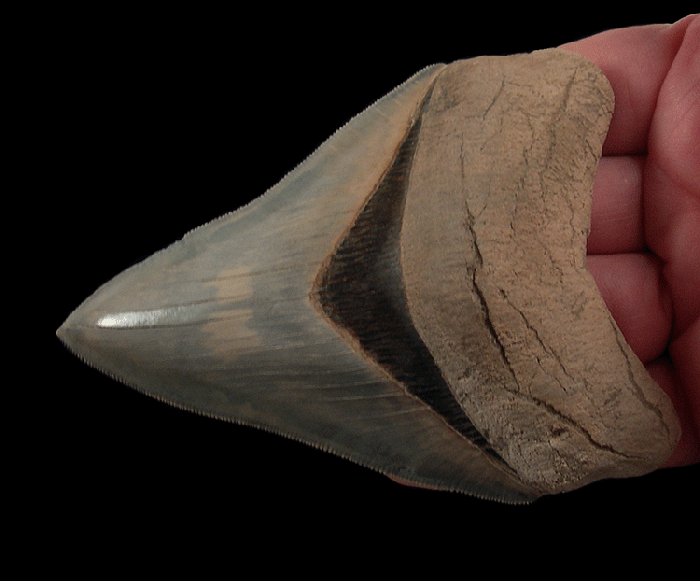
In the grand timeline of Earth’s prehistoric oceans, few creatures command the awe and admiration earned by the largest shark that ever lived. Long before modern whales ruled the seas, an ancient predator grew to nearly 60 feet long, armed with rows of deadly, serrated teeth. Among the fossil record left behind, Carcharocles megalodon teeth hold a special place—especially those recovered from Peru, which are considered some of the rarest and most desirable specimens on Earth. At Buried Treasure Fossils, we’re proud to offer these prized pieces to advanced collectors who appreciate both their rarity and beauty.
Why Peruvian Megalodon Teeth Are So Rare
The world is rich in Carcharocles megalodon fossils, with teeth frequently found in regions like the southeastern United States, Morocco, and parts of Europe. But when it comes to truly exceptional pieces, Peru—specifically the Ocucate region—has become legendary. This area, located within the Pisco Formation of southern coastal Peru, is known for Miocene-aged marine sediments that occasionally yield exquisitely preserved fossilized shark teeth. However, due to increasing legal restrictions and environmental protection laws, access to these fossil beds has become highly limited, making these Peruvian specimens increasingly difficult to obtain.
The unique geological conditions of Peru have transformed Megalodon teeth into highly coveted treasures among collectors and enthusiasts. With the primary source locality now largely closed to commercial collecting, the number of available specimens is limited, creating a sense of rarity that is hard to ignore. Each tooth represents not just a fragment of ancient marine history, but also a tangible connection to a time long past. As these remarkable artifacts slowly disappear from the market, their scarcity elevates their worth, making them prized possessions both in scientific circles and among collectors seeking to own a piece of this fascinating history. Once these specimens are no longer accessible, their absence will be felt forever, deepening their allure and value.
The Ocucate Formation: A Fossil Hunter’s Dream
The Ocucate area of Peru is a captivating segment of the expansive Pisco Formation, celebrated for its extraordinary marine deposits that hark back to the Miocene epoch, a rich geological era spanning approximately 23 to 5 million years ago. This region's geological composition provides an ideal environment for fossil preservation, characterized by densely compacted marine sediments, a parched climate, and very little disturbance after burial. Such optimal conditions have led to the preservation of fossils, particularly shark teeth, with remarkable detail and integrity, allowing researchers to gain invaluable insights into prehistoric marine life. The striking clarity of these fossils captures the imagination, offering a window into the ancient oceanic world that once thrived in this unique landscape.
In this region, many of the Carcharocles megalodon teeth unearthed showcase phenomenal qualities: rich hues of dark tan or mocha, complete and well-defined bourlettes, intact roots, and extraordinarily sharp serrations that have stood the test of time. These are not the rugged, weathered teeth often seen from river or beach finds; Peruvian specimens often exhibit exceptional enamel gloss, fine color contrast, and near-perfect form. When we describe them as "gem quality," we mean it in every sense.
The Collector’s Perspective: What Makes Them Special
Advanced fossil collectors and high-value buyers are often drawn to rarity, condition, and provenance—and Peruvian Megalodon teeth offer all three in abundance. For those familiar with fossil grading and investment-grade paleontology, a top-tier tooth from Peru sits at the pinnacle of desirability.
Why? Because these teeth are strikingly different in appearance. Their vibrant colors and exceptional preservation set them apart from their North American counterparts. Many collectors note that the root structures on Peruvian teeth are among the most articulated, often revealing subtle anatomical details not commonly preserved elsewhere. For enthusiasts who already have U.S. or Moroccan specimens in their collection, a Peruvian Carcharocles megalodon tooth fills a crucial and prestigious gap.
Adding to their allure is the dwindling availability. With the Ocucate locality now largely closed, any new Peruvian Megalodon teeth entering the market are almost exclusively from old private collections or rare, previously unearthed inventory. That scarcity is not just a selling point—it’s a fact that enhances both the fossil’s collectible value and its long-term appreciation.
Our Commitment to Authenticity and Quality
At Buried Treasure Fossils, we understand the gravity of offering a specimen as rare and valuable as a Peruvian Carcharocles megalodon tooth. That’s why we guarantee the authenticity of every fossil in our catalog. Each piece we offer is legally and ethically sourced, with no repairs or restorations that diminish its integrity. What you see is exactly what prehistoric oceans left behind—nature’s artwork preserved in stone.
Our team is composed of experienced collectors and enthusiasts, so we know what to look for in a top-tier tooth. Whether it’s a perfect bourlette, razor-sharp serrations, or a flawless root, we’re meticulous about our curation process. We take pride in offering our customers some of the finest examples available on the market, including rare Peruvian finds that are nearly impossible to come by elsewhere.
A Legacy Preserved in Enamel
Owning a Peruvian Megalodon tooth isn’t just about having a fossil—it’s about preserving a piece of Earth's ancient marine legacy. These teeth are remnants of a predator that once dominated the seas, capable of biting with a force unmatched in today’s oceans. Each serration tells a story of survival, dominance, and eventual extinction, encapsulated in mineralized perfection.
Beyond their aesthetic and scientific significance, these fossils offer an irreplaceable connection to natural history. Displayed in a home, office, or gallery, a premium Megalodon tooth from Peru commands attention and inspires wonder. For educators, it serves as a tactile teaching tool; for collectors, it becomes a prized centerpiece; for investors, it represents a finite asset with enduring appeal.
Why Now Is the Time to Acquire One
As more collectors enter the fossil market and regulations tighten globally, rare items like Peruvian Megalodon teeth continue to climb in value. This isn’t just a passing trend—it’s a shift in how the fossil community views premium specimens. We’re witnessing a transition where fossils, especially those with unique origin stories, are seen as both scientific artifacts and alternative investments.
If you're a collector who values provenance, perfection, and prestige, a Peruvian Carcharocles megalodon tooth should be on your radar. These are the kinds of specimens that don’t just hold their value—they become legacy pieces passed down through generations.
Conclusion: A Tooth Worth the Pursuit
In the world of fossil collecting, few finds rival the mystique and rarity of Carcharocles megalodon teeth from Peru. Their origin in the Ocucate region, the unparalleled quality of preservation, and the increasingly limited availability make them a crown jewel in any serious collection. At Buried Treasure Fossils, we’re thrilled to help passionate collectors secure these exceptional specimens before they vanish from the market entirely.
If you're ready to elevate your fossil collection with something truly world-class, explore our latest Peruvian Megalodon offerings. It's not just a tooth—it’s a tangible piece of Earth’s deep-time story, waiting to be rediscovered and appreciated all over again.






