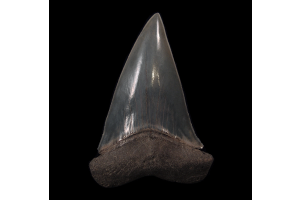
Pick up a megalodon tooth and you’ll notice something curious — it doesn’t just sit there. It almost stares back at you. There’s a weight to it, not just in grams but in presence, as though you’ve been handed a secret straight from the ocean’s depths. The serrations, whether razor-sharp or softened with age, feel like they’re telling you about hunts long past.
You can’t help but imagine the shark it once belonged to — an animal the size of a bus, gliding silently before striking with enough force to shatter bone. For collectors and explorers alike, finding a megalodon tooth is never just about adding another trophy to a display case. It’s about the connection you forge with a creature that swam millions of years before humans ever took their first steps. And for those brave (or lucky) enough to go megalodon tooth hunting, the chase becomes part of that bond.
Meeting the Shark Behind the Tooth
The megalodon wasn’t simply large — it was a force of nature. Estimates put it at up to 60 feet long with a jaw that could open wider than most people are tall. Its bite force? Roughly 40,000 pounds, strong enough to crush a whale’s skull.
The only part of this predator that consistently survives the passage of time is its teeth. Made of hard enamel, they weathered millions of years of burial, pressure, and mineral transformation. Hold one in your palm and you’re essentially shaking hands across epochs with the apex predator of the Miocene and Pliocene oceans. This handshake isn’t delicate. It’s firm, confident — as if the shark is still letting you know who ruled the sea.
A Tooth with Personality
Not all megalodon teeth are created equal. Some look like they could still slice through flesh, their serrations intact, their tips perfect. These teeth feel regal, like they belonged to a shark in its prime. Others bear scars — a broken edge, a dulled point, a bite mark from some long-forgotten clash.
One collector I spoke with swears that a chipped tooth he owns “still looks smug,” as though the shark broke it off during an especially bold hunt and didn’t care. This individuality is part of the appeal. The tooth you hold doesn’t just represent a megalodon. It represents your megalodon — a specific animal with its history.
The Long Journey from Predator to Fossil
A tooth’s transformation into a fossil is anything but quick. After falling from the shark’s mouth (yes, sharks shed teeth regularly), it would sink to the ocean floor. Over thousands to millions of years, layers of sediment buried it deeper and deeper. Minerals slowly replaced the organic material, locking the tooth in stone without erasing its form.
The colors — jet black, smoky grey, golden brown — come from the minerals in the surrounding sediment. A tooth found in a South Carolina river might be deep, glossy black. One from a Florida riverbed might carry warm amber tones. The story of its burial is written in its palette.
The Adrenaline of the Hunt
For many, the romance of megalodon tooth hunting lies in the search itself. Imagine sliding into the still water of a river just after sunrise. The mist clings to the surface as you feel your way along the bottom. Your fingers brush against shells, rocks, bits of debris — and then something triangular. You pull it free, brushing away the silt, and there it is.
That moment is electric. Every hour of searching melts away in a rush of satisfaction. Even if you never find another tooth that day, you’ve touched a piece of the ancient ocean with your own hands.
Places Where Legends Wait
While some people get lucky strolling along the beach after a storm, others dive into rivers or sift through sediment at known fossil sites. Spots like the Peace River in Florida, the blackwater rivers of South Carolina, and certain coastal cliffs in Maryland have produced stunning specimens.
Each location has its own challenges — murky water, slippery rocks, or even the need for dive certifications. But they all share one thing: the possibility of discovery. And once you’ve found your first, you’re hooked. That’s the danger of this hobby — it’s addictive in the best possible way.
Science in Every Serration
A megalodon tooth isn’t just a collector’s piece; it’s a data point. Paleontologists use these fossils to estimate the size of individual sharks and map their former range. Wear patterns can indicate what the shark was eating — whales leave different marks than fish. Isotopic analysis can even hint at water temperatures and migration patterns.
In other words, each tooth is a notebook page from the ocean’s most fascinating chapter.
The Cultural Side of Shark Teeth
Long before megalodon teeth were studied in labs, they were revered by different cultures. In some Pacific Island traditions, shark teeth were worn as symbols of courage and strength. Ancient peoples sometimes believed they offered protection, not just in the ocean but in life.
Today, they still inspire awe. Some collectors frame them like fine art. Others turn them into jewelry, letting them serve as bold, wearable statements of history and power.
From Ocean Floor to Your Hands
If you’ve never hunted for a tooth yourself, buying one from a trusted source is the next best thing. A reputable dealer ensures the fossil is authentic, ethically sourced, and accurately represented. There’s an entire spectrum — from small, affordable pieces perfect for beginners to massive, museum-grade teeth that command attention. Unlike many collectibles, a megalodon tooth doesn’t lose its allure once it’s yours. If anything, the more you look at it, the more it seems to invite questions.
Why We Treat Them with Respect
When we share these incredible fossils, we’re not just passing along an object. We’re connecting you with a predator that shaped marine life for millions of years. The tooth you choose might be the first in your collection or the crown jewel among dozens, but either way, it deserves respect.
That’s why we take great care in sourcing, preserving, and presenting each specimen. We know that for you, this isn’t just a purchase. It’s the moment you step into a story that began long before humans were part of the plot.
The Lasting Connection
A megalodon tooth has a strange way of grounding you. It makes you feel small in the best sense — a reminder that life on Earth has been fierce, beautiful, and resilient for far longer than we’ve been here. When you hold one, you’re not just thinking about the shark. You’re thinking about the ocean it swam in, the prey it hunted, and the eons that passed before it reached your hands. It’s a souvenir, yes, but one that refuses to sit quietly on a shelf.
It’s alive in its way. And it’s waiting for you to listen. Suppose you’ve ever dreamed of holding history in your hands, of feeling that hum of connection across millions of years. Now’s the time to explore. Whether you discover it in the wild or choose one from our collection, finding a megalodon tooth is an experience you won’t forget. And for those ready to start or continue their journey into megalodon tooth hunting, we’re here to help you meet the ocean’s greatest legend — one tooth at a time.