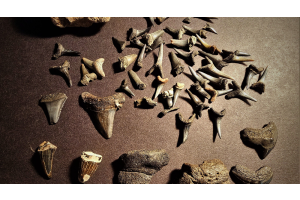
When we think of the ocean's most fearsome predators, the great white shark often comes to mind. However, paleontologists, scientists, and enthusiasts exploring the prehistoric age know that today's great white shark is not the largest of them all. Long before the great white ruled modern oceans, Megalodon — a colossal super-shark — dominated aquatic life nearly 20 to 2.6 million years ago. This prehistoric giant could grow up to 16–18 meters (55–60 feet) in length, making it approximately three times larger than the largest recorded great white shark.
At Buried Treasure Fossils, we’ve always been fascinated by these massive predators, and we dive deep into their incredible differences, especially when comparing a Megalodon tooth vs great white tooth.
The Size Factor: Megalodon vs. Great White Shark
When it comes to sheer size, Megalodon has no rival. While great white sharks typically measure up to 6 meters (20 feet) long, Megalodon stretched up to an astonishing 18 meters (60 feet). To put that into perspective, Megalodon was roughly the length of a school bus, while the great white compares to an average family car.
The Megalodon’s immense size contributed to its dominance in prehistoric oceans. Its towering presence allowed it to command the marine food chain, while today’s great white, though powerful, simply cannot match the colossal proportions of its ancient ancestor.
Jaw Power: The Ultimate Comparison
One of the most remarkable differences between these two sharks lies in their jaws. Megalodon had an enormous jaw structure, lined with 276 teeth arranged in five rows, spanning approximately 2.7 to 3.4 meters (9 to 11 feet) wide. This jaw size was so massive it could easily engulf two average-sized adults standing side by side.
In comparison, the great white shark’s jaws are formidable but smaller, with a maximum width of about 2 meters (6.5 feet). The difference in jaw size directly correlates to their bite force — and this is where Megalodon truly shows its dominance.
Bite Force: Nature’s Unmatched Power
By studying fossilized teeth and jaw structure, experts estimate that Megalodon’s bite force ranged between 10.8 to 18.2 tonnes. That’s enough pressure to crush the skull of any prehistoric marine animal with ease. On the other hand, the great white shark — often celebrated for its strength — delivers an estimated bite force of 1.7 tonnes at best.
This nearly tenfold difference demonstrates that Megalodon was not only larger but far stronger, making it one of the most powerful marine predators ever to exist.
Teeth Tell the Tale: Megalodon Tooth vs. Great White Tooth
The key to understanding much of what we know about Megalodon lies in its teeth. Fossils collected from around the globe reveal that Megalodon teeth could grow up to 18 cm (7 inches) in length — roughly the size of an adult’s hand. These triangular, serrated teeth were designed for slicing through large prey with incredible efficiency.
By contrast, the largest great white shark teeth rarely exceed 6 cm (2.5 inches). When comparing a Megalodon tooth vs great white tooth, the difference is striking — not only in size but in design. While both species evolved sharp, serrated edges, Megalodon’s teeth were significantly broader and heavier, optimized for its massive size and powerful jaw structure.
At Buried Treasure Fossils, we specialize in showcasing these fascinating relics of prehistoric life, allowing enthusiasts to explore just how extraordinary these creatures truly were.
A Glimpse Into the Prehistoric Ocean
Imagine the oceans nearly 20 million years ago — vast, teeming with life, and dominated by the enormous Megalodon. Its sheer size, unmatched bite strength, and powerful jaws made it the ruler of its era. The great white shark, as formidable as it is today, simply cannot compare to its ancient predecessor’s scale and strength.
However, it’s important to note that the great white shark remains one of today’s most efficient apex predators. Its evolutionary adaptations have allowed it to thrive for millions of years, even as larger species like Megalodon disappeared from Earth.
Why Megalodon Remains a Fascination
At Buried Treasure Fossils, we understand the enduring fascination with Megalodon. Its fossils continue to offer invaluable insights into prehistoric marine life and give us a deeper appreciation for the power and diversity of Earth’s ancient ecosystems.
Megalodon represents more than just size and strength — it’s a window into a time when our planet’s oceans were home to some of the most extraordinary creatures ever to exist. Each fossilized tooth tells a story, providing clues about a species that once reigned supreme in the ancient seas.
Final Thoughts: The Ocean’s Ultimate Giant
When comparing Megalodon to the great white shark, the differences are monumental. From size and jaw width to tooth structure and bite force, Megalodon was on an entirely different level. While today’s great whites inspire awe and respect, they are only distant shadows of the prehistoric giant that once ruled the seas.
The discovery and preservation of Megalodon fossils continue to inspire curiosity, deepen our understanding of Earth’s history, and fuel a passion for paleontology among enthusiasts worldwide.
Explore the Past With Buried Treasure Fossils
At Buried Treasure Fossils, we take pride in connecting people with the incredible history of our planet through authentic prehistoric fossils. Each piece is a tangible link to a world that existed millions of years ago. If you’re fascinated by ancient marine life and want to explore authentic Megalodon fossils, our collection offers a remarkable journey into Earth’s prehistoric past. Our passion lies in bringing these extraordinary relics to enthusiasts, collectors, and curious minds who wish to hold a piece of Earth's ancient story.
Discover the stories hidden within the fossils — explore with us.
Disclaimer: This blog is intended for informational purposes only. It does not encourage or endorse any unethical or illegal practices related to fossil collection. Please always adhere to local laws and regulations and practice environmental responsibility.