

We have spent years studying and handling some of the finest fossils from the Bone Valley Formation, and our work allows us to see how these ancient treasures have been preserved. Through our experience, we can recognize that the sediments in this region hold silent yet powerful stories. The softer marl, phosphorite pebbles, and chert found here give us the ability to piece together the environmental conditions of the past, as well as understand the process that has fossilized teeth over millions of years.
Among these remarkable finds, Otodus megalodon in Bone Valley stands as a striking example of how time, chemistry, and geology can shape a legacy that survives far longer than the creature itself.
Softer Marl – Nature’s Gentle Cradle
In the world of fossil preservation, the sandy marl of the Bone Valley Formation could be compared to a protective blanket laid by ancient waters. Soft and fine-textured, it held its treasures close, allowing teeth to settle without the harsh wear of coarser sediments. This calm, stable environment may have acted as nature’s own vault, where delicate details like serrations and root edges could rest undisturbed.
Marl’s embrace has kept a fossil’s character intact. Every groove, every curve of enamel, speaks to the patience of time layered softly upon it. In the stillness of that ancient seabed, the story of a predator was written in mineral and stone.
Phosphorite Pebbles – The Alchemists of Preservation
Threaded through the marl are phosphorite pebbles, each one rich in the minerals that breathe permanence into ancient remains. Phosphate has the remarkable ability to replace organic structures with minerals, creating a mirror image in stone that can last millions of years.
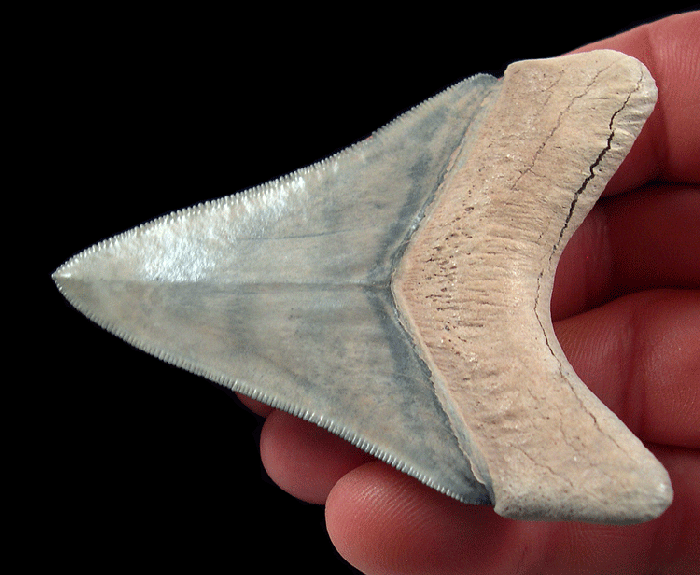
It is within these phosphate-rich environments that tooth enamel sometimes takes on remarkable hues—soft blues, sandy tans—colors shaped not by paint or polish but by nature’s slow chemical artistry. One Otodus megalodon in Bone Valley tooth carries this story vividly: its light blue enamel and tan root are framed by sharp serrations and an intact bourlette, all testament to an environment that did not simply bury, but transformed.
Chert – The Silent Guardian
Chert, scattered in nodules throughout the formation, offers another layer of resilience. Rugged and resistant to weathering, its quartz composition acts as a quiet guard, stabilizing sediments and providing protection to nearby fossils. The contrast between the marl’s softness and chert’s unyielding strength reflects the balance of forces that preserved these relics.
Fossils near chert nodules may have endured with a little more certainty, shielded from the slow erosion that could strip away detail. Together, marl’s softness, phosphorite’s chemistry, and chert’s strength formed a triad of preservation unlike any other.
How the Sediments Shape What Is Seen Today
The Megalodon tooth from Polk County shows the harmony of these elements in a single object. Marl’s gentle burial protected it. Phosphorite infused it with minerals and influenced its unique coloring. Chert reinforced the surrounding ground, holding the tooth in its original form over unfathomable spans of time.
The result is not simply a fossil—it is a perfect balance between environment and artifact. Every curve of enamel, every serrated edge, is an echo of both the predator’s life and the Earth’s patient craftsmanship.
Layers of History in Stone
Each sediment type is a page in a larger book:
● Marl tells of quiet waters and slow, undisturbed deposition.
● Phosphorite reveals chemical richness and the art of mineral transformation.
● Chert signals enduring stability, a promise that the past will not be erased too easily.
Read together, they form a chapter of Earth’s history in which enormous sharks prowled ancient seas, and where their remains were carried gently into a world of stone.
Silent Evidence of a Lost Ocean
The sediments beneath Bone Valley teeth are more than geological matter—they are storytellers. They whisper of currents that no longer flow, of creatures whose shadows once passed over sunlit shallows, of a world that existed millions of years before the present.
The fossils are the characters in that story, but the sediments are the stage, holding every scene in place for all time.
Preserving the Details for Generations
Bone Valley’s fossils, like the light blue and tan Megalodon tooth, endure because of a remarkable
alignment of conditions. Marl has shielded them, phosphorite has immortalized them, and chert has guarded their form. Each fossil is both a specimen and a historical record, carrying the story of the creature and the environment that preserved it.
The Interplay of Time and Transformation
Over millions of years, minerals seeped into bone and tooth, replacing what once was living with crystalline permanence. The sediments shaped their fate, cushioning them, preserving them, and locking their stories into solid form.
Holding an Otodus megalodon in Bone Valley tooth today is carrying not only the remains of an apex predator, but also the record of an ocean’s chemistry, the pace of sedimentation, and the patience of time itself.
Closing Reflections
The Bone Valley Formation offers more than fossils—it provides a lesson in endurance. Each marl grain, phosphorite pebble, and chert nodule plays its part in a story written over eons. These elements teach that preservation is as much about the journey after death as the life that came before.
In the words of an old saying, “Stone remembers what the sea forgets.” Here, in the silent sediments of Bone Valley, the sea’s forgotten giants still speak—if one has the patience to listen.






