

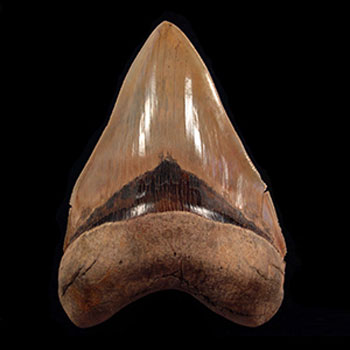
In our work, we explore how extraordinary fossils can inspire new ways of thinking about geology and preservation. Megalodon teeth are among the most fascinating examples, and they allow us to see the durability of life’s traces across millions of years.
With their immense size, sharp serrations, and mineralized resilience, these teeth can guide us in considering how fossil-like structures might survive in extraterrestrial environments. As we continue to expand our studies, these relics help us understand preservation in places far different from Earth.
“Stone Memories” – Teeth That Outlived Oceans
The Megalodon’s skeleton was made of cartilage, which did not endure over time. The teeth, however, were fossilized through petrification. Minerals replaced the original structures, preserving every edge and curve. These teeth can still show serrations and enamel, even after millions of years.
This endurance gives researchers a model for thinking about preservation on other planets. If fossil-like remains are ever discovered in extraterrestrial rock layers, they will likely be preserved in a similar way—through mineral replacement. Megalodon teeth can therefore be used as analogs to help us understand how biological structures might remain intact under very different planetary conditions.
“The Palette of Fossils” – Colors Written by Earth
Megalodon teeth often appear in shades of gray, brown, black, or even more unusual hues. These colors are the direct result of the minerals present in the sediments where the teeth were buried. Every color is a clue to the environment in which the fossil formed.
This principle could also guide planetary geology. If life traces are ever preserved on Mars or icy moons, their coloration may reflect the chemical environment. By studying Megalodon teeth, we can begin to understand how mineral signatures serve as markers of preservation, giving us insights into the environmental history of other worlds.
“Giant Blades” – Size and Shape that Defy Time
Most Megalodon teeth measure between three and five inches, but exceptional specimens exceed six inches, with rare examples surpassing seven. Their triangular form, sharp serrations, and broad base demonstrate both biological function and remarkable preservation.
For space researchers, these features show how identifiable forms can survive long after fossilization. A structure as distinct as a Megalodon tooth remains recognizable across millions of years. If anything similar is found on another planet, it may be possible to study its shape and conclude that it was once part of a living system.
“Windows into Ancient Seas” – Lessons from Preservation Quality
Not every Megalodon tooth is preserved in the same way. Some found in places like Sharktooth Hill in California or rivers in the Carolinas and Florida retain extraordinary enamel and striking coloration. Others are more worn or incomplete. This variation demonstrates how burial environments directly affect preservation.
For planetary geology, these differences become important. Fossilization requires the right combination of sediment, chemistry, and time. Megalodon teeth show us how those conditions can lead to stunningly preserved specimens in one place and incomplete examples in another. This knowledge can guide us when considering where to search on other planets.
“Rare Giants” – Scarcity that Speaks Volumes
Teeth over six inches are uncommon, and they are highly valued because of that rarity. Their existence points to unique conditions that allowed both the survival of a giant shark and the preservation of its teeth.
In planetary exploration, finding a preserved trace of life will likely be equally rare. Yet, as Megalodon teeth remind us, rarity can hold immense scientific value. Even one extraordinary find could provide a window into the history of a planet.
“Fossils That Inspire” – More Than Science Alone
Megalodon teeth also capture attention because of their visual power. Their massive size and serrated edges make them striking objects, whether displayed in collections, museums, or even fashioned into adornments. They spark curiosity and connect people to Earth’s deep history.
For planetary studies, a similar discovery could have the same effect. Fossils do not only teach us about science—they also inspire wonder. Megalodon teeth are proof that a fossil can be both an educational tool and a cultural symbol.
“A Playbook for Exploration” – What Teeth Teach Future Missions
Studying Megalodon teeth gives us valuable lessons for planetary missions:
● Preservation Processes – They demonstrate how minerals can replace organic material while keeping form intact.
● Sediment Influence – They show us how certain sediments preserve fossils better than others.
● Structural Clues – Their size and symmetry prove that the shape can endure and remain recognizable.
These lessons may influence how rovers and landers are designed, ensuring they can analyze shape, texture, and minerals to identify preserved structures.
“Echoes Across Time and Space” – Fossils as Analogues for Other Worlds
Megalodon teeth are more than remnants of Earth’s oceans. They act as analogs for exploring how fossils might be preserved in entirely different environments. Their survival tells us that biological traces can endure for millions of years if the right conditions are present.
For planetary science, this resilience is encouraging. If a world like Mars ever hosted life, there may still be preserved signs locked in rock, waiting to be uncovered. Megalodon teeth provide a living example of how possible endurance can be.
Conclusion: From Ancient Seas to Alien Shores
Megalodon teeth remain some of the most extraordinary fossils known, preserved across vast spans of time. Their mineralization, coloration, and massive size make them more than relics of Earth’s oceans—they are models for how scientists might interpret preserved structures on other planets.
As planetary geology moves forward, the lessons of Megalodon teeth could help guide discoveries. They remind us that life leaves traces, and with the right conditions, those traces can survive far longer than the creatures that created them. From the depths of ancient seas to the unexplored surfaces of distant planets, these fossils continue to shape how we think about preservation.






