

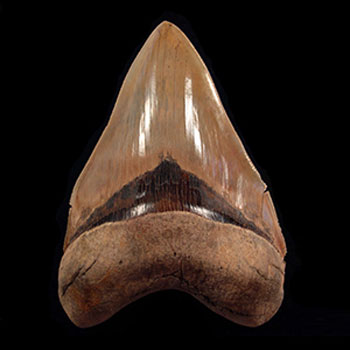
Long before humankind gazed upon the stars or built civilizations, enormous creatures ruled the oceans. Among them was the megalodon—a colossal predator whose bite could crush the bones of whales and whose presence defined marine dominance. Its existence may have faded millions of years ago, but the secrets it left behind are captured in the relics that resurface from ancient sediments. The Aurora Megalodon tooth embodies one of those enduring connections—a fragment of history that bridges us to an untamed past.
These fossils, once part of the jaw of the largest shark to ever live, tell stories beyond mere survival. Each groove, ridge, and shade speaks of shifting seas, vanished ecosystems, and the rhythm of prehistoric life.
From the Depths of Lee Creek to the Surface of Discovery
One of the most remarkable sources of these fossilized treasures is the Lee Creek Mine in North Carolina. Once an active phosphate mine, it now serves as a geological time capsule, preserving remnants of a world that thrived roughly 20 million years ago. Fossil enthusiasts and paleontologists alike consider it one of the richest marine fossil sites in the world.
When unearthed, the teeth gleam with unique hues—from soft grays and oceanic blues to deep browns kissed with minerals. Each tooth carries subtle signs of its journey through time, shaped by water pressure, sediment, and mineral absorption. Holding one feels like having a whisper of an era long gone—an echo that refuses to fade.
A Glimpse into the Gigantic Hunter’s Legacy
The megalodon wasn’t just another shark. Reaching lengths of up to 60 feet, it was the ocean’s unrivaled hunter. Its teeth, often larger than a human hand, could slice through flesh and bone with seamless precision. But what makes these teeth truly fascinating isn’t merely their size—it’s their survival.
While the rest of the megalodon’s body decomposed, its teeth fossilized over millions of years. As the organic material decayed, minerals slowly replaced it, preserving its shape and detail. The result is an artifact that offers a rare, tangible connection to a time when giants ruled the seas.
Each fossilized tooth, whether pristine or weathered, holds immense value—not just as a collector’s item but as an educational relic of Earth’s biological evolution.
The Allure of Natural Beauty
The fascination with these teeth goes beyond science. There’s an undeniable allure to their form—the perfect symmetry, the serrated edges, and the natural artistry of time. Some collectors describe them as pieces of sculpture created by nature itself. Others view them as amulets of strength and endurance, representing the might of creatures that once dominated the planet.
For those drawn to marine fossils, an Aurora Megalodon tooth offers a deeper meaning. It embodies both raw natural beauty and the subtle elegance of prehistoric craftsmanship. Displaying one can instantly transform a space, turning curiosity into conversation and admiration into reflection.
Why Collectors Treasure Authentic Fossils
In a world where replicas abound, authenticity holds immense importance. Genuine megalodon teeth from Lee Creek are prized for their provenance and geological integrity. Their unique enamel preservation and coloration are often unmatched by specimens found elsewhere.
Collectors value the subtle variations in hue and shape—no two teeth are ever identical. Some are broad and triangular, others slender with sharper serrations. Each carries its own fingerprint of nature’s artistry. Whether placed on a shelf, framed as a statement piece, or studied for research, these fossils bring history to life in a way that few other artifacts can.
The Science Behind Their Survival
How did these teeth endure millions of years beneath the sea? The process is nothing short of remarkable. Over eons, mineral-rich waters flowed through sediment layers, gradually replacing the organic material of the tooth with minerals like silica and calcite. This transformation transformed fragile structures into stone-hard relics that could withstand pressure, erosion, and the passage of time.
When found today, their weight and texture are unmistakably ancient—smooth, cool, and dense with geological memory. Scientists study these specimens to understand shifts in ocean chemistry, ancient prey species, and even global temperature patterns from the Miocene and Pliocene eras.
A Connection Between Past and Present
Owning a fossilized shark tooth isn’t simply about possession—it’s about connection. It ties us to a world long vanished and reminds us of Earth’s continuous transformation. Every line etched on its surface tells a silent story of adaptation, survival, and extinction.
Holding such a relic can feel humbling, grounding us in a perspective larger than time itself. For educators, it serves as a teaching tool; for collectors, it is a symbol of respect for natural history; and for enthusiasts, it is a reminder that beauty often hides in the forgotten corners of the past.
How to Identify Authentic Fossils
For those new to fossil collecting, distinguishing between real and imitation fossils is vital. Authentic megalodon teeth will show natural wear, mineral staining, and subtle imperfections. The edges might reveal tiny serrations worn by ancient prey, while the root may carry mineral deposits indicative of long burial.
Synthetic copies often lack depth of color or carry an artificial sheen. Trusted fossil dealers provide detailed provenance and geological information, ensuring the authenticity of each piece. Before purchasing, it’s wise to research sources and learn about regional fossil formations to truly appreciate the value of what you’re holding.
Bringing Ancient Oceans into Modern Spaces
Displaying a megalodon tooth can elevate any environment—from home offices to classrooms and art spaces. Mounted under soft lighting or encased in glass, it evokes a sense of awe and curiosity. For many, it becomes more than decoration; it’s a daily reminder of Earth’s resilience and the mysteries that still lie beneath our feet.
Some collectors create themed displays, pairing teeth with fossilized shells or ammonites to tell a visual story of the prehistoric seas. Others prefer simplicity—letting the tooth alone speak for itself, as if echoing the call of ancient waves.
Preserving the Legacy of the Deep
As mining sites close and access to fossil-rich areas becomes limited, the rarity of authentic specimens grows. Each remaining tooth becomes not only a collectible but also a preserved chapter of Earth’s narrative. Caring for these fossils ensures their story continues—one passed down through generations, connecting the past with the present and the present with eternity.
By displaying and cherishing such artifacts, we help keep alive the fascination with marine history and the lessons it offers about evolution, resilience, and natural beauty.
A Piece of History Waiting for Discovery
There’s a quiet thrill in owning something that has witnessed millions of years of history. The Aurora Megalodon tooth represents that thrill—a moment frozen in time, inviting us to imagine the vast oceans once ruled by giants. Whether for study, admiration, or personal inspiration, this ancient relic continues to inspire awe with every glance.
We invite you to explore this timeless wonder for yourself. Bring a piece of the ocean’s forgotten world into your collection, and let history live on through your hands.
Experience the story beneath the surface—discover your own connection to the ancient sea today.






