Fossil hunting has always been about more than finding ancient bones or buried shells. It’s a way to connect with Earth’s distant past—one that existed long before humans set foot on the planet. For those who find joy in tracing these ancient timelines, few discoveries evoke the same thrill as a fossilized megalodon tooth (Otodus).
Tucked into the dry hillsides near Bakersfield, California, sits a fossil site that has amazed collectors and paleontologists for decades. Revered for the volume and condition of its marine fossils, Otodus megalodon – Sharktooth Hill has earned its place in the fossil world.
This quiet stretch of land holds more than dust and stone—it has stories. Here’s why Sharktooth Hill continues to fascinate fossil lovers across the world and why a megalodon tooth from this site is more than a collectible—it’s a genuine piece of natural history.
A Fossil Bed Frozen in Time
Roughly 15 million years ago, the land now called Sharktooth Hill was underwater, covered by a warm, shallow sea. This prehistoric ocean was teeming with life—from ancient whales and sea turtles to rays and smaller sharks. And swimming above it all was one of Earth’s most significant marine predators.
At an estimated 50 to 60 feet in length, the megalodon was larger than any shark alive today. Fossil remains suggest it had a bite force capable of crushing whale bones. Though only its teeth stay in the fossil record, that’s more than enough to give us a glimpse of its presence in ancient seas.
The fossil layer at Sharktooth Hill preserves this marine ecosystem with remarkable detail. Sediment from that era hardened over time into a fossil-rich bed, capturing a wide variety of aquatic species in exceptional condition.
Why the Hill Still Yields Teeth Today
Sharktooth Hill isn’t a massive, craggy mountain—it’s a modest rise in an otherwise dusty landscape. Yet what lies beneath its surface is extraordinary.
Unlike some fossil sites, where erosion and foot traffic compromise specimen quality, Sharktooth Hill has remained relatively well-preserved. The dry climate, combined with gentle sediment coverage, has helped shield fossils from exposure and decay.
This has created the ideal environment for fossil preservation. The surrounding soil protects the fossilized remains without exerting excessive pressure. That means the teeth found here often have razor-sharp serrations, fully developed root structures, and interesting mineral coloration.
For collectors, an Otodus megalodon tooth from Sharktooth Hill isn’t merely old—it’s often exceptionally well-kept.
The Signature Shape of a Giant
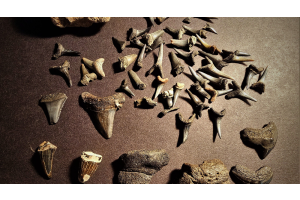
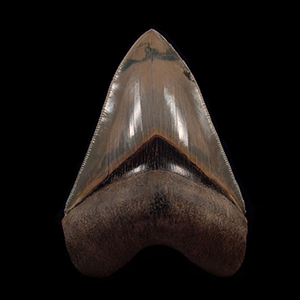
Megalodon teeth are easy to recognize. They’re large and triangular, with thick enamel and often well-defined serrations. Some specimens of Otodus megalodon from Sharktooth Hill reach lengths of over 5 inches, although most range between 2 and 4 inches.
Color adds even more personality. Depending on the surrounding minerals, teeth may take on colors like charcoal gray, tan, pale orange, or soft bluish tones. The variation adds a layer of uniqueness, making each fossil feel personal.
The symmetry and shape of a well-preserved tooth offer valuable information about how the shark may have hunted. These weren’t delicate tools—they were built to slice through flesh, crush bone, and dominate the food chain.
What These Fossils Teach Us
Each tooth tells a story beyond its shape or size. Because shark skeletons are made of cartilage, which decays quickly, teeth are often the only evidence left behind. But those teeth offer a wealth of information.
From the enamel, scientists can gather clues about the ancient ocean’s chemistry. The wear on the tooth’s edge may reveal the kind of prey the shark targeted. Patterns of discovery across locations reveal how megalodon populations might have migrated in response to seasonal changes.
In this way, fossil shark teeth from Sharktooth Hill become valuable pieces of a much larger puzzle. Researchers use them to study ocean temperatures, extinction patterns, and the food webs of long-gone ecosystems.
So while a tooth may look like a curiosity on a shelf, it’s actually a highly specialized artifact filled with scientific insight.
A Collectible With Depth
For many fossil lovers, Sharktooth Hill offers the thrill of discovery in a legal, structured environment. There are areas near the site where you can participate in guided digs, searching through layers of sediment for a glimpse of the prehistoric past.
Even if you’re not digging yourself, owning a fossil from Sharktooth Hill carries a certain appeal. These aren’t mass-produced items—they’re the result of millennia of geological transformation. Every tooth is a one-of-a-kind piece of history.
Fossils from this region are particularly valued for their condition, color, and authenticity. Knowing exactly where a tooth was found adds to its scientific and collectible worth.
If you’re a beginner building your collection or a seasoned enthusiast seeking a new centerpiece, a megalodon tooth from Sharktooth Hill checks every box—authenticity, history, and beauty.
Ethical Sourcing Matters
It’s important to note that not all fossils on the market come from legal or ethical sources. Over-harvesting, black market sales, and careless digging can ruin sites and erase valuable scientific data.
Fossils collected from permitted, regulated areas—like those near Sharktooth Hill—help preserve both the environment and the scientific integrity of the site. Ethical dealers document where and how specimens were found, ensuring that the fossil's story stays intact.
Collectors should always ask about provenance. A legally sourced fossil isn’t just safer to buy—it’s part of preserving Earth’s historical record.
A Bridge Between Science and Storytelling
There’s something special about fossils that goes beyond science. Holding a megalodon tooth in your hand is like having time itself. It invites questions: How big was this shark? What did it eat? Where did it swim?
You don’t have to be a scientist to appreciate those mysteries. Fossils give us a tactile connection to the deep past—no screens, no batteries, no simulation. Just stone, formed over millions of years, whispering truths from an ancient world.
Whether displayed on a shelf or given as a gift, a fossil tooth carries meaning that resonates on both scientific and emotional levels.
Discover a Piece of Prehistoric Majesty
In a world full of digital distractions, it’s easy to overlook the value of holding something real—something ancient. A megalodon tooth from Sharktooth Hill offers more than novelty. It brings with it a story of a world where giants ruled the sea.
It’s history, science, and art rolled into one enduring fossil. Whether you’re buying for curiosity, display, education, or investment, it’s an item that rewards attention and inspires wonder.
Ready to bring home a piece of Earth’s ancient past?
Explore an authentic collection of megalodon teeth and choose the one that speaks to you. Trace your fingers along serrated edges formed millions of years ago—and own a relic of nature’s most iconic predator.