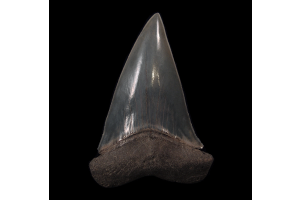
When we talk about fossils, our focus often turns to the fascinating Megalodon teeth that we bring to collectors. These extraordinary fossils allow us to share pieces of prehistoric history, giving people the chance to hold something that has survived for millions of years.
By working with us, collectors are able to access Otodus megalodon from Indonesian fossils that display rare beauty and detail.
From Ancient Seas to West Java Hillsides
Indonesian Megalodon fossils are found in limestone deposits within the Bentang Formation in West Java. The geological environment in which they were buried has helped preserve them with impressive clarity. They date to the Late Miocene and Pliocene epochs, which places them between 4 and 10 million years old, and some can be traced further back to the Middle Miocene, around 10 to 15 million years ago.
These fossils are not only remnants of a prehistoric predator but also pieces of history that reveal what ancient seas were like. The limestone and volcanic activity in the region have both shaped their preservation and created the distinctive appearance that makes them recognizable today.
A Palette Written in Stone
One of the most striking features of Indonesian Megalodon fossils is their wide range of colors. They can display tans, browns, golds, reds, blues, and deep black shades. These hues often blend across the crown of the tooth, creating unique combinations that catch the eye. Some fossils show scattered colors, while others reveal a more consistent pattern known as the Fountain design.
The bourlette, a band at the base of the enamel, adds another layer of character. Often extensive and detailed, the bourlette sometimes displays what collectors describe as a Tiger eye pattern, alternating bands of gold and red that create a visually captivating effect. Each fossil carries its own natural palette, making no two exactly alike.
Fossils That Keep Their Bite
These fossils are admired not only for their color but also for their preservation. The enamel on many of these teeth has remained smooth and glossy, often showing minimal cracking thanks to the protective qualities of the limestone matrix. Serrations, which are among the most delicate features of a Megalodon tooth, are usually retained in Indonesian specimens. It is common to find them intact and sharp, extending all the way to the tip. Some even show serrations continuing onto the root, a feature that makes these fossils distinctive.
Roots, which are often missing or damaged in fossils from other regions, are frequently preserved as well. Although tropical soils can sometimes cause light pitting, a complete root greatly enhances the fossil’s impact. Together, glossy enamel, detailed serrations, and substantial roots make these fossils particularly appealing to collectors.
The Challenge of Unearthing Giants
Uncovering Indonesian Megalodon fossils requires a great deal of effort. Local miners dig them by hand from limestone hillsides, stream beds, and natural cave walls. Extracting teeth intact is not simple, since large amounts of limestone must be removed with care to avoid damage. The tropical environment creates additional challenges.
Acidic soils can erode roots, and excavation tools can sometimes leave marks. For this reason, fossils that emerge with intact enamel, sharp serrations, complete roots, and vivid colors are considered rare finds. Larger specimens add further rarity, with teeth exceeding 5 inches in length standing out as awe-inspiring examples.
Why Collectors Keep Coming Back
The value of Indonesian Megalodon fossils lies in qualities that make them desirable for both private collections and museum displays. Their visual impact is undeniable, with colors and patterns that shift under light and highlight their natural beauty. Their authenticity is another strength, as many specimens reach collectors without any restoration or repair. Fossils that display completeness, with enamel, serrations, bourlettes, and roots all intact, are considered particularly valuable.
Their provenance also contributes to their significance, since these fossils are explicitly sourced from the Bentang Formation in West Java. Finally, their scientific importance cannot be overlooked. Dating back millions of years, they serve as evidence of the ecosystems in which Otodus megalodon from Indonesia once thrived and offer insight into one of the ocean’s greatest predators.
What Collectors Watch For
Those who study or collect Indonesian Megalodon fossils often pay close attention to certain features. Fossils that exhibit bold and vivid colors, such as reds and golds or dramatic blends of several hues, are particularly admired. The bourlette can serve as a defining feature, with larger, detailed examples displaying Tiger eye patterns that draw strong interest. Serrations that remain sharp and extend to the tip are signs of a specimen that has survived in remarkable condition.
Roots that are intact and full add weight and dimension, while glossy enamel surfaces with minimal cracks enhance both appearance and durability. These qualities combine to distinguish the most collectible fossils from those that are more common.
Filling the Gap Left by Other Sites
In the past, fossil sites in regions such as Chile, Peru, Lee Creek, and Bone Valley provided a steady supply of Megalodon teeth. However, production from those areas has slowed over time. Indonesian fossils have stepped into this space, offering collectors a new opportunity to acquire specimens that are rich in both color and preservation. West Java has become a significant source of material that blends scientific relevance with natural artistry, giving collectors reasons to seek out these fossils above others.
A Fossil Treasure Worth Displaying
Indonesian Megalodon fossils combine striking beauty with excellent preservation. Their bold colors, from deep reds and golds to browns and blues, create a visual presence that makes them remarkable display pieces. Features such as sharp serrations, glossy enamel, detailed bourlettes, and substantial roots add depth to their appeal. The excavation process is demanding, and the tropical environment increases the difficulty of finding intact fossils, which makes well-preserved examples even more special. Large specimens that surpass 5 inches and retain these features are particularly prized.
These fossils link the modern world with the prehistoric seas of West Java. They carry both scientific importance and aesthetic beauty, serving as treasures that capture the power and history of the Megalodon. For collectors and admirers alike, Otodus megalodon from Indonesia remains one of the most colorful and collectible fossil discoveries available today.