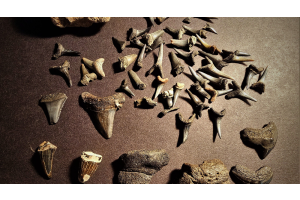
Beneath the quiet blue of the ocean lies a world of forgotten stories—some whispered in coral canyons, others frozen in stone. Among the most awe-inspiring remnants of the prehistoric sea are the fossilized teeth of an ancient predator whose name still sends ripples through the scientific community: Otodus megalodon.
This creature may be long gone, but its shadow continues to loom large over marine history. These fossilized fragments don’t speak, yet they reveal volumes about one of the most dominant species ever to swim Earth’s oceans.
Let’s explore how these teeth help us piece together the life of a vanished giant.
A Predator Measured in Feet, Not Inches
Millions of years ago, a different ruler commanded the seas. With a body stretching up to 60 feet or more, this shark was larger than a school bus and had a bite that could crush a whale’s spine. While its skeleton—made of cartilage—left few traces, its teeth remain as nature’s evidence.
Unlike most shark species today, which boast thin, serrated teeth designed for slicing, Otodus megalodon had thick, broad teeth built to bite through bone. These teeth measure up to 7 inches in length and often weigh over a pound. Holding one is like having the imprint of an oceanic legend.
The Allure of a Tooth Frozen in Time
Tooth fossils are unique. Each one tells a slightly different story depending on the mineral content of the soil in which it fossilized and the environmental pressures it endured. Some come in deep blues, others in earthy tones—each with a subtle charm all its own.
Collectors and fossil lovers often speak of an almost spiritual connection when they first hold one of these ancient artifacts. It's not simply about rarity—it’s about tangible history. These teeth weren’t polished in a lab. Their edges were shaped by time, tide, and terrain.
Global Hunt for a Giant's Remains
Fossilized megalodon teeth have been discovered across various regions: the Atlantic coasts of North and South America, the deserts of Morocco, and parts of Europe and Australia. This wide distribution is no accident. These areas were once covered by warm, shallow seas—the preferred hunting ground for this prehistoric giant.
In the southeastern United States, particularly in Florida, South Carolina, and North Carolina, fossil divers and beachcombers still find these ancient teeth today. Riverbeds and phosphate pits often yield specimens with exceptional sharpness and preservation, thanks to being shielded from erosion for thousands of years.
Not Just Teeth—Scientific Treasures
To the untrained eye, a tooth might seem like a cool keepsake, but to paleontologists, it’s a biological blueprint. From the enamel’s condition to the wear along the edge, these details offer insights into feeding behavior, habitat range, and even lifespan.
Some teeth exhibit tiny serration patterns, which suggest their effectiveness in tearing into large prey. Others are worn smooth, suggesting long-term use or older age. Through studying these fossils, researchers have learned that Otodus megalodon may have had a global migratory pattern, chasing prey across ancient oceans.
Tips for Collecting with Intention
Not all fossilized teeth are created equal. Suppose you’re beginning your journey as a fossil collector or considering acquiring a piece of marine history. In that case, several factors should be considered. Size is certainly an eye-catcher, but it’s far from the only thing that matters.
Look for strong enamel coverage, minimal cracks, and good root preservation. Serrations—those tiny ridges along the edge—can indicate the tooth’s original sharpness and whether it was from the upper or lower jaw. Some collectors also value symmetry or unique coloration patterns, which make a fossil more visually compelling.
From Sediment to Shelf: Handling and Care
Despite surviving millions of years underground or underwater, fossil teeth still need proper care once unearthed. Displaying them in direct sunlight can lead to discoloration, especially in specimens with delicate mineral compositions. Humidity fluctuations can also cause subtle cracking over time.
Use soft materials, such as velvet-lined cases or cushioned stands, for displays. If your specimen needs cleaning, skip chemical treatments—warm water and a soft brush are usually enough. Treat each piece like a museum artifact, because, in truth, that’s what it is.
Misconceptions and Mystery
The term "megalodon" often conjures images of an aggressive, movie-monster shark. But science tells a more nuanced story. Yes, it was large, and yes, it likely topped the food chain, but it was part of a complex ecosystem. Its prey included whales, large fish, and other marine mammals.
Despite its fame, there's still debate about its exact extinction timeline. Most researchers agree that it vanished about 3.6 million years ago, likely due to changes in ocean temperatures and declining food sources. These mysteries keep interest alive, both academically and culturally.
The Middle of the Story Still Unfolds
While the fossil record can never be complete, each new discovery helps refine our understanding of the Otodus megalodon. Museums and universities worldwide continue to study, analyze, and compare teeth samples to build timelines, test theories, and map prehistoric oceans.
It’s the kind of scientific pursuit that’s both methodical and filled with wonder—proof that even something as small as a tooth can rewrite chapters of Earth's story.
More Than a Hobby, a Connection to Deep Time
Collecting these fossils isn’t only for scientists or historians. Every day, people are increasingly drawn to these relics, finding joy in learning about a world they previously knew nothing about. Whether displayed on a shelf or passed down through generations, each fossil represents more than an object—it means survival, change, and ancient wonder.
By owning a genuine megalodon tooth, you aren’t just acquiring a fossil. You’re stepping into a timeline that began long before us and will continue to evolve long after.
Why It Still Captivates Us
Something is humbling about gazing at the tooth of Otodus megalodon. It doesn’t roar or flash across a screen. It’s silent. Still. Ancient. But in that quiet presence, it speaks to our endless curiosity—to know more, to reach back, to understand.
In an age where so much of our world feels fast and fleeting, a fossilized tooth reminds us of the depth and patience of time. It invites us to look deeper—at the world and at ourselves.
Ready to Own a Piece of Prehistoric History?
Whether you’re an avid fossil enthusiast or simply drawn to the mysteries of the deep, acquiring a megalodon tooth is more than a purchase—it’s an experience. Let these remnants of the past enrich your present, spark new interests, and add a timeless edge to your collection.