

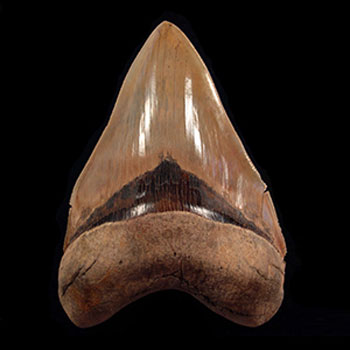
At the heart of our fossil collection, we offer more than awe-inspiring prehistoric relics. We provide access to rare insights into ancient marine giants through the authentic specimens we make available. One of the most fascinating chapters in this story involves juvenile sharks.
While the massive, serrated teeth of the megalodon (Otodus or Carcharocles megalodon) capture the imagination, it's often the smaller ones that reveal the most about the creature’s earliest years. A small megalodon tooth, though less dramatic in size, can help us understand nursery behavior and growth stages that shaped one of Earth’s most powerful predators.
The Truth in Tiny Teeth
Although large megalodon teeth are the most prized by collectors, a surprising number of much smaller ones can be found. These teeth likely came from sharks that were far from full size, possibly measuring only a few meters in length. Scientists have come to believe that these tiny teeth offer vital evidence of a specific life stage. They suggest that megalodon juveniles may have occupied shallow, protected environments much like some modern shark species do today. This behavior, if accurate, shows a survival-focused approach that may have increased the young sharks’ odds in a challenging prehistoric ocean.
These findings are not based on speculation alone. Researchers have continued to study the relationships between tooth size, jaw placement, and developmental stage to confirm that small teeth did not originate from adults but from growing individuals. It adds an essential layer to understanding the complex life history of this extinct predator.
The Gatun Formation: A Miocene Nursery
The Gatun Formation in Panama has become a key site for understanding early megalodon life. Between 2007 and 2009, nearly 400 shark teeth were uncovered, 28 of which belonged to megalodon. Most of these were small, and their sizes could not be explained by jaw placement or evolutionary changes. Instead, they most likely came from juvenile sharks.
This formation is believed to have represented a shallow marine environment. The combination of fossil size and the geological context has led researchers to conclude that this location may have served as a nursery area. Scientists estimated the juveniles ranged from 2 to 10.5 meters long. These estimates reflect a growth stage that required safety, likely provided by such coastal zones.
Additionally, the lack of larger prey fossils in this region supports the idea that adult megalodons did not frequent these waters for hunting. This creates a picture of separation in habitat usage between juveniles and adults—each occupying different spaces for specific biological needs.
Why a Nursery Area Makes Sense
Nursery areas play a crucial role in early shark development. They tend to be shallow, rich in food, and safer from significant marine threats. In these settings, young megalodons could feed and grow without facing direct competition or predation from larger adults. The Gatun Formation contains very few whale fossils, which are often found where adult megalodons are fed. This absence supports the view that it wasn't a feeding ground for large predators.
When a small megalodon tooth is found in such a setting, it can strongly suggest that young individuals used the area to develop. These fossil clues help researchers reconstruct ancient marine behaviors and identify key survival strategies.
These conclusions also align with what is observed in modern-day shark species. Juveniles are often found in mangrove-rich or coastal areas where food is abundant and threats are minimized. If megalodon adopted a similar strategy, it reflects a long-standing evolutionary approach used by many shark lineages.
Implications for the Megalodon Lifecycle
The Gatun site offers the first clearly documented evidence of a nursery area used by megalodon. This discovery adds to the understanding of how these massive sharks structured their lives. While adults were dominant hunters in deeper waters, juveniles likely stayed closer to shore, where they could grow and mature with lower risk.
Even juvenile sharks, which might have already measured several meters in length, were still vulnerable. Other predators—including adult megalodons—could have posed a danger. Nursery environments likely helped these young sharks avoid harm during the most fragile part of their development.
Because shark skeletons are made mostly of cartilage, they usually do not fossilize. Their teeth, however, are far more durable. That is why a single fossilized tooth can offer a wealth of information, from estimating size and age to identifying behavior patterns and habitat use.
Fossil Teeth as Clues to Prehistoric Behavior
Each megalodon tooth discovered is more than a collectible. It can offer details about feeding habits, growth stages, and environmental preferences. Smaller teeth, when found in formations like the Gatun, help scientists trace how young sharks survived in ancient waters.
Collectors may value large, well-preserved specimens the most, but even worn or incomplete examples have scientific importance. These fossils contribute to a broader understanding of the ecosystem and the roles different shark age groups played in it.
When a small megalodon tooth is studied closely, it may show distinct differences in shape, serration, and wear compared to an adult tooth. These variations allow scientists to determine whether the tooth came from a juvenile, helping to map out different phases of development and behavior over time.
A Broader View of Developmental Behavior
● Juvenile Indicators: The small size and specific characteristics of certain teeth reveal they came from megalodon individuals in the early stages of growth.
● Habitat Evidence: Sites like the Gatun Formation indicate behavior tied to development. Juveniles likely spent early years in protected marine settings.
● Growth Strategy: Separation from adult shark environments likely reduced predation and competition, improving survival rates.
● Collector and Scientific Value: While collectors seek pristine specimens, even the smallest fossils play a role in building knowledge about extinct marine life.
Conclusion
Massive teeth from fully grown megalodons may attract the most attention, but smaller specimens often tell a richer story. A small megalodon tooth can offer clues to growth patterns, safe zones for young sharks, and the behavioral adaptations that helped the species thrive for millions of years.
Mainly when found in places like the Gatun Formation, these tiny remnants serve as vital records of prehistoric life stages. Through their study, researchers continue to gain new insight into how one of history’s most iconic predators developed from vulnerable young sharks into the rulers of ancient seas.






