

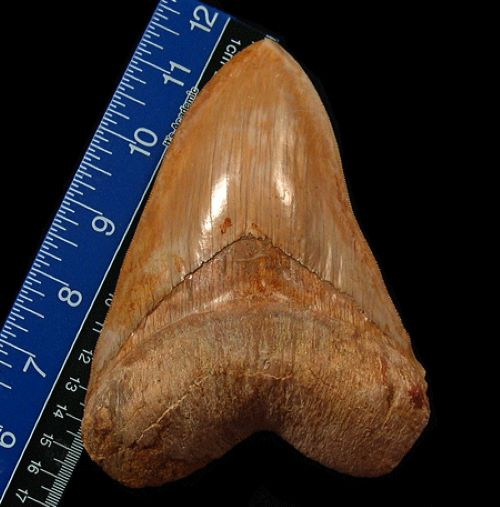
There’s something awe-inspiring about holding a fossil that once belonged to the ocean’s most formidable predator. These remnants of the megalodon tooth size range give us a direct connection to one of Earth’s most powerful marine creatures. At Buried Treasure Fossils, we’re fascinated by how science helps decode these ancient wonders, revealing not only their measurements but also insights into the biology, behavior, and life stages of the mighty Megalodon. Each tooth—whether two inches or seven—offers clues to this shark’s size, hunting style, and evolutionary story. When studying megalodon tooth size, accuracy matters, and that’s where scientific measurement methods play an essential role.
Understanding the Megalodon’s Magnitude
The Megalodon (Otodus megalodon) was no ordinary shark. Estimated to have grown up to 60 feet in length, it was the apex predator of its time. Paleontologists have long relied on fossilized teeth as the primary means of studying the species, since cartilage—what makes up a shark’s skeleton—rarely fossilizes. These teeth are not only breathtaking in size and condition but also serve as crucial data points in reconstructing the Megalodon’s anatomy and growth.
Each tooth in the megalodon tooth size range tells a story. Teeth from the front of the jaw tend to be larger and broader, ideal for gripping and slicing prey. Smaller teeth, typically found near the back of the jaw or from juvenile specimens, represent different growth stages and feeding adaptations. By comparing these sizes and shapes, scientists can determine not only how large a Megalodon may have grown but also how it developed from youth to adulthood.
Measuring Megalodon Tooth Size: The Basics
When it comes to megalodon tooth size, paleontologists follow standardized measurement techniques to ensure accuracy and consistency. Tooth size is generally measured in three dimensions: height, width, and thickness. Of these, height is the most commonly referenced metric, measured from the tip of the tooth’s crown to the base of the root.
Researchers use calipers or digital measuring tools for precision. Even a small deviation of millimeters can significantly affect estimations of the shark’s total body length. That’s why professional fossil appraisers and academic researchers rely on consistent reference points—such as the enamel edge and root line—to produce reliable size data. Collectors who purchase fossils from trusted sources like us can rest assured that our specimens are measured and described according to these scientific standards.
Correlating Tooth Size with Body Length
One of the most fascinating aspects of the megalodon tooth size range is its correlation with the shark’s total body length. Scientists have developed several mathematical models based on comparisons between Megalodon teeth and modern great white shark teeth. One widely accepted formula suggests that for every inch of tooth height, a Megalodon measured roughly 10 feet in body length. Thus, a 6-inch tooth would correspond to a 60-foot shark—a size that commands both respect and imagination.
However, while these estimations are valuable, they are approximations. The Megalodon’s proportions were not identical to modern sharks, so researchers continue to refine these equations with fossil evidence. Ongoing studies involving 3D modeling and CT scanning have allowed scientists to visualize how jaw curvature and tooth spacing influenced bite structure and overall size accuracy.
Why Tooth Size Varies So Widely
The megalodon tooth size range typically spans from about 2 inches for smaller or juvenile teeth to over 7 inches for exceptionally large specimens. But what causes such variation? Several biological and environmental factors come into play:
● Growth Stages: Like all sharks, Megalodons continuously replaced their teeth throughout their lives. Younger individuals had smaller teeth, while adults developed significantly larger ones.
● Jaw Position: Teeth located near the front of the mouth tend to be larger and more triangular, whereas those toward the back are smaller and narrower, designed for slicing rather than gripping.
● Sexual Dimorphism: Some scientists hypothesize that males and females exhibited slight differences in tooth size and shape due to feeding and reproductive roles.
● Environmental Influence: Differences in prey availability, habitat, and geological conditions where the fossils formed may also affect the preservation and apparent size of teeth.
Each tooth, therefore, reflects a combination of anatomy, behavior, and environment—factors that collectively shaped this apex predator’s evolutionary success.
Ensuring Measurement Accuracy
Accuracy in documenting megalodon tooth size is critical for both scientific research and fossil appraisal. At Buried Treasure Fossils, we recognize that collectors depend on precise measurements when evaluating authenticity and value. To achieve this accuracy, several methods are used in the field and laboratory:
1. Digital Calipers and Photogrammetry: High-precision calipers help record exact dimensions, while photogrammetry—capturing multiple photographs from different angles—creates accurate 3D models of each specimen.
2. CT Scanning: For rare or delicate teeth, CT scans provide non-invasive imaging, allowing researchers to measure internal structures without damaging the fossil.
3. Comparative Reference Systems: Scientists compare Megalodon teeth with those of related extinct species (like Otodus chubutensis) and modern sharks to calibrate size estimates.
4. Replicas and Casting: In cases where original fossils are too fragile or incomplete, detailed casts allow researchers to test measurements and maintain consistency across studies.
By applying these methods, the scientific community continues to refine its understanding of the Megalodon’s true scale while ensuring that measurements remain trustworthy.
Interpreting Biological Insights from Tooth Size
Beyond the thrill of collecting, studying megalodon tooth size range helps paleontologists uncover remarkable biological insights. For instance, smaller teeth often indicate juvenile specimens that lived in shallow coastal “nurseries,” while larger teeth suggest adults that roamed open oceans in search of massive prey. The distribution of tooth sizes across fossil sites gives scientists a glimpse into the species’ life cycle, migration patterns, and predatory hierarchy.
Even the serrations on these teeth reveal behavioral clues. Fine serrations on medium-sized teeth suggest adaptations for slicing through flesh, while thicker, coarser edges on larger teeth point to bone-crushing capabilities. These variations reflect a highly evolved predator that adapted its feeding techniques as it grew—a marvel of evolutionary engineering.
The Role of Collectors and Appraisers
For fossil appraisers, researchers, and advanced collectors, accurately identifying and measuring teeth within the megalodon tooth size range is essential. Condition, symmetry, and completeness all influence a specimen’s value. A 6-inch tooth with minimal restoration, intact enamel, and sharp serrations can be worth thousands of dollars—especially if it retains its natural luster and root structure.
At Buried Treasure Fossils, we take pride in providing fossils that meet professional and academic standards. Each Megalodon tooth in our collection is carefully measured, photographed, and described with detailed notes on its provenance and geological context. Whether you’re an academic researcher analyzing size variation or a collector searching for a museum-grade piece, our catalog ensures confidence in every purchase.
The Challenges of Measuring Fragmentary Teeth
Not all Megalodon teeth are complete. Some fossils are found broken or eroded by time and sediment. For these specimens, researchers use reconstruction techniques to estimate their original dimensions. By comparing incomplete teeth with complete examples of similar shape and proportion, scientists can approximate their full size. This process involves mathematical modeling, geometric scaling, and sometimes even machine learning algorithms that “predict” missing portions based on known data patterns.
While these reconstructed measurements are less definitive, they still contribute valuable information to understanding the megalodon tooth size range. Each fossil—complete or partial—adds a new piece to the puzzle of this prehistoric predator’s existence.
Conclusion
From meticulous measurements to advanced imaging techniques, the science behind studying the megalodon tooth size range reveals far more than just numbers. It opens a window into the growth, behavior, and ecological dominance of one of Earth’s most extraordinary creatures. Every tooth—whether two inches or seven—marks a chapter in an evolutionary story written across the ocean floor millions of years ago.
At Buried Treasure Fossils, we share that same passion for discovery. We believe that every collector, researcher, or appraiser deserves access to authentic, accurately measured fossils that spark curiosity and inspire learning. Our catalog of megalodon tooth size variations showcases nature’s incredible diversity and the precision of modern science working hand in hand.
If you’re ready to deepen your appreciation for these magnificent relics, explore our collection today and experience the excitement of owning a genuine piece of prehistory. Each fossil we offer connects you not just to a specimen—but to a story millions of years in the making.






