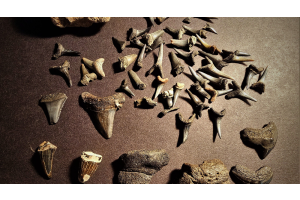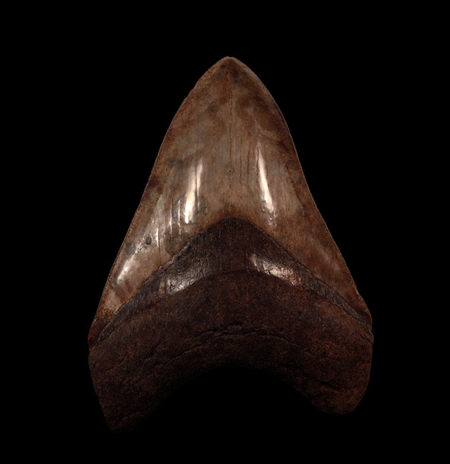
At our fossil service, we provide collectors, paleontologists, and enthusiasts with authentic specimens, and we understand how thrilling it can be to hold a Megalodon tooth. These massive relics allow us to connect with ancient seas and creatures that once dominated the oceans. Yet as demand has grown, so has the risk of fakes and replicas. Distinguishing a real Megalodon tooth from a counterfeit is a nuanced task that relies on careful observation, geological knowledge, and expert consultation.
Specialists continue to debate authenticity because features can overlap, and forgeries are becoming more sophisticated. The debate about whether megalodon teeth are fake or real remains central for anyone interested in these fossils.
Surface Texture: Nature vs. Artifice
One of the first aspects that experts examine is surface texture. Genuine Megalodon teeth typically show a weathered appearance that develops over millions of years. They display subtle imperfections, such as pits, scratches, and irregularities, that reflect exposure to pressure, mineralization, and geological changes. The texture is rarely smooth, with natural ruggedness and fine cracks forming part of the fossil’s story.
By contrast, forgeries are often polished or artificially aged to appear convincing. These replicas may lack nuanced texture, instead looking overly smooth, uniform, or shiny in places where authentic teeth would usually show wear or mineral deposits. Although this distinction sounds clear, debates persist because some genuine fossils have been cleaned or treated, which reduces the very features used for identification.
Weight and Density: What Lies Beneath
Weight is another critical factor. Real Megalodon teeth have undergone mineralization that replaces organic material and increases density. As a result, authentic teeth tend to feel heavier than expected for their size, with a solid and dense structure.
Fake teeth, however, are often crafted from resin, plaster, or other lightweight materials. They may appear convincing in size but feel unusually light when handled. Problems arise because some genuine fossils have lost minerals, developed internal voids, or fractured, which makes them lighter than usual. On the other hand, counterfeiters sometimes add artificial weight to mimic density. These complications highlight why no single criterion is enough for a conclusive judgment.
Root and Blade: The Biological Signature
Examining the root and blade provides another layer of evidence. Real Megalodon teeth usually feature distinct root structures, including nutrient foramina and root lobes, which are part of their anatomy. The blade, or cutting edge, often carries fine serrations, even if they are partially worn away by time.
Forgeries often fall short in this area. Serrations may look uneven or smoothed out, and roots frequently appear too uniform or overly clean, lacking the small but important details that reveal authenticity. Still, this marker is not absolute. Genuine fossils may lose serrations due to erosion or damage, while some replicas are sophisticated enough to mimic anatomical shapes. Composite fossils, which combine authentic parts with artificial additions, further complicate identification.
Signs of Fossilization
Fossilization itself can provide vital clues. Genuine teeth often display mineral deposits such as calcite, which appear as white or colored patches. Sedimentary residue or matrix remnants may be found at the base, linking the specimen to its geological origin. Natural mineral replacement also creates irregular coloration, with streaks, patches, and discolorations that vary from one tooth to another.
Forgeries attempt to replicate these traits using stains, dyes, or painted effects. Artificial sediment or plaster may also be applied to the base. While these techniques can appear convincing, close inspection often reveals inconsistencies. Still, authenticity is not always apparent. Genuine fossils that have been polished may appear too uniform, while replicas can successfully imitate natural mineralization. This is why the megalodon tooth fake vs real comparison remains such an essential tool for collectors and experts.
Expert Consultation: A Necessary Step
Because identifying authenticity can be complex, consultation is often essential. Fossil specialists and experienced dealers bring years of knowledge and have studied numerous specimens, which helps them recognize subtle markers of authenticity.
They may also provide provenance or supporting documentation that adds credibility to a fossil’s history. This combination of expertise and records often becomes the deciding factor when visible features alone are not enough.
Why Debate Continues
Despite these guidelines, debate continues around Megalodon teeth because of the wide variability in fossilization. Different environmental conditions create distinct appearances, meaning no two fossils are precisely alike. Authentic teeth may also degrade, crack, or be restored, further altering their natural traits.
Meanwhile, counterfeiters are improving their methods, producing replicas that capture details once thought too difficult to imitate. Lack of provenance compounds the problem, as fossils without a clear discovery context are much harder to verify. Even scientific tools such as advanced imaging can leave room for interpretation, and disagreements among specialists show that certainty is often elusive.
Practical Tips for Collectors
For those interested in acquiring Megalodon teeth, a careful and balanced approach is best. It is essential to consider multiple factors rather than relying on a single marker of authenticity. Evaluating surface texture, weight, anatomical details, and signs of fossilization together provides more substantial evidence.
Handling specimens when possible can also reveal much about their authenticity. Asking about provenance and comparing specimens with verified examples adds further reassurance. Most importantly, purchasing from trusted sources with transparent practices offers the best safeguard against disappointment.
Conclusion
The fine line between fake and real Megalodon teeth has always been subject to debate. Fossils vary widely, counterfeiters continue to refine their methods, and restoration often complicates matters further. Authenticity is usually determined by combining several indicators, including surface texture, weight, root and blade anatomy, fossilization signs, and provenance.
For those who value these extraordinary relics, the goal is not only to display a striking object but also to preserve a genuine fragment of prehistory. With patience, careful observation, and dependable knowledge, authentic Megalodon teeth can be identified and appreciated as treasures of natural history. That is why megalodon tooth fake vs real remains one of the most discussed and essential topics in fossil collecting today.