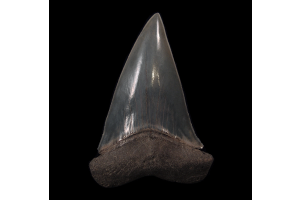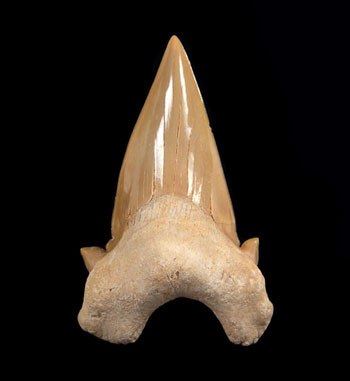
For advanced shark tooth collectors and fossil traders, the thrill of the hunt often lies in the details. Size and condition are essential, of course—but those in the know understand that truly exceptional finds are distinguished by something rarer still: intact side cusps. Our carefully curated Otodus teeth for sale are hand-selected with this critical feature in mind, offering not just prehistoric beauty, but scientifically and historically significant specimens that elevate any collection.
A Glimpse into the Eocene Seas
Over 50 million years ago, during the warm and dynamic early Eocene epoch, a formidable predator ruled the ancient seas—the mighty Otodus obliquus. This colossal shark was among the earliest and most fearsome members of the mackerel shark family. It holds special importance in paleontology not only because of its size and power but also as a direct evolutionary precursor to the legendary Megalodon. As one of the ocean's top predators, Otodus was equipped with a remarkably specialized set of teeth that made it a master of aquatic hunting.
Its teeth featured a broad, sharply pointed triangular crown flanked by distinct, finely crafted lateral cusplets—usually two smaller cusps on either side of the main tooth. This unique structure wasn’t just for show; it allowed Otodus to grip slippery prey firmly and slice through flesh with terrifying precision. While collectors and enthusiasts often admire the central crown for its size and aesthetic appeal, it’s the more fragile side cusps that offer deeper insights into the health, development, and rarity of the fossil. Their preservation can significantly influence the scientific and commercial value of each tooth, making them a key focus for serious fossil hunters.
Otodus obliquus thrived in shallow marine environments that once stretched across what are now parts of northern Africa and southern Europe. Vast stretches of these regions—especially present-day Morocco and Egypt—were once teeming with life and served as prime hunting grounds for these apex predators. The remains of these sharks, particularly their robust and numerous teeth, have been discovered in large quantities, offering glimpses into the prehistoric ecosystems they once dominated. Today, the phosphate mines near Khouribga in Morocco are world-renowned among paleontologists and collectors as some of the richest and most productive fossil beds for Otodus teeth.
However, the process of unearthing these ancient relics is far from delicate. The mining operations are often industrial and rushed, aimed more at phosphate extraction than careful fossil recovery. As a result, the more delicate structures—especially the precious side cusps—are frequently damaged or lost during excavation. This makes finding a complete and well-preserved Otodus tooth, with its side cusps intact, a rare and highly coveted discovery in the world of fossil collecting.
Why Side Cusps Matter
To the untrained eye, the absence of side cusps on a fossilized shark tooth might appear to be a small, insignificant defect. However, for seasoned fossil enthusiasts and paleontologists, it’s far more than a superficial issue. Side cusps on an Otodus tooth were never merely ornamental—they played a crucial role in both the shark’s survival and our understanding of its biology. These sharp projections, located on either side of the central cusp, were not evolutionary accidents. They were finely tuned tools, developed over millions of years, to enhance the shark’s ability to grasp and immobilize slippery prey such as fish and smaller marine reptiles.
When these side cusps are preserved in a fossil specimen, they provide invaluable insight. Their shape, sharpness, and wear patterns allow experts to reconstruct feeding strategies and ecological roles of these ancient predators. Moreover, intact side cusps help determine how complete and authentic a fossil is, aiding in the verification of its age and origin. They offer clues about the environmental conditions under which the tooth was fossilized and can even help distinguish between different species or evolutionary stages of Otodus. In this way, something as seemingly minor as a pair of small flanking projections becomes a window into prehistoric life and evolutionary innovation.
Intact side cusps add considerable value—both monetary and historical. A tooth with its side cusps preserved is far rarer and more prized than a similarly sized specimen missing them. At Buried Treasure Fossils, we make it our mission to locate and offer only those Otodus teeth that are in extraordinary condition, many with side cusps fully preserved or with professionally undetectable repairs.
The Challenge of Preservation
Many Otodus teeth available in the fossil market are often incomplete due to rough extraction methods that can cause chips or damage to the cusps and root ends. While some sellers may attempt to reattach these fragments, our approach prioritizes authenticity and quality assurance. We meticulously sort through thousands of specimens to ensure we offer only those with minimal or no damage, or those that have been restored so seamlessly that the repairs are nearly undetectable.
Extra-large Otodus obliquus teeth, measuring over 3 inches, are particularly rare, and finding one in near-perfect condition with intact side cusps is exceptional. These details are significant for fossil grading, collector value, and overall display appeal. Furthermore, these specimens serve as excellent educational resources for teaching concepts related to paleontological anatomy and evolutionary biology.
A Must-Have for Serious Collectors
For collectors aiming to elevate their shark tooth collections, Otodus should never be overlooked. These remarkable fossils are far more than typical shark teeth; they mark a pivotal chapter in shark evolution, bridging the ancient mackerel sharks and their impressive descendants.
While Otodus teeth may be found in certain areas, specimens that retain all anatomical features are truly rare. This is why discerning collectors turn to us. We offer not just large and visually striking teeth but also specimens of exceptional integrity. We distinguish between display-grade fossils and true collector-grade treasures, ensuring our inventory reflects the highest standards for serious enthusiasts.
What Sets Our Catalog Apart
We go beyond just offering otodus teeth for sale. Our process is meticulous: every fossil is evaluated for authenticity, symmetry, color, preservation, and completeness. Teeth with vibrant tan crowns and contrasting white roots are especially striking—and when side cusps are intact, the fossil becomes exponentially more valuable.
Our team invests countless hours curating and preparing these pieces so that collectors can purchase with confidence. Whether you're seeking a centerpiece for your private collection or an educational specimen to illustrate prehistoric shark evolution, you'll find that our offerings combine visual impact with paleontological integrity.
The Rare Beauty of Intact Evolution
In conclusion, intact side cusps transform a good fossil into a great one. They not only complete the anatomy of a tooth but also offer rare glimpses into the evolutionary path of some of Earth’s greatest predators. With otodus teeth for sale that feature fully preserved features and superior quality, we proudly serve advanced collectors looking for authenticity, rarity, and aesthetic brilliance in every purchase.
If you're ready to deepen your collection with specimens that tell the full story of ancient shark evolution, explore our carefully curated selection. The right fossil isn't just a relic—it's a legacy, waiting to be held in your hands.