

Souvenirs are funny things. Most people bring back seashells from the beach—delicate, pretty, and easy to stuff into a bag. They rattle around on the ride home, maybe get turned into a necklace or sit in a glass jar, and then fade into the background of your living room.
But there’s another kind of keepsake from the Carolina coast that doesn’t sit quietly. A North Carolina Megalodon tooth doesn’t just remind you of the ocean—it reminds you that the ocean was once home to the largest predator ever to swim our planet. That difference alone is why seashells are cute, but Megalodon teeth? They’re legendary.
Seashells Are Fleeting, Fossils Last Forever
Seashells have their charm. Kids scoop them up by the bucketful, vacationers make jewelry, and they’re nice for crafts. But they don’t last. They crack, fade, and collect dust.
A fossilized shark tooth, though, is different. It’s heavy in your hand, dense with mineralization, and it carries millions of years of history. One glance and you know it’s not just another trinket—it’s a piece of prehistory. When you compare the two, seashells are souvenirs; fossils are artifacts.
That’s what makes the Megalodon so captivating. You’re not just buying something pretty, you’re buying something that connects you directly to a time when sharks the size of buses cruised the Atlantic.
The Megalodon: Shark of Sharks
Let’s pause for a moment and appreciate the Megalodon itself. Picture a shark that could grow longer than a school bus, with teeth as big as your hand and serrated edges sharper than steak knives. Scientists estimate its bite was strong enough to crush whale bones. Even the apex predators we know today—the great whites—would look small next to it.
When you hold one of its teeth, you’re holding proof of that monster. Unlike seashells that feel delicate and fragile, a Megalodon tooth feels indestructible. It’s almost like holding a weapon forged by nature itself.
And this isn’t just a legend. Fossilized Megalodon teeth have been studied by paleontologists for decades, helping us understand the shark’s diet, growth, and eventual extinction. Every tooth is a chapter in the story of Earth’s oceans.
Why North Carolina Is Fossil Heaven
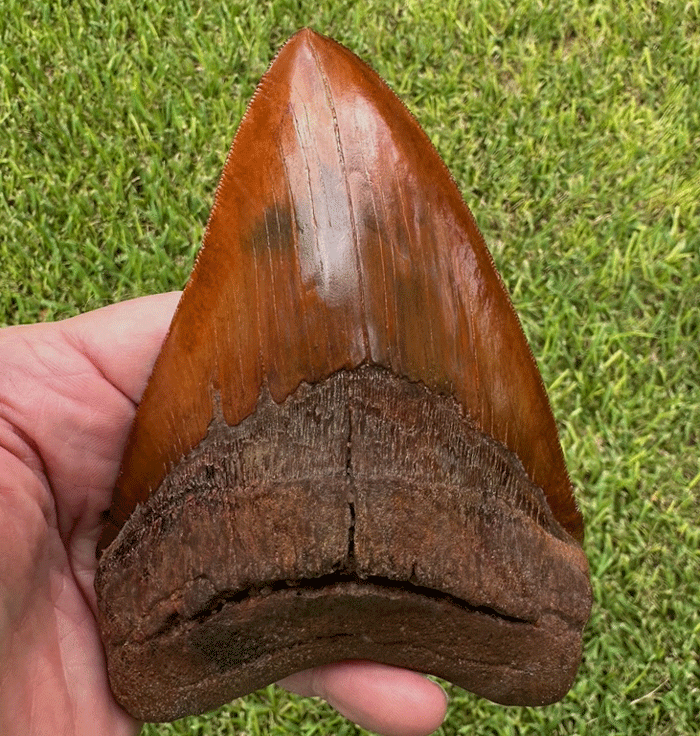
You can find Megalodon teeth in different parts of the world, but North Carolina has a reputation for something special: copper-red teeth.
Rivers like the Meherrin and formations such as Castle Hayne, Pungo River, and Yorktown are famous for producing teeth with brilliant coloration—rich reds, deep browns, and hues you simply don’t find elsewhere. These colors come from minerals in the sediments, and collectors know immediately when they’re looking at a true Carolina specimen.
But here’s the catch: they’re rare. The rivers don’t give them up easily. Divers can spend hours searching and come home with nothing. That scarcity makes every recovered tooth even more valuable. When you find or buy one, you’re holding something that’s not only beautiful but scarce—far rarer than the seashells anyone can scoop up by the handful.
The Hunt Adds Thrill to the Story
One of the things that makes fossils exciting is the chase. Collectors dive into murky waters, sift through silt, and sometimes spend entire days without luck. When they finally spot that telltale triangular shape, it’s like striking gold.
That effort is part of the allure. No one brags about finding a seashell. But tell someone you’ve got a copper-red North Carolina Megalodon tooth, and you’ll see their eyebrows shoot up. It’s a badge of honor, proof that you either hunted for it or knew where to buy one from experts who did.
Why Megalodon Teeth Hold Value
Souvenirs usually lose their sparkle—and their value. Fossil shark teeth do the opposite—their worth increases with rarity, condition, and size. A large, flawless specimen can fetch thousands, and even smaller ones maintain strong demand among collectors.
This makes them more than just beautiful objects—they’re investments. Unlike seashells that disintegrate, fossils endure. They can be passed down through families, becoming heirlooms with both scientific and sentimental value.
Think about it: handing your grandkids a seashell necklace is nice. Handing them a tooth from the most terrifying predator in history? That’s unforgettable.
Science You Can Hold in Your Hand
Beyond the wow factor, fossils carry scientific weight. Paleontologists examine serrations to understand feeding habits, roots to estimate growth, and colorations to trace the minerals of prehistoric environments. Each tooth tells a different story, a data point in Earth’s vast natural history.
When you own a fossil, you’re not just adding something pretty to your collection—you’re holding a fragment of science itself. It’s tangible evidence of a world long gone, a story that seashells simply can’t tell.
How We Bridge the Gap Between Collector and Discovery
This is where we step in. At Buried Treasure Fossils, we’ve made it our mission to connect collectors with authentic, high-quality fossils. We specialize in North Carolina Megalodon teeth, but our catalog stretches into other rarities—Auriculatus, Angustidens, Chubutensis, Great Whites, and Makos.
We know the difference between an ordinary fossil and an exceptional one. The gloss of the enamel, the sharpness of serrations, the strength of the root—these details matter. They separate a casual find from a collector’s dream.
And we guarantee authenticity. No polished replicas, no knock-offs, no disappointments. Every fossil we sell has been carefully curated, and we stand behind it with our reputation.
For collectors, that matters. It means when you buy from us, you’re not just making a purchase—you’re investing in history with the confidence that what you’re holding is the real deal.
The Copper-Red Standard
Let’s talk more about those copper-reds. These teeth are among the rarest fossil finds in the world, and the ones from North Carolina are prized above all others. The Meherrin River, for example, has produced some of the finest specimens ever seen, with enamel so rich in color it almost glows under the light.
Because these rivers yield so few fossils, the market is limited. Many divers come back empty-handed, and that scarcity fuels demand. When a collector finally secures a copper-red Megalodon tooth, they’re not just acquiring a fossil—they’re securing one of the most elusive natural treasures.
And that’s precisely the kind of piece we’re proud to offer in our collection.
A Collector’s Journey
Every collector starts somewhere. Maybe with a small shark tooth found on the beach, or a fascination sparked by a museum exhibit. Over time, the passion grows, and the goal becomes clear: owning a specimen that feels like the crown jewel of a collection.
For many, that crown jewel is a North Carolina Megalodon tooth. It’s not just because of its size or rarity, but because it embodies the thrill of discovery, the beauty of natural preservation, and the weight of prehistoric power.
We’ve seen customers light up when holding one for the first time. The grin, the awe, the instinct to show it off—it’s a universal reaction. Seashells don’t do that.
Why We’re the Right Choice
So, why trust us? Because we’ve dedicated ourselves to doing this right. Our inventory isn’t random—it’s carefully selected, authenticated, and documented. We know that collectors, whether seasoned or new, deserve more than just a fossil; they deserve a story, a guarantee, and a piece they can proudly display.
Our Lee Creek catalog, for example, showcases fossils from a site that was closed to collectors in 2008. These aren’t just fossils; they’re pieces of history that can’t be found anymore. We make them available because we believe every collection should tell a story.
When you shop with us, you don’t just buy an object—you buy trust, expertise, and a slice of prehistoric life.
Wrapping It Up: Seashells vs. Sharks
Here’s the truth: seashells will always have their place. They’re sweet, they’re sentimental, and they’re reminders of afternoons at the shore. But they’re fragile, fleeting, and common.
A North Carolina Megalodon tooth, on the other hand, is unforgettable. It’s rare, it’s valuable, and it’s steeped in history. It outshines seashells in every way—strength, beauty, science, and collectibility.
At Buried Treasure Fossils, we make it possible for you to own that kind of history. We connect you with fossils that aren’t just objects but experiences—pieces of the past you can hold in your hand.
So the next time you’re tempted to pick up another seashell, think bigger. Think prehistoric. Think Megalodon. Because while seashells fade, fossils last forever.






