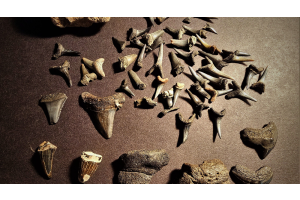
Understanding how paleontologists derive accurate body-size estimates for extinct sharks relies heavily on quantitative tooth analysis, especially when we compare specimens such as megalodon vs great white tooth in the broader context of scaling relationships. At Buried Treasure Fossils, we work closely with collectors, researchers, and institutions who depend on precise measurements and scientifically grounded methodologies to interpret what these teeth reveal about the true size of the sharks that produced them.
Why Shark Teeth Are the Key to Body-Size Reconstruction
Unlike bony fish and marine reptiles, sharks are cartilaginous; their skeletons rarely fossilize. What we consistently recover instead are teeth—durable, mineral-rich structures capable of preserving fine morphological data. For both fossil Megalodon and modern Great Whites, tooth dimensions remain the most reliable proxies for body length because they scale predictably with jaw width and overall body proportions.
Tooth morphology also reflects ecological role, feeding mechanics, and evolutionary lineage. For serious fossil collectors and professional researchers, the tooth is not simply a collectible artifact—it is a precise scientific instrument containing measurable anatomical information.
Standard Measurements: Crown Height, Root Width, and Slant Length
When we evaluate teeth from Megalodon (Otodus megalodon) and Great White Sharks (Carcharodon carcharias), we rely on three primary metrics:
Crown Height (CH)
This is the vertical measurement from the apex of the cusp to the base of the enamel. Crown height correlates strongly with the vertical dimension of the bite and helps estimate proportional jaw depth. In Megalodon, crown height often exceeds 100 mm, whereas Great White teeth typically fall between 40–60 mm depending on position in the jaw.
Root Width (RW)
Root width indicates how broadly the tooth was anchored in the jaw. Wider roots correlate with thicker and more powerful jaws. Megalodon root widths routinely exceed 120 mm in large anterior teeth, reflecting a jaw structure capable of handling prey such as juvenile whales. Great White roots are far narrower, generally 35–50 mm.
Slant Length (SL)
Slant length measures the diagonal distance from apex to root corner. Researchers use it to estimate lateral curvature and functional bite area. For Megalodon, slant lengths exceeding 150 mm indicate a tooth positioned in a critical anterior role, essential for scaling equations.
These measurements allow paleontologists to develop regression analyses correlating tooth size with overall shark length, based on known analogs—primarily modern Great Whites.
How Paleontologists Estimate Megalodon Body Size Using Teeth
Scientists have developed several mathematical models to estimate Megalodon’s length from its tooth measurements. Among them, the most commonly used for anterior teeth is the ratio derived by Randall (1973) and later refined by Shimada (2002, 2019). Shimada’s method is especially relevant because it uses linear relationships between tooth crown height and known proportional scaling in living lamniform sharks.
Shimada’s Equation (Simplified):
Total Length (TL) ≈ (Crown Height × 14.1) + Constant Adjustment
Although the constant varies depending on tooth position, the equation offers reliable predictions when the tooth's jaw position is known. For instance:
● A Megalodon anterior tooth with 120 mm crown height may indicate an individual roughly 14–15 meters long.
● A 140 mm specimen could indicate a shark exceeding 18 meters.
These measurements align with bite-radius reconstructions and fossil whale-bone damage patterns, providing convergent evidence for Megalodon’s giant proportions.
At Buried Treasure Fossils, we regularly handle scientifically significant Megalodon teeth whose measurements fall into these ranges. Researchers and advanced collectors often rely on our detailed specimen data to calculate or cross-verify body-size models.
Scaling from Great White Teeth: The Baseline for Comparison
Understanding megalodon vs great white tooth also requires analyzing the size and geometry of modern Great White teeth, since lamniform scaling patterns derive from extant species.
Key points for comparison:
● An average adult Great White is about 4–6 meters long.
● Large individuals approaching 6.5 meters may produce teeth with crown heights around 55–60 mm.
● Scaling ratios between crown height and body length are consistent enough to extrapolate to extinct relatives.
Great Whites serve as a biological anchor for estimating Megalodon size because both species share similar feeding strategies, serrated cutting teeth, and anterior-posterior tooth gradients. By comparing proportional changes across the tooth row, paleontologists infer how Megalodon's jaws scaled as it evolved from smaller lamniform ancestors.
Functional Differences in Tooth Architecture
Tooth structure also reflects biomechanics:
Megalodon Tooth Characteristics
● Wide triangular crowns
● Robust enameloid thickness
● Large, broad roots indicating massive jaw musculature
● Serrations optimized for cutting dense mammalian flesh
These features suggest a predator capable of shearing through vertebrae and breaking rib cages of medium-sized whales.
Great White Tooth Characteristics
● Narrower crowns with more acute angles
● Moderately thick enameloid
● Root proportions suited for rapid tooth replacement
● Serrations designed for slicing through fish and pinnipeds
Comparing a Megalodon specimen to a Great White tooth in our collection shows dramatic differences in scale and function, reinforcing how tooth morphology reveals ecological role.
Tooth Position and Accuracy in Body-Size Estimates
A critical point for researchers is that estimation accuracy depends on knowing which position in the jaw the tooth represents. Megalodon had approximately 276 teeth across five rows; size varies considerably depending on position:
● Anterior teeth (positions A1–A3) are tallest and most reliable for body-size estimation.
● Lateral teeth have less predictable scaling relationships.
● Posterior teeth are too small and curved for accurate extrapolation.
At Buried Treasure Fossils, we provide detailed positional assessments when possible. Experienced collectors and researchers often use root angle, crown curvature, and slant length to identify position before applying scaling models.
Collecting Research-Grade Teeth: Why Measurements Matter
Professionals and advanced collectors value teeth not just for rarity or aesthetic condition but for quantitative research potential. Our specimens include precise measurement data, enamel preservation notes, serration integrity assessments, and positional estimates—all essential for body-size calculations.
Collectors can use these metrics to:
● Reconstruct bite mechanics
● Compare ontogenetic stages (juvenile vs adult)
● Evaluate regional size variations in populations
● Conduct independent scaling analyses
● Produce educational material for academic or museum settings
Accurate metrics transform a fossil tooth into a high-value scientific specimen.
Conclusion: What Tooth Data Reveals About Megalodon vs Great White Body Size
Understanding megalodon vs great white tooth through systematic measurement—crown height, root width, and slant length—allows scientists to reconstruct the true magnitude of these apex predators with precision. These quantitative tools give researchers, graduate students, and serious collectors a way to translate a single tooth into a full-body estimate grounded in comparative anatomy and modern lamniform scaling models. Whether you are building a research collection, refining academic analysis, or adding a premium display piece, exploring our selection of scientifically documented specimens gives you access to data-rich fossils that support accurate paleobiological interpretation. If you're ready to deepen your study or enhance your collection, we invite you to explore more of what we offer and continue your work with authentic, measurable fossils that advance real scientific insight.