

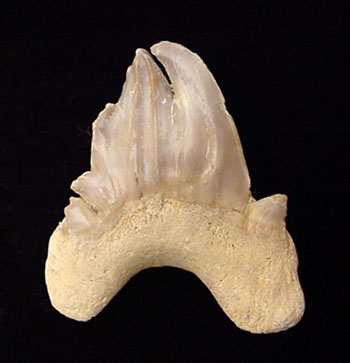
Shark teeth are extraordinary relics of prehistoric seas, and we are proud to share how pathology adds a new dimension to their story. In our work, we often see specimens that become remarkable not only for their size or completeness but also for the unusual signs of pathology. When a Megalodon or its ancestor Otodus tooth shows evidence of disease, injury, or abnormal growth, its story becomes far more compelling, and collectors can recognize that it holds added value.
These pathologic teeth bring a rare and fascinating aspect to fossil collecting, and our role is to ensure their authenticity and significance are preserved for those who study and admire them. For collectors searching for a pathological megalodon tooth for sale, the rarity of these specimens makes them especially intriguing.
Understanding Pathologic Shark Teeth
A pathologic tooth can be described as one that displays irregular features resulting from injury, disease, developmental stress, or unusual growth. These abnormalities often appear as splits, twists, distortions, compressions, asymmetries, or unusual root and crown deformations. Pathologic Otodus teeth from Morocco usually reveal dramatic examples of such features, including split crowns, crowns compressed both horizontally and vertically, twisted tips, symphyseal distortions, and crowns divided into multiple sections.
Each of these forms captures an extraordinary event in the life of an ancient shark. Importantly, these specimens are complete and free of repair or restoration, which confirms that their pathologic traits are entirely natural. This authenticity is crucial for collectors and researchers who want to understand the actual biological history behind these fossils.
Types of Pathology Found in Otodus Teeth
The range of pathologic forms is extensive and offers fascinating variations. Some teeth display split crowns where the biting surface is divided into two or more sections, occasionally accompanied by twisted tips. Others reveal compressed crowns that appear squeezed horizontally or vertically, creating flattened or distorted surfaces. There are also teeth with tips that are visibly twisted or rotated, further evidence of the unusual stress these animals endured.
Symphyseal deformation, which occurs along the midline where the left and right halves of the tooth meet, shows how growth could be significantly altered. In addition, some crowns appear compressed or folded across their width, occasionally pressing side cusps forward. Each of these examples demonstrates how trauma, developmental stress, or genetic anomalies could reshape the structure of a tooth in ways that endure millions of years later.
The Rarity and Appeal of Pathologic Teeth
Pathologic teeth are rare and often carry an appeal that extends far beyond their size. Because pathologic conditions create structural weak points, such as splits or twists, these teeth were more likely to break during the shark’s lifetime or to be damaged during fossilization. For that reason, specimens that survive intact with clear pathologic traits are unusual. Their rarity is matched by their authenticity since collectors expect teeth to remain complete and unrestored, ensuring confidence that the irregular features are original.
These pathologic specimens are also visually distinct, capturing attention in ways that ordinary teeth cannot. A large tooth with a split tip or twisted crown immediately tells a story, making it an essential piece in a collection. Scientific value further increases their importance, as pathologic teeth can reveal details about shark biology, possible disease, environmental stresses, or predatory injury.
How Pathology Influences Value
The presence of pathology influences fossil value in significant ways. Because pathologic teeth are rare, collectors often place them at a premium compared to standard specimens of similar size and preservation. The type of pathology plays a significant role. More dramatic and unusual deformations, such as crowns split into several sections or multiple distortions, can create higher demand. Size also matters since larger Otodus teeth are already rare, and when combined with pathology, they achieve even greater interest.
Preservation contributes to value as well. If the enamel remains intact, the root is well preserved, and the pathology is easy to see, the tooth becomes highly desirable. Visual distinctiveness cannot be overlooked either, since collectors often seek fossils that immediately stand apart from others in their collection. Finally, provenance supports authenticity and adds confidence, as in the case of Moroccan specimens from the Khouribga phosphate region that are known for their quality. These factors often guide those interested in finding a pathological megalodon tooth for sale to carefully evaluate rarity and preservation.
Key Considerations for Collectors
Collectors who assess pathologic teeth often focus on several essential factors. They first consider the nature of the pathology since features like split crowns or twisted tips are more dramatic than minor compressions, and therefore more desirable. Completeness is another factor because whole teeth with both crown and root intact are significantly more valuable than incomplete or repaired examples.
Preservation quality also matters since clean enamel and dentine with visible distortions increase both scientific and aesthetic worth. Size remains a significant influence, with larger teeth offering greater rarity and more substantial impact in a collection. Finally, provenance and authenticity must be confirmed since teeth tied to recognized fossil sites and described as unrestored inspire the highest confidence.
Pathology as a Dimension of Value
The fascination with pathological teeth comes from their ability to tell stories about survival and struggle. Each irregularity is more than a flaw; it is a record of the challenges faced by an ancient predator. Instead of reducing value, these pathologic features often increase it, transforming fossils into remarkable specimens that represent resilience and uniqueness.
Collectors who appreciate these qualities find that pathologic teeth bring variety and depth to their collections. The scientific insights they provide make them even more valuable as windows into prehistoric life.
Conclusion
Pathologic teeth from Otodus and related species add meaningful layers of value to the study and collection of Megalodon-era fossils. They show how abnormalities and imperfections can enhance interest and provide a richer understanding of ancient sharks. Collectors prize them for their dramatic appearance as well as for the biological insights they offer.
The combined factors of size, preservation, pathology type, and provenance determine their true worth. Far from being defects, these irregularities can elevate teeth into treasures that connect collectors and researchers to the lived reality of prehistoric oceans. Each pathologic tooth represents a story locked in enamel and dentine, making it a fossil of remarkable rarity and fascination. For collectors who want to secure a pathological megalodon tooth for sale, these fossils provide a rare opportunity to own a piece of prehistoric history shaped by both biology and survival.






