

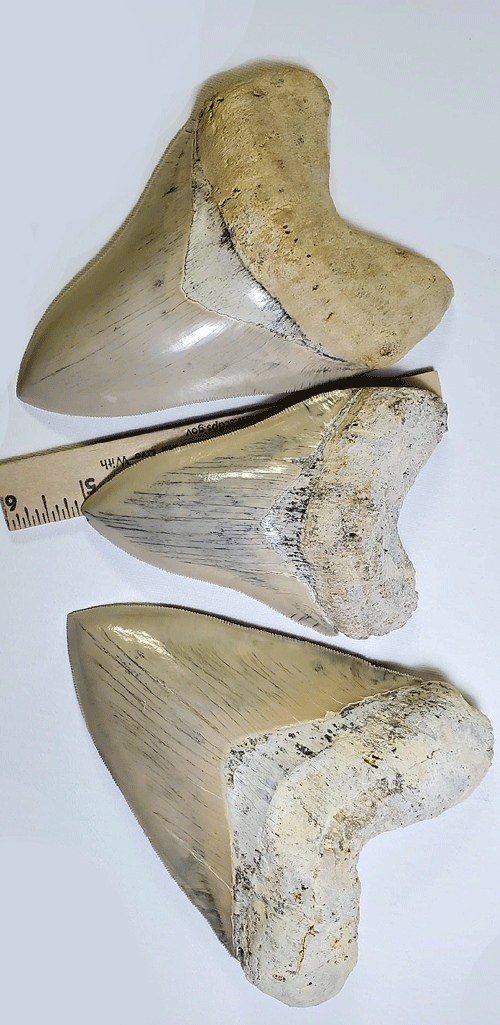
Understanding how ancient seafloor environments influence fossil preservation offers profound insight into paleoceanographic processes and the deep-time chemistry of Earth’s oceans. Within this framework, a megalodon tooth fossil becomes more than a collector’s item—it becomes a mineral archive recording millions of years of sediment interaction. At Buried Treasure Fossils, we work directly with scientifically significant specimens, allowing us to observe firsthand how depositional settings shape the appearance, mineralization, and coloration patterns that make each megalodon tooth fossil unique.
Sediment Geochemistry: The Architect of Fossil Color and Density
Marine sediments dictate nearly every aspect of fossil transformation, from pore-water chemistry to the rate of mineral replacement. When a tooth from Otodus megalodon settles onto the seafloor, it enters a reactive geochemical environment where iron, manganese, phosphate, carbonate, and silica ions exchange and infiltrate the tooth’s microstructure. For academic readers, this diagenetic process mirrors the broader sequence observed in marine hard-part fossilization: dissolution of original tissues, mobilization of ions in the burial environment, and subsequent precipitation of new minerals.
Because a megalodon tooth fossil is composed largely of dentin and enamel—each with different porosity levels—the mineral uptake differs between these layers. Enamel often records subtle color gradients reflecting slow ion diffusion, whereas dentin absorbs larger quantities of minerals, producing dramatic, high-contrast patterns that collectors and scientists both recognize. These mineralogical distinctions help us interpret ancient marine chemistry, making each tooth a small but meaningful paleoenvironmental dataset.
Why Marine Sediments Influence Fossil Appearance So Strongly
Sediment granulometry and chemistry together determine how pore waters circulate. In fine-grained clays, diffusion is slow, enabling prolonged contact between the tooth and mineral-rich fluids. In coarser sands and gravels, circulation is faster, reducing the duration of chemical interaction but often enhancing oxygen penetration. These differences control oxidation states, which in turn control color.
For example:
● Iron-rich sediments promote red, orange, and brown hues.
● Manganese-rich sediments introduce blues, blacks, and charcoal tones.
● Phosphate-dense environments create dense, heavy teeth with dark enamel and thick mineral crusts.
● Carbonate-dominated settings often yield lighter gray or tan enamel depending on the diagenetic stage.
At our store, we see these characteristic patterns repeatedly in specimens from around the world, especially those sourced from scientifically important regions like Bone Valley, Calvert Cliffs, Peru, and Chile.
Bone Valley, Florida: Phosphate Saturation and Vivid Coloration
The Bone Valley Formation exemplifies a high-phosphate depositional system. Miocene and Pliocene marine sediments here were inundated with reworked phosphorite nodules, leading to extremely mineral-dense fossils. The resulting teeth often display:
● Sky-blue and mint hues
● Cream-tan enamel
● Jet-black root surfaces
● High overall density due to pervasive phosphate infill
These colors arise because phosphate-rich pore waters migrate through sediment layers, depositing apatite-rich minerals into the porous dentin. The localized concentration of phosphorite mines also plays a role by continuously exposing new sediment surfaces, which allows us to provide scientifically meaningful Bone Valley fossils to our customers.
Marine geologists will appreciate that Bone Valley coloration reflects repeated marine transgressions, fluctuating redox conditions, and prolonged residence time within phosphate-saturated environments. These conditions imprint the fossil with stable, non-bleaching colors that endure for millions of years.
Calvert Cliffs, Maryland: Silty Clays and Oxidation-Driven Hues
Calvert Cliffs, a globally recognized Miocene marine exposure, offers a very different geochemical system. Here, teeth originate from compacted silty clays where iron and manganese are both present but not uniformly distributed. This depositional matrix produces teeth with:
● Subtle gray-to-black transitions
● Occasional caramel tan enamel
● Fine mineral veining caused by fluctuating oxidation layers
● Highly preserved enamel textures due to low abrasion
The clay-based environment slows diagenesis enough that oxidation fronts form gradually. As redox layers migrate vertically, they leave behind banded color zones that allow scientists to infer past water-column conditions. These teeth are less dense than Bone Valley examples because phosphate saturation is lower, revealing how mineral availability shapes preservation pathways.
At Buried Treasure Fossils, we often highlight Calvert Cliffs specimens for educators and researchers because they visibly encode changes in paleo-oxygenation—information crucial to understanding mid-Miocene climate and circulation.
Peru: Upwelling Zones and Manganese-Rich Mineralization
Peruvian coastal deposits, especially from the Pisco Formation, occur in a setting strongly influenced by ancient upwelling systems. Upwelling elevates nutrients, attracts large predators, and introduces manganese-rich sediments that dramatically affect fossil color. Peru-sourced teeth often display:
● Deep blacks and slate grays
● High manganese veining
● Enamel surfaces with a glossy, almost metallic sheen
● Dense mineral replacement from prolonged burial in low-oxygen basins
These teeth provide evidence of paleo-upwelling intensity, basin anoxia, and diatom-rich sedimentation. The manganese concentration in particular enhances black coloration, a hallmark of Pisco fossils. This chemical signature allows paleoceanographers to reconstruct the productivity cycles that supported large marine megafauna.
Collectors value these visually striking teeth, and we appreciate the opportunity to supply them because they showcase the geological richness of one of the world’s most scientifically productive marine formations.
Chile: Mixed Sediment Inputs and Complex Color Patterns
Chilean megalodon teeth originate from formations that combine marine sands, siltstones, and volcanic sediments. This mixture produces unique geochemical interactions, often with alternating iron and silica phases. The result is:
● Patchwork patterns of tan, gray, and black
● Enamel marbling caused by silica infiltration
● Dentin coloration reflecting alternating redox cycles
● Occasional preserved bioerosion traces that add scientific value
Volcaniclastic material introduces additional mineral phases—particularly iron-bearing silicates—that react during burial to produce dramatic enamel mosaics. These specimens elegantly demonstrate how varied sediment inputs create complex fossil signatures. For geologists, they highlight the interface between tectonically active margins and marine preservation, making them especially compelling for research and teaching.
Why These Colors Matter to Scientists and Collectors
Because mineralization reflects the chemistry of surrounding sediments, a megalodon tooth fossil serves as a natural geochemical proxy. The colors and mineral phases preserved within each tooth mirror conditions such as:
● Oxygen levels in pore waters
● Iron/manganese availability
● Sediment pH and alkalinity
● Sediment residence time
● Water-column productivity
● Proximity to volcaniclastic or phosphatic inputs
For collectors who shop with us, these scientific signals become part of the fossil’s story, increasing both educational and monetary value. For researchers they contribute to regional reconstructions of paleocean chemistry and depositional environments.
Conclusion: Geological Clues Encoded in Every Megalodon Tooth Fossil
A megalodon tooth fossil is far more than a relic of an extinct marine predator; it is a geochemical archive shaped by the sediments that entombed it. Whether shaped by Bone Valley’s phosphate-laden strata, Calvert Cliffs’ oxidizing clays, Peru’s manganese-rich upwelling zones, or Chile’s volcaniclastic sands, each specimen reveals clues about ancient oceans, diagenetic processes, and deep-time sediment dynamics. We take pride in offering scientifically meaningful fossils that help researchers, educators, and enthusiasts explore these stories. If you’re looking to study or collect specimens that truly reflect the ancient seafloor, we invite you to explore our collection and discover the geological narratives preserved in every tooth.






