

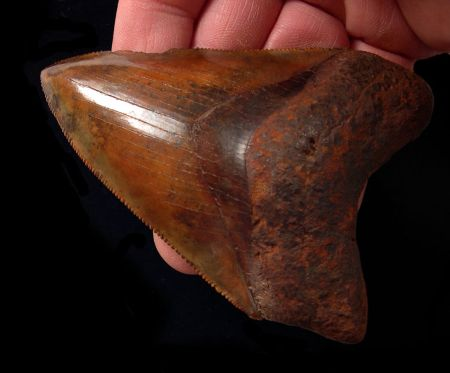
There is something almost magical about holding a tooth from Megalodon, the gigantic prehistoric shark that once dominated the seas. When we uncover a specimen that shines with a deep copper red glow, it connects us to both the ocean’s past and the rivers that reveal these treasures today. As fossil hunters, we find ourselves drawn to these rare discoveries, marveling at how nature has preserved such beauty for us to experience.
Unlike the more common black, gray, or tan teeth, a megalodon tooth found in North Carolina seems to carry a glow of its own, making it one of the most extraordinary fossils ever pulled from the riverbeds of the state.
Fossilization and the Colors of Time
To understand how such a remarkable hue comes to be, it helps to think about fossilization itself. When a Megalodon died millions of years ago, its teeth would settle into layers of sediment at the bottom of ancient waterways. Over unimaginable spans of time, groundwater and minerals would move through those layers, slowly transforming the teeth from organic material into enduring fossils. The enamel and dentine, once part of a living predator, would gradually take on the minerals of their surroundings.
In most places, the result of this process is dark and muted. Fossilized shark teeth usually appear in shades of black, gray, or tan, colors shaped by minerals like carbon, manganese, or iron oxides. These shades tell their own story, revealing the chemistry of the soils and waters where the fossils rested. Yet in northeastern North Carolina, the story unfolds in a much brighter and rarer palette.
Rivers That Paint with Copper
The Meherrin River and nearby waterways hold the secret to these luminous specimens. Unlike other rivers, their sediments and currents carry minerals that interact with fossilized enamel in a special way. As the teeth rest in these riverbeds, minerals slowly seep into their structure, filling microscopic spaces and altering the very chemistry of the enamel. Over millions of years, this process paints the fossils in copper red hues that seem almost unreal.
The source does not reveal every detail of the mineral mix, but the repeated presence of red suggests that copper plays a leading role. When exposed to the right conditions, copper compounds can oxidize into warm red tones. Iron may also be present, but copper-bearing minerals appear to give these fossils their striking glow. The rivers become natural artists, tinting these prehistoric relics with colors that echo fire more than water.
The Rarity of Red
Such treasures remain rare, even in the rivers known to produce them. For teeth to emerge with a copper red hue, conditions must align in a delicate balance. The rivers must deliver the right minerals in a steady supply. The chemical environment must allow those minerals to bond with the fossil without erasing the fine details of the enamel. And the teeth themselves must endure millions of years without breaking apart or losing their serrations.
Even in places like the Meherrin River, collectors often return empty-handed. Fossil diving in these waters does not guarantee discovery. A megalodon tooth found in North Carolina with a vivid copper red hue is scattered and elusive, its scarcity only adding to its mystique. To find one is to stumble across a geological prize that nature has hidden well.
Beauty, History, and Desire
Part of the fascination with copper-red Megalodon teeth lies in their appearance. Against the backdrop of standard fossil colors, the deep red tones look vibrant and striking. They have the glow of gemstones, as though they were designed for display rather than buried in riverbeds for ages. Collectors who add one to their shelves know they are not simply preserving a piece of prehistory but displaying something that feels like natural art.
Beyond their beauty, these teeth embody history on two scales. They carry the legacy of Megalodon, the colossal shark that once ruled the oceans. At the same time, they tell the story of the rivers and sediments that transformed them long after the animal disappeared. The copper red hue becomes a bridge between ancient seas and modern streams, reminding us how time reshapes everything it touches.
Preservation also plays a vital role in their appeal. Teeth from the Meherrin River region often emerge with sharp serrations, complete roots, and strong enamel. When combined with the rare coloration, this level of preservation makes them remarkable specimens. It is no wonder that collectors prize them above more common finds, cherishing each tooth as a treasure that blends rarity, history, and natural artistry.
The Chemistry Written in Enamel
Though no laboratory charts accompany these fossils, the story written in their enamel can still be read. The enamel, originally rich in hydroxyapatite, would take in new minerals as fossilization unfolded. Copper-bearing compounds, transported by river sediments, would gradually infuse the tooth, bonding into its structure and tinting it from within. Over the ages, this process would not only preserve the tooth but also color it in a way that sets it apart from the typical fossil spectrum.
The result is a fossil that is not merely preserved but transformed. It becomes a relic touched by both the predator that bore it and the river that reshaped it. Each tooth tells two stories: one of an ancient shark and another of the mineral-rich waters that gave it new life in color.
Holding on to a Piece of Time
Collectors who acquire these fossils often speak of the care required to maintain them. Despite their age, copper red teeth are still vulnerable to light, handling, and storage conditions. Direct sunlight can fade the color over time, while careless handling can chip enamel or serrations. Safe storage in cushioned cases or careful display away from harsh light helps preserve their vibrancy. With proper care, these fossils continue to glow as they have for ages, carrying their copper red hue into the future.
A Legacy Carved in Color
Copper-red Megalodon teeth from North Carolina rivers remind us that fossils are not frozen moments but evolving stories. Each one reflects the power of ancient predators, the flow of rivers, and the quiet work of minerals settling into enamel grain by grain. Their rarity makes them treasures, their color makes them beautiful, and their preservation makes them invaluable windows into the past.
In the end, they stand as proof that the earth can turn even the most fearsome relic into something radiant. By carrying the glow of copper red across millions of years, a megalodon tooth found in North Carolina gives us a chance to hold history in our hands, not as a shadow of the past but as a shining reminder of the artistry of time itself.






