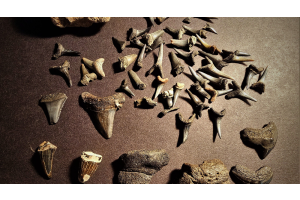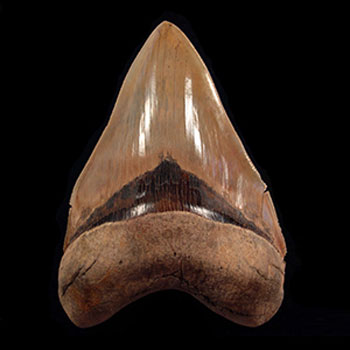
At our fossil collection services, we often marvel at how nature can transform something as ordinary as a tooth into an extraordinary artifact. When we hold a Black Megalodon tooth, we can feel that transformation. These fossils are not only massive relics of a legendary predator, but they also carry striking colors that tell geological stories. Among them, black teeth capture attention the most. Their dramatic hue seems to hold secrets from oceans long gone, and we can trace that mystery back to the sediments and minerals that surrounded them millions of years ago.
From Shark’s Bite to Geological Relic
The journey of a black Megalodon tooth begins in the same way as all fossilized teeth. Like modern sharks, the Megalodon was constantly shedding teeth throughout its life. Each one would fall to the seabed, where it could quickly be covered by sediment. Once buried, fossilization could begin.
This process would gradually replace the organic material of the tooth with minerals from the surrounding sediment. What was once living tissue would slowly harden into stone, but the transformation would not end there. The minerals present in the sediment would also determine the final color of the fossil, giving every tooth a unique fingerprint of its environment.
Sediments as a Natural Palette
The seabed was not uniform. Different regions contained different mineral compositions, and this variation meant that Megalodon teeth could fossilize in a wide range of colors. Over time, sediments acted like pigments, painting the teeth in tones that reflected local chemistry.
● Iron-rich sediments could create fossils in shades of red, orange, or brown.
● Clay and limestone environments could leave teeth with gray, yellow, or green hues.
● Phosphate-rich deposits could transform teeth into dramatic black specimens.
This means that coloration was not random—it was the direct result of the minerals that surrounded the tooth. Two teeth shed by the same shark might look entirely different today, depending on where they settled on the ocean floor.
The Role of Phosphate in Black Teeth
Black Megalodon teeth owe their striking coloration to phosphate. When a tooth was buried in phosphate-rich sediments, this mineral would gradually replace the tooth’s organic material during fossilization. Over millions of years, phosphate would infuse the fossil with deep, dark tones, ranging from charcoal to jet black.
Phosphate was especially common in areas with abundant organic decay, where sediments were chemically rich. That environment allowed for the bold transformation of an ordinary shed tooth into the sleek black fossils that collectors and researchers admire today.
A Step-by-Step Transformation
To fully appreciate how a black Megalodon tooth gained its color, it helps to imagine the process step by step:
1. Tooth lost – A Megalodon shed a tooth while hunting or growing.
2. Burial – The tooth became buried in layers of sediment.
3. Fossilization – Minerals from the sediment began to replace the organic material.
4. Color formation – The chemistry of the surrounding environment determined the tooth’s final color.
In the case of a Black Megalodon tooth, phosphate acted as the defining mineral, giving it its iconic hue.
The Appeal of Black Megalodon Teeth
Collectors are often drawn to black Megalodon teeth, and it is not hard to understand why. Their dark coloration provides a powerful contrast that brings out the serrations and enamel in sharp relief. Each tooth becomes more than a fossil—it becomes a bold statement piece.
From a geological perspective, the fascination runs even deeper. Black teeth indicate phosphate-rich environments, providing a direct link to the chemistry of ancient seas. That connection means a black Megalodon tooth is not only visually stunning but also scientifically significant, offering insights into the conditions of prehistoric oceans.
A Glimpse into Ancient Oceans
Examining a black Megalodon tooth is like looking at two histories at once. On one level, the fossil reflects the life of the predator that shed it. On another, it records the environment in which it fossilized. The phosphate that created the black color points to regions rich in organic activity, where marine ecosystems thrived and decayed in constant cycles.
Each fossil serves as a silent witness, carrying both the biological story of the shark and the geological story of its oceanic grave. That dual narrative makes every black tooth a bridge between life and earth.
Scientific Importance of Coloration
For paleontologists, the coloration of Megalodon teeth provides more than aesthetic value. It serves as evidence of the environments in which they fossilized. By analyzing the colors of teeth from different regions, scientists can reconstruct aspects of ancient marine ecosystems.
● Red or orange hues highlight iron-rich sedimentary deposits.
● Gray, yellow, or green hues reveal clay or limestone influence.
● Black coloration confirms phosphate saturation.
This means that each tooth adds a piece to the puzzle of ancient marine history. Even color alone can reveal valuable insights into prehistoric environments.
The Patience of Geological Time
Black Megalodon teeth also remind us of the vastness of geological time. The process that turned them from biological matter into glossy black fossils did not happen quickly. It required millions of years for minerals to seep in, replace, and harden the structures.
The deep black color is a mark of that patience, showing what can happen when nature works slowly but persistently. Every black tooth is a testament to both the predator that once ruled the seas and the ancient environment that preserved it.
Conclusion: Darkness as History
A Black Megalodon tooth holds a special place in fossil collections because it is more than an artifact. Its coloration is a geological story, written in phosphate-rich sediments that shaped it over immense spans of time. Each fossil reflects both predator and environment, biology and geology, life and earth.
To hold one is to experience millions of years compressed into a single object. Its black sheen does not only symbolize beauty; it represents patience, transformation, and history. That dark surface is a storyteller, carrying the memory of oceans long gone and predators long extinct, while reminding us of the decisive role that geology plays in shaping the treasures of prehistory.