

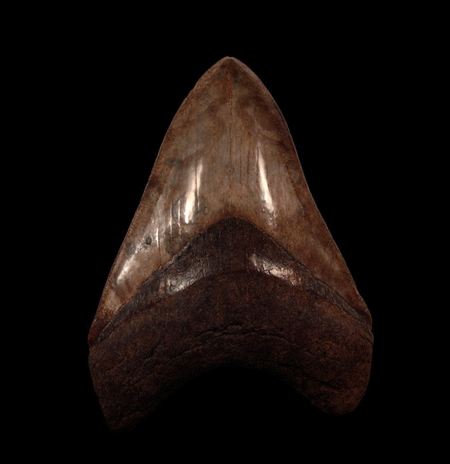
We have always believed that every fossil holds a story, and it is our responsibility to bring that story to life. When we examine a real megalodon tooth, we often use our trained eyes and careful hands to study its appearance, weight, and structure.
Now, we are exploring how sound—through a gentle tap or a measured wave—might help us discover whether a specimen is truly an ancient relic or a well-made imitation. This method does not replace traditional evaluation; instead, it adds another dimension to the process, helping us provide a more complete picture of authenticity.
Texture as a Sonic Signature
A genuine Megalodon tooth typically features a weathered surface with natural imperfections, including pits, scratches, and uneven patches. These marks tell of long mineralization and environmental exposure, forming over millions of years. Replicas, particularly those made from resin or composite, may often appear overly smooth, lacking the subtle irregularities that a real fossil develops.
When we lightly tap an authentic tooth, those surface details could help scatter sound in unique ways. The vibrations might be absorbed and redirected by small pits and grooves, creating a more layered and muted sound. A replica’s smooth, uniform finish might cause the sound to travel evenly, resulting in a cleaner and more predictable tone.
Density and Its Influence on Resonance
Through fossilization, an authentic Megalodon tooth becomes much denser than a modern reproduction. Minerals slowly replace organic material, adding weight and changing how the tooth responds when handled and when exposed to vibration.
If we tap a dense fossil, the sound may come through as deeper and more subdued. By contrast, a lighter resin model could produce a sharper and higher-pitched response. This difference in pitch and tone is one that we can listen for and, with experience, begin to associate with authenticity.
Root and Blade Structure Shaping the Sound
The root of a real Megalodon tooth often shows nutrient foramina—small openings that once allowed blood vessels to pass through—and clear root lobes. The blade typically retains fine serrations, which indicate the tooth’s original function as a hunting tool.
We can hear differences in how these features affect sound. Serrations along the blade could create tiny disruptions in vibration, adding a brief variation to the tone. Nutrient foramina in the root may act as small chambers that subtly change resonance. Replicas without such natural features often allow sound to move more uniformly across the surface.
Fossilization Marks as Acoustic Modifiers
Authentic fossils frequently display mineral deposits, sediment patches, or visible color changes—signs of the long period they spent buried. Some may have calcite spots or even remnants of the surrounding matrix still attached.
These variations can alter the way sound behaves. A calcite patch might reflect vibration differently from the enamel around it. Sediment remnants may absorb part of the vibration, producing a softer, less sustained tone. Listening for these subtle differences could help us identify whether a tooth has undergone natural fossilization.
Guidance from Experienced Evaluation
The process of identifying authenticity often benefits from the insights of an experienced evaluator. Acoustic testing could become another step in such an assessment. By comparing the resonance of an unknown specimen to a reference collection of confirmed fossils, an evaluator could identify patterns that support or challenge authenticity. This method, when used alongside visual and structural analysis, might offer a stronger foundation for conclusions.
A Process That Combines Sight, Touch, and Sound
An effective evaluation process might involve the following:
Visual and Tactile Review
Examine surface texture, check weight, study root and blade features, and look for signs of mineralization.
Acoustic Test
Apply a gentle tap or measured sound wave, then listen for changes in pitch, tone, and resonance.
Comparison with References
Match the acoustic profile with known examples from authenticated specimens.
Final Assessment
Use all gathered information to decide whether the specimen is consistent with genuine fossil characteristics.
When each stage aligns—natural texture, proper density, distinctive structure, signs of fossilization, and a sound profile that reflects mineralized material—the evidence becomes far stronger. This is where the differences between a replica and a real megalodon tooth can be made even more apparent.
Advantages of Adding Resonance Checks
● Non-Invasive: The method leaves the specimen unharmed.
● Efficient Screening: Allows for quick checks before a more involved study.
● Recorded Data: Resonance patterns can be measured and compared.
● Revealing Subtle Clues: May expose internal differences that visual inspection alone cannot detect.
Limitations to Keep in Mind
● Reference Collection Needed: Testing requires a baseline of confirmed fossils for comparison.
● Specialized Tools: Microphones or vibration sensors may be necessary.
● Interpretation Skill: Correct reading of results takes practice and knowledge of both fossil anatomy and acoustic behavior.
While there are considerations to address, resonance testing holds promise as a supportive method for fossil evaluation.
Final Reflection
Megalodon teeth are treasured not only for their rarity but also for the history they represent. Verifying authenticity is critical, and visual texture, density, structural features, and fossilization signs remain the core indicators.
Adding acoustic resonance to the process can provide a fresh way of interpreting those existing markers. The pitch, depth, and decay of a sound may reveal details about a tooth’s density, mineral composition, and surface features. While this approach is still emerging, it has the capacity to strengthen traditional assessment methods, offering a fuller picture of a fossil’s story without altering it in any way. The combination of sound testing with established evaluation methods can help confirm when a specimen is indeed a real megalodon tooth.






