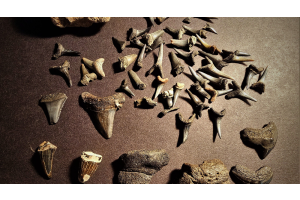
Some fossils fascinate, fossils that excite, and then there are fossils that command silence the moment they are revealed. Among shark tooth collectors, one type stands above all others in that category: the Copper-Red Megalodon tooth. These brilliant specimens, with their fiery glow and impeccable preservation, aren’t just pieces of natural history, they are icons of rarity and prestige. To hold one is to hold not just a fossil, but a legend.
In the world of paleontology and fossil collecting, the words “rarest of the rare” are thrown around with care, reserved only for specimens that combine geological uniqueness, visual allure, and scarcity. Otodus Copper-Red site Megalodon teeth check every box. But what makes them so legendary, so worthy of awe?
Let’s dive deep into their story.
A Predator That Left a Legacy
Before exploring why the copper-red specimens stand apart, it’s important to recognize the creature behind them: Otodus (Carcharocles) megalodon, the most fearsome shark ever to exist. Swimming the world’s oceans between 23 and 3.6 million years ago, Megalodon dwarfed every modern shark. With lengths estimated at up to 60 feet and teeth over 7 inches long, this predator ruled the seas.
Megalodon’s teeth are among the most recognizable fossils in existence, found across the globe in colors ranging from jet black to light gray to tan. Yet within this wide spectrum, one small pocket of discoveries glows with a distinctive copper-red hue, a phenomenon that has elevated them to collector superstardom.
Geological Alchemy: The Science Behind the Color
What makes these teeth so visually extraordinary? The answer lies not in chance, but in geological chemistry.
Over millions of years, sediment-rich rivers buried Megalodon teeth in mineral-heavy layers.
In rare locations, most famously the Meherrin River of North Carolina, iron-rich sediments seeped into the enamel and dentin.
These minerals oxidized, transforming the original tooth material into a radiant copper-red or reddish-brown glow.
It’s essentially nature’s alchemy: a prehistoric predator’s weapon forged anew into a fiery relic of earth’s artistry. Unlike teeth found in blackwater rivers or ocean beds that often fossilize into darker tones, the copper-red coloration is unique to very specific conditions. That exclusivity forms the foundation of their value.
Where They’re Found: A Narrow Window of Rarity
Unlike common fossil beds where shark teeth are abundant, copper-red specimens appear in extremely limited localities. The Meherrin River is the most famous, but even there, only a small fraction of recovered teeth display the iconic hue.
Other rivers, such as the St. Mary’s in Georgia, have occasionally produced red-tinted teeth, but none match the saturation, preservation, and consistency of those from North Carolina. That narrow geographic window ensures that supply remains minuscule, and as demand rises, so does the mystique.
Why Collectors Call Them the “Holy Grail”
In the collecting world, rarity and beauty are two halves of the same equation. Otodus Copper-Red site Megalodon teeth deliver both in abundance.
Exceptional Coloration – Their fiery tones simply stand out in any display. Among rows of gray or black teeth, a copper-red specimen becomes the instant centerpiece.
Pristine Preservation – Many of these teeth maintain sharp serrations, strong bourlettes, and unbroken roots. The enamel gleams rather than dulls, preserving the tooth’s full grandeur.
Documented Provenance – Collectors value trust. The best copper-red specimens often come with a clear record of origin, typically tied to the Meherrin River, which adds credibility and value.
When these three factors align, the result is a fossil that collectors describe as the ultimate prize, the holy grail of shark teeth.
How to Spot a Genuine Copper-Red Tooth
With their value soaring, replicas and misrepresented fossils sometimes make their way into the market. Collectors should know how to distinguish genuine specimens:
True enamel glow – The coloration is deep within the enamel, not a surface stain. It should shimmer naturally in light.
Mineral consistency – Look for uniform coloration that follows natural enamel lines. Artificial dyes often appear blotchy.
Provenance documentation – Serious dealers provide site details and, when possible, collection history.
A trusted seller with a long-standing reputation, like established fossil dealers, is the safest route for securing an authentic specimen.
Caring for Copper-Red Teeth
Owning such a fossil comes with responsibility. Unlike modern teeth, fossilized specimens are vulnerable to improper care. To preserve their beauty:
Avoid direct sunlight – Prolonged exposure can fade coloration.
Handle gently – While fossilized, these teeth can still chip or crack under pressure.
Display smartly – Use cushioned stands or display cases to protect from accidental drops.
Clean minimally – A soft brush is usually all that’s needed. Never use harsh chemicals that could erode enamel.
With careful stewardship, a copper-red Megalodon tooth will retain its glow for generations, serving as both a display piece and an heirloom.
Beyond Collecting: The Fascination Factor
The appeal of copper-red Megalodon teeth isn’t only about rarity or monetary value. They carry a cultural and emotional weight:
For some, they are time capsules, tangible links to an ocean that existed millions of years ago.
For others, they embody the raw power of nature, proof of the largest predator to ever live.
For many collectors, they represent a personal milestone, the pinnacle of a fossil collection, and a trophy that sparks endless conversation.
Each tooth tells a story, of a hunt, of a riverbed, of a fossil hunter’s discovery. Owning one means carrying that story forward.
A Comparison: Why They Surpass Other Fossils
While other rare fossils captivate collectors, such as iridescent ammonites or dinosaur claws, copper-red Megalodon teeth hold a special edge:
They combine visual artistry (color), prehistoric relevance (top predator), and scarcity (geologic rarity).
They are instantly recognizable, even to non-collectors, which makes them universally appealing.
Unlike some delicate fossils, they are robust enough to be displayed proudly without fear of rapid decay.
This blend of features ensures their place at the top of fossil-collecting hierarchies.
Final Thoughts: Legends in Enamel
When collectors say Otodus Copper-Red site Megalodon teeth are the “rarest of the rare,” it’s not hyperbole. These fossils are geological miracles, artifacts that unite science, history, and beauty. They’re the kind of specimen that transforms a collection from impressive to extraordinary.
In their fiery glow, you see more than enamel, you see the reflection of a vanished ocean, the shadow of the largest shark in history, and the artistry of time itself. For those lucky enough to own one, it’s not just a fossil. It’s the ultimate symbol of rarity, prestige, and the awe-inspiring power of nature.
So whether you’re a seasoned collector or simply a lover of natural history, remember this: if ever you encounter our collection of copper-red Megalodon tooth, you’re not just looking at a fossil, you’re staring at the crown jewel of paleontology.