

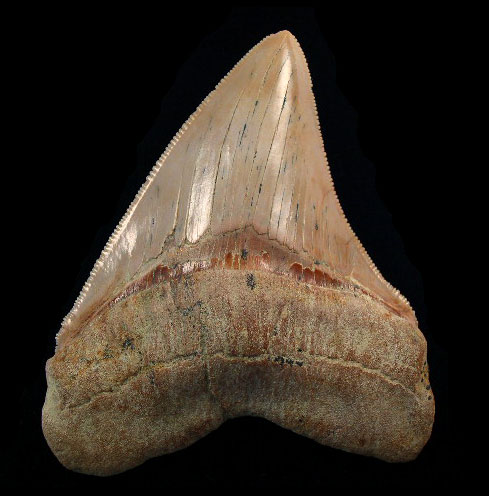
Every serious collector remembers the first fossil that stopped them in their tracks. A tooth that seemed to glow under the case lights. A root so sculpted it looked handmade. That is the feeling Sharktooth Hill is famous for inspiring, not with volume but with specimens that feel singular and storied. In this article, the focus is on quality, history, and the sort of provenance that turns admiration into ownership of a Sharktooth Hill Megalodon tooth.
Why Sharktooth Hill keeps collectors talking
Sharktooth Hill sits inland near Bakersfield, California, where a warm Miocene sea once rolled over whales and giant sharks. The site’s geology preserved teeth in fine silt, and that quiet matrix gave them a look you can spot across a room. Enamel tones lean tan and honey with charcoal whispers. Bourlettes can appear cinnamon or chestnut. Serrations are coarse and satisfyingly sharp from base to tip. Some teeth show the interlocking root indentations and the small root ears that mark early to middle Miocene development. That combination of traits gives these fossils a signature that experienced buyers learn to recognize quickly.
What rarity really means here
Rarity is not a slogan. It is what happens when an already uncommon animal intersects with a locality that yields limited material and has been collected for decades. You can find thousands of Megalodon teeth from the Atlantic coastal plains. You will not find thousands from this California hill. That asymmetry is precisely why a Sharktooth Hill Megalodon tooth appears elevated in any collection. When a four or five-inch specimen surfaces with crisp edges, strong enamel, and an intact bourlette, the piece becomes a headline rather than another entry in a catalog.
The design details that make these teeth irresistible
Collectors love specifics, so here are a few. The serrations tend to be bigger and bolder than many East Coast examples. The crown often flares subtly, setting off the bourlette like a frame. Some teeth show Chubutensis like bumps along the base of the cutting edge, a clue to earlier lineage. Root ends may carry deep grooves that feel engineered for strength. None of these traits on their own is unheard of elsewhere. Together, they add up to an identity that is pure Sharktooth Hill.
Why museum-grade matters to a private buyer
A fossil can be large and still feel ordinary. Museum grade is different. It signals honest surfaces, unblunted serrations, color that has depth rather than a chalky flatness, and a root that sits square and confident. It also signals authenticity with no undisclosed repair or restoration. When those boxes are checked, a Sharktooth Hill Megalodon tooth becomes something rare in the collecting world. It becomes both science and sculpture.
From old quarries to modern showcases
Many of the finest teeth today do not come fresh from a pit. They come from vintage collections built by diligent fieldwork and careful trades. As estates change hands, a small number of standout pieces reenter the market. Seasoned buyers move quickly because they know opportunities at this level do not repeat on a schedule. If a five-inch specimen is paired with its original silt matrix or a companion whale bone, it is the kind of find people remember by month and year.
How to evaluate a potential purchase
Start with the tip. Is it complete and consistent with the serrations around it? Follow the cutting edge down each side. Are the serrations present and unrounded? Study the bourlette. Is it complete or mostly present, with a color that complements the enamel rather than muddying it? Inspect the root for symmetry and articulation, and look for those classic Miocene grooves at the ends. Finally, consider color and presence. Does the tooth have that quiet glow that high-end Sharktooth Hill pieces are known for? If the answers line up, you are looking at a fossil that deserves a place of honor.
Display that earns a double take
Presentation changes perception. A custom stand tailored to the root allows the crown to float, and the serrations catch the light. Five-inch pieces especially deserve a stand that lifts them a little higher than the surrounding fossils. A clean acrylic base or a dark wood plinth lets the enamel colors speak. Place the piece where a passerby will meet it at eye level, and even non-collectors will pause.
Good lighting rewards the enamel and makes every serration stand crisply at once.
Why now is the right time to act
Supply is not increasing. Access to classic quarry areas is limited, and authentic high-grade pieces are being absorbed into permanent collections. Demand, however, continues to grow as more people learn the difference between a good Meg tooth and a Sharktooth Hill standout. Waiting rarely makes rare objects easier to acquire. If you have been considering a purchase, momentum favors decisiveness.
Service that respects both science and desire
Confidence matters when you decide to invest. That is why you should expect transparent provenance, clear macro photos of serrations and bourlette, and an authenticity guarantee stated in plain language. For significant pieces, you should expect professional packaging and insured shipping. For five-inch or larger specimens, you should expect a thoughtfully designed display stand included as part of the experience. We make the entire process straightforward so your attention can stay on choosing the tooth that fits your eye and your collection.
For new collectors building a first-tier
Begin with a strong three to four-inch example from the hill. Look for sharp edges and attractive color before chasing extreme size. Learn to see how the bourlette condition changes a piece. Compare a few side by side if possible, and trust your eye. Once you know what excellence looks like at a moderate size, you will be ready to recognize a top-tier five-inch specimen when it appears.
For advanced collectors seeking the crown jewel
You already know the basics. What will elevate your case now is a tooth with presence and provenance. Matrix backed pieces with associated whale bone have a gravitas that cannot be faked. Teeth with unusual color like natural white or dramatic contrasts turn heads even across a crowded show floor. Early Miocene traits, such as deep root grooves or subtle edge bumps, can be the detail that tips a decision from maybe to must-have.
Care that keeps beauty honest
These fossils have survived millions of years, but they appreciate a little consideration. Keep them out of prolonged direct sun to preserve color. Avoid harsh cleaners and settle for a soft brush and gentle dusting. Handle by the root whenever possible. If you transport a large tooth, wrap the crown and edges to protect serrations. Small habits like these keep value and allure intact for decades.
A fossil that earns conversation every time
The best pieces do more than look impressive. They create a connection. Guests ask what era they are from. Children ask how big the shark was. Fellow collectors ask how you found that particular specimen. A Sharktooth Hill Megalodon tooth invites all three questions at once. It is an object you can enjoy daily and still admire anew a year later.
The quiet pleasure of owning something scarce
There is a difference between buying often and buying well. A cabinet packed with ordinary pieces can feel busy. A cabinet anchored by a single extraordinary tooth feels confident. That is the promise of Sharktooth Hill. It offers fewer choices but better ones, and for a collector, that balance is a gift.
Conclusion
Collector status is earned by taste, patience, and a willingness to act when the right piece appears. If you are ready to add a fossil that carries both scientific interest and visual drama, this is the moment to move. Choose the specimen that makes you lean closer. Let it anchor your display and remind you why you collect in the first place. Your next great acquisition may be waiting as a Sharktooth Hill Megalodon tooth, and when it arrives, it will feel as inevitable as it is rare.






