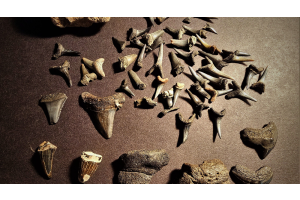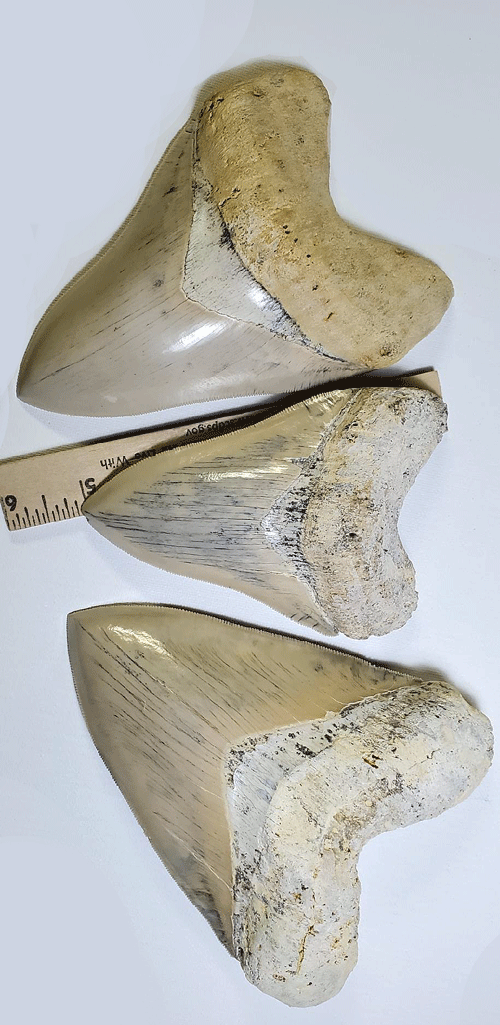
When we hold a Megalodon tooth, we are having a fragment of prehistoric time. Our fascination with these fossils drives us to study, preserve, and share them with care. The massive size, serrated edge, and mineralized surface tell the story of an apex predator and the geological processes that shaped it.
For us, authenticity is not only about appearance but also about ensuring that each specimen reflects its true history. Fossilization and preservation leave behind indicators that replicas cannot convincingly reproduce. These subtle yet consistent signs form an unmistakable record of natural history.
Serrations and Natural Wear
A genuine Megalodon tooth exhibits serrations that reveal the impact of both feeding activity and geological processes. These serrations may be chipped, softened, or slightly uneven, revealing a history of natural wear. They demonstrate how the tooth was used during the animal’s life and later altered by burial, pressure, and shifting sediments. Such irregularities give a tooth its authenticity.
Replicas, however, often attempt to imitate serrations with uniform cuts. Instead of irregular edges that reflect natural use and time, replicas tend to display mechanical precision. That kind of perfection fails to match the marks left by millions of years, making it clear that imitation can never fully capture authenticity.
Mineral Influence and Color Variation
Over time, mineral-rich groundwater penetrates fossils and alters their appearance. This slow process creates hues of black, brown, gray, or even blue. Genuine specimens often display marbling or blended tones, and the color depth reflects natural infiltration. No two authentic teeth look identical because mineral composition varies depending on the burial environment.
Replicas struggle to reproduce this natural variation. They often rely on artificial stains or paints applied only to the surface. While these coatings may appear convincing at first, they lack the layered depth of natural mineralization. The absence of subtle blending and marbling makes it clear that such specimens are not genuine fossils.
Density and Weight
The weight of an authentic Megalodon tooth offers another unmistakable sign of fossilization. Over millions of years, minerals replace organic material, creating a dense and heavy structure. A real tooth feels substantial when lifted, and that density reflects the process of mineral replacement.
In contrast, replicas are usually made from resin or plastic. These materials are far lighter and fail to replicate the natural heft of mineralized fossils. When handled, the difference can be detected immediately, making weight a reliable indicator of authenticity.
Enamel Texture and Gloss
The enamel surface of a genuine fossil provides additional insight. Real enamel often appears smooth and reflective in some areas, but it is rarely uniform across the entire tooth. Natural processes introduce variations, leaving sections dulled or lightly scratched. These inconsistencies reflect years of geological activity, from erosion to pressure in the sediment.
Replicas often attempt to mimic enamel by applying a uniform glossy finish. While this may catch the eye, the consistency of shine is unnatural. Authentic fossils always balance areas of shine with natural wear, producing a surface that speaks to history rather than artificial creation.
Provenance and Source History
The background of a fossil adds further weight to its authenticity. When provenance is documented, it strengthens confidence that the specimen is genuine. Details such as geological formations, regions of discovery, and collection history are valuable and help confirm the origin of a tooth. Reliable sources are often able to share this context clearly.
By contrast, replicas rarely come with such information. A specimen offered without provenance should immediately raise questions. Authentic fossils typically carry some record of discovery, making context as crucial as physical traits when assessing authenticity.
Why Authentic Fossils Are Difficult to Replicate
The process of fossilization is shaped by countless environmental factors. Burial under sediment, exposure to mineral-rich groundwater, chemical replacement, geological pressure, and the passage of time each leave unique traces. These traces appear in worn serrations, marbled coloration, micro-abrasions, and overall density. Together, they form a natural signature that cannot be convincingly reproduced by artificial means.
Replicas may succeed in copying one or two surface features, but they cannot recreate the full spectrum of traits that fossilization produces. Uniform color, flawless serrations, or incorrect weight expose their artificial nature. No manufactured product can convincingly replicate the complexity of natural preservation.
Examples of Authenticity in Practice
Consider a Megalodon tooth with identical serrations on both sides, a flat black surface, and an unexpectedly light feel. Without provenance, such traits strongly suggest it is a replica. The uniform edges and surface coating fail to reflect the irregularity and depth that fossilization produces.
Now imagine another specimen of similar size. Its serrations are chipped and uneven, the enamel has areas of shine and dullness, and the coloration shows marbled tones of gray and brown. It feels heavy when held, and provenance connects it to a sediment layer well known for fossils. This combination of traits demonstrates authenticity and highlights the difference that genuine preservation creates.
The Value of Authentic Fossils
Authentic fossils hold scientific, educational, and historical significance. They preserve evidence of an extinct predator and provide insight into ancient oceans. Replicas may copy appearance, but they cannot capture the narrative that a real fossil carries. Every authentic specimen is a record of geological time, preserved through natural processes that no artificial creation can replicate.
For collectors and educators, authenticity enhances appreciation. Natural wear, unique coloration, heavy density, and clear provenance turn fossils into more than artifacts; they become tangible evidence of life that once shaped the planet’s ecosystems.
Conclusion
Preservation and fossilization leave behind telltale signs that fakes cannot mimic. Natural serrations, mineral coloration, enamel texture, density, and provenance all contribute to a fossil’s authenticity.
Replicas may attempt to imitate certain aspects, but they cannot reproduce the complex interplay of geological forces over millions of years. Recognizing these indicators ensures that authentic specimens of a Megalodon tooth are valued and preserved for their true significance as irreplaceable pieces of natural history.