

When we hold two shark teeth in our hands, one fossilized and ancient, the other sleek and modern, we are not simply examining pieces of biology. We are holding chapters of ocean history. One tooth belongs to the mighty megalodon, a predator that once dominated prehistoric seas but has long vanished. The other belongs to the great white shark, a living predator still patrolling today’s oceans.
Through these remarkable teeth, we can uncover two very different narratives: one of extinction, the other of endurance. Our fascination with these teeth allows us to connect with both a vanished past and a vibrant present, and it brings to life the timeless comparison of megalodon vs great white tooth.
Teeth of Titans: The Colossal Legacy of the Megalodon
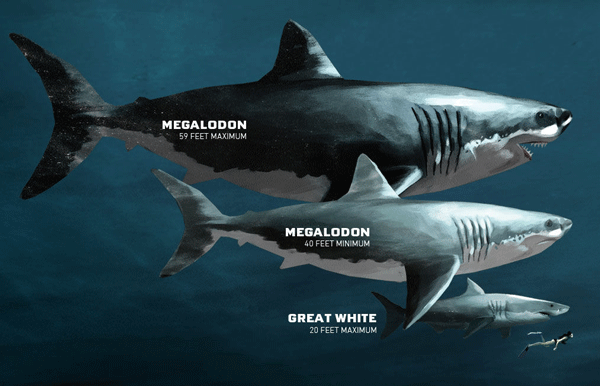
The megalodon is often remembered as one of the largest predators ever to exist, and its teeth give us a clear picture of why. These teeth are massive, wide, and built for sheer power. They were designed to crush through bone and tear into enormous prey, making them the tools of an apex hunter that ruled the seas millions of years ago.
Some teeth from this prehistoric giant could reach lengths of over seven inches, easily dwarfing the teeth of any shark alive today. Most fossils fall between three and six inches, but even at the smaller end, they speak of a creature of incredible size. The rare specimens that exceed six inches are especially prized, not only for their size but for the story they carry.
Looking closely at a megalodon tooth reveals how it was used. Serrated edges were made to slice through flesh, while the thickness of the tooth allowed it to withstand the crushing impact of biting into large marine mammals. These traits tell us that megalodons were built to feed on massive creatures such as early whales.
Some of these teeth date back as far as 23 million years. Each one acts as a fossilized time capsule, offering a connection to ancient oceans and ecosystems that no longer exist. They remind us of a world that has changed dramatically, where even the mightiest predator could not withstand the forces of extinction.
The Survivor’s Bite: Great White Teeth in Action
If megalodon teeth are relics of a vanished past, great white shark teeth are the living symbols of survival. Though smaller, they are no less impressive. These teeth are sleek, razor-sharp, and perfectly adapted to the challenges of modern oceans.
Great white teeth generally measure around three inches long, far shorter than the colossal size of a megalodon’s. But what they lack in size, they make up for in efficiency. These teeth are pointed and narrow, with serrations that allow them to slice cleanly through prey such as seals, fish, and other sharks. Where the megalodon’s teeth were built for raw crushing force, the great white’s teeth are shaped for agility and precision.
Some great white teeth found today are thousands of years old, preserved as natural artifacts. Unlike the fossils of their ancient cousin, these younger teeth still connect us to a predator that is alive, moving, and evolving. They represent a shark that has mastered the art of survival through adaptation.
In comparing megalodon vs great white tooth, the contrast becomes clear: one tells of a predator that reached unmatched size but vanished, the other shows the enduring efficiency of a shark that continues to thrive.
Extinction Meets Endurance: Two Stories Written in Teeth
Placing a megalodon tooth beside a great white tooth highlights more than physical differences. It reveals the divergent paths of two species, one lost to extinction and the other still thriving.
In terms of size and shape:
● Megalodon teeth are massive, broad, and crushing, suited to overwhelming prey of tremendous size.
● Great white teeth are compact, sharp, and slicing, suited to versatile hunting across varied conditions.
In terms of time and history:
● Megalodon teeth are fossils that carry us back millions of years.
● Great white teeth are much younger, but they still embody centuries of marine history, bridging past and present.
In terms of the stories they tell:
● Megalodon teeth speak of a predator that dominated but eventually disappeared, a reminder of how even the greatest species can face an end.
● Great white teeth reflect survival and persistence, proof that adaptability can ensure longevity in a changing world.
Fossils and Fangs: The Collector’s Fascination
Both megalodon and great white teeth hold powerful appeal, though for different reasons. Collectors and enthusiasts often see megalodon teeth as artifacts of prehistory, tangible evidence of a creature that once inspired awe and fear. Holding such a tooth is like having a fragment of Earth’s ancient power.
Great white teeth, by contrast, captivate through their connection to a predator that still lives and hunts today. They represent a living link to the ocean’s ongoing drama. Their sleek design reflects the refinement of evolution, a predator that continues to adapt and survive.
Each type of tooth carries its own beauty. Megalodon teeth are rugged, heavy, and commanding, while great white teeth are sharp, clean, and efficient. Together, they show us that beauty can be found not only in size or power but in the story each form represents.
Echoes of the Deep: Lessons Etched in Enamel
When viewed together, these two types of teeth remind us of larger truths about life on Earth. The megalodon’s massive teeth are symbols of power that could not guarantee survival. They remind us of the impermanence of dominance and the inevitability of change.
The great white’s teeth, though smaller, carry lessons in resilience. They show that survival does not always require being the largest or the strongest. Instead, it may require adaptability, efficiency, and the ability to thrive in changing conditions.
Both stories, one of extinction and one of endurance, are etched into enamel and fossilized through time. They are reminders that every species, no matter how formidable, faces the forces of evolution and environment.
Conclusion: The Sea’s Storytellers
Megalodon teeth are ancient monuments to a predator that no longer roams the seas. They speak of immense power, dramatic change, and eventual extinction. Great white teeth, by contrast, are living echoes of survival, sharp tools still being used by a predator that continues to rule its environment.
Together, these teeth create a narrative of loss and persistence, of endings and continuations. They are not merely fossils or biological curiosities. They are storytellers, bridging millions of years and connecting us to the mysteries of both the prehistoric and the present-day ocean.
In the end, the story of megalodon vs great white tooth reminds us of two powerful truths: even the greatest predators can fall to extinction, and survival often belongs to those who adapt. Both kinds of teeth carry lessons etched in enamel, calling us to listen to what the oceans have always known.






