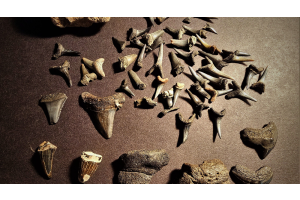
When researchers explore the fossil record, they often find themselves captivated by the wide variation in Megalodon teeth. These fossils allow insights into how this prehistoric shark lived, grew, and hunted. Among the wide range of specimens recovered, the exceptional Chile discovery provides an extraordinary example of size and preservation. It is often described as the world's biggest megalodon tooth, raising new questions about the upper limits of this ancient predator.
Growth, Age, and the Life Cycle of a Giant
Variation often begins with age. Like modern sharks, Megalodon replaced its teeth throughout life, producing smaller, less robust teeth during its juvenile years and much larger teeth as it matured. Fossil evidence shows that older individuals shed teeth significantly bigger than those of younger sharks, which helps explain why most specimens recovered today are smaller.
Larger teeth were less common in life and, therefore, less likely to survive through time. The Chile specimen demonstrates what could be achieved when a shark reaches its full maturity, showcasing how size reflects a long life in the ancient seas.
Shape Shifts Within the Jaw
Tooth size and form were also shaped by position within the jaw. Teeth at the front tended to be broader and larger, optimized for grasping prey, while those positioned further back became narrower and smaller, more suited for slicing and tearing. This functional diversity meant that even within a single jaw, there was significant variation.
Collectors and paleontologists often highlight this difference when analyzing specimens, because it helps reveal how the shark fed and how each part of the jaw played a role in its hunting strategy. The Chile tooth, with its impressive dimensions, would have belonged to a prime location within the jaw, reinforcing its dominance in predatory function.
Subtle Differences Between Individuals
Sex and individual variation also likely contributed to differences in tooth size. Although details remain under discussion, comparisons with modern sharks suggest that males and females may have produced teeth with subtle distinctions.
On top of this, natural differences between individuals—whether influenced by genetics, diet, or overall health—would have added another layer of diversity. Each fossilized tooth carries hints of these unique life histories, making every discovery part of a broader mosaic of variation across the species.
Nature’s Role in Shaping Fossils
Once a tooth was shed, it faced a new challenge: survival as a fossil. Natural forces could enhance or diminish its final form. Erosion and movement by water currents often left teeth chipped or broken before burial. Sediment conditions played a crucial role, as rapid burial helped protect the enamel and root, while unfavorable deposits could crush or distort the structure.
Over millions of years, mineral replacement and compaction sometimes caused shrinkage or subtle warping. These geological processes explain why so many teeth today are imperfect, damaged, or smaller than their original size. Against this backdrop, the Chile specimen appears even more remarkable for retaining its impressive dimensions and excellent preservation.
A Discovery That Pushes the Limits
The tooth unearthed on Chile’s rugged coastline has been described as one of the largest ever found. Its size alone places it among the rarest specimens, standing near the extreme upper range of what is known for the species. Such a scale is not merely impressive—it provides valuable data for refining scientific estimates of maximum body length.
The Chile specimen demonstrates how extraordinary growth could be achieved under the right conditions and shows how much the fossil record can still surprise us with discoveries that push boundaries. It reminds researchers that even when one encounters the world's biggest megalodon tooth, each measurement adds a crucial piece to the story of this legendary shark.
A Rare Case of Exceptional Preservation
Size is only part of the story. The Chile specimen is notable for the condition it has maintained over millions of years. Its enamel remains robust, its serrations are visible, and the root is intact. These features suggest it was buried quickly, spared from the abrasion and transport that destroy so many other fossils.
This preservation allows researchers to analyze the details with greater confidence, from the cutting edge of the tooth to the strength of its base. Such quality ensures that the tooth is more than a curiosity; it is a reliable piece of scientific evidence.
Chile’s Fossil-Rich Coastline
The geological setting of Chile is central to why such a remarkable fossil could be found. Coastal formations in the region are known for their abundance of prehistoric material, the result of ancient seabeds that have since been uplifted and exposed. This environment not only allowed sharks of extraordinary size to thrive but also created conditions where their remains could be preserved. The Chile specimen underscores the global range of Megalodon and emphasizes South America’s significance in understanding prehistoric marine life.
What This Tooth Teaches Science
The Chile tooth adds depth to scientific knowledge in several ways. Because it is both enormous and well preserved, it provides reliable measurements that can be used to refine body size estimates. Its serrations and enamel help scientists infer feeding behaviors, giving a clearer picture of how Megalodon interacted with its prey.
The location of the discovery expands understanding of the species’ distribution, showing that the southern Pacific played a crucial role in its history. In addition, the find encourages renewed study of other specimens, with the possibility that overlooked teeth might also represent extremes in size or preservation.
Why Most Teeth Will Never Match This Find
Despite its significance, the Chile specimen is an exception, not the rule. Most teeth that reach us today are smaller because they came from younger sharks or from jaw positions where smaller teeth developed.
Preservation rarely favors the largest specimens, as their size alone makes them vulnerable to breakage. Geological processes often reduce or distort fossils before they are discovered. This reality explains why discoveries of extraordinary size and condition remain rare, and why the Chile tooth is such an essential contribution to paleontology.
Closing Thoughts
Variation in Megalodon teeth reflects the interplay of biology, environment, and time. Most specimens are modest, worn, or damaged, leaving paleontologists with partial glimpses into the lives of these ancient predators.
The Chile tooth, however, presents a rare convergence of immense size and exceptional preservation, expanding the understanding of the species and reshaping perspectives on its accurate scale. As one paleontologist aptly noted, “Each tooth is a fragment of a giant’s story, and some fragments speak louder than others.” For now, the world's biggest megalodon tooth stands as a reminder that the ocean’s giants still have secrets waiting to be revealed.