

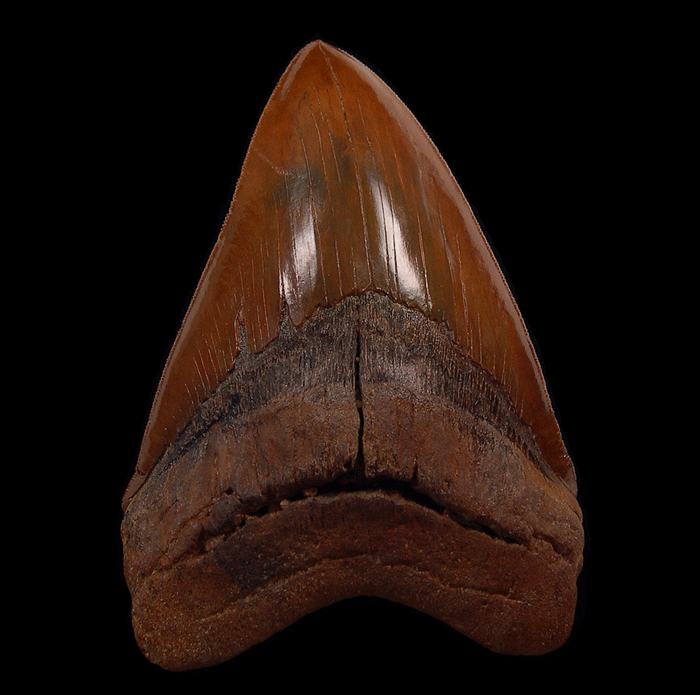
Picture this: a riverbank in North Carolina, early morning mist drifting across the water’s surface, and in our hands a tooth the size of a palm, gleaming with an otherworldly copper-red sheen. It’s heavy, sharp, and alive with history. For fossil enthusiasts who work with us, this isn’t simply any Megalodon tooth.
It’s a North Carolina Megalodon tooth, a fossil so rare and spectacular that it is often described as the “Holy Grail” of the collecting world.
The Copper-Red Glow That Captures Attention
What makes these teeth so admired starts with their breathtaking color. Only North Carolina’s Meherrin River copper-red site can provide the special combination of iron-rich sediment and fossilization conditions that form the brilliant copper-red hue. Over millions of years, these ancient shark teeth have absorbed minerals from the soil, changing their enamel into vibrant tones of red and brown that simply are not seen anywhere else.
Unlike the darker grays and blacks typical of Megalodon teeth from other localities, these pieces appear as though they have been brushed with metallic fire. Collectors instantly recognize this coloration as unique to the region, and it elevates even the most moderately sized tooth into a striking display piece.
Nature’s Preservation at Its Finest
North Carolina’s geological layers, coastal plains, and riverbeds have managed to preserve fossils with incredible detail. Teeth from the Meherrin River are admired for their pristine enamel, glossy finish, and sharp serrations that can still catch the light.
The bourlette, the dark band that sits between the crown and root, often remains intact, and the roots themselves are broad and complete. Each tooth tells a story through the remarkable details that have survived millions of years. These are not ordinary fossils; their preservation gives them an elegance that feels like something from a museum exhibit.
Scarcity That Fuels a Collector’s Passion
While Megalodon teeth from other regions can occasionally be found, copper-red Megalodon teeth from the Meherrin River are in a class of their own. The geological conditions that produce this copper-red color and impeccable preservation exist only at this site.
Because of this, these fossils rarely become available. When they do appear, such as the incredible specimens known as NC001, NC002, or NC003, they tend to sell almost immediately. Collectors watch trusted sources closely, knowing that waiting too long might mean losing their chance forever. This scarcity fuels passion and drives the desire to secure one of these exceptional fossils.
The Qualities That Make Them Shine
The brilliance of a North Carolina Megalodon tooth is not defined by color alone. The finest specimens carry a combination of features that collectors treasure. Many reach sizes over five inches, and some surpass six inches, offering a vivid reminder of the size and power of the Megalodon shark.
The serrations, incredibly, can still be sharp and defined, and the brown dentin strip, the bourlette, is usually visible and essentially complete. Roots remain heavy and unbroken, creating balance in the tooth’s triangular profile. Fossils like NC003, measuring 5-11/16 inches, or NC002, measuring 5-5/8 inches, are examples of what collectors hope to find. One exceptional North Carolina Megalodon tooth even retained serrations sharper than those of many modern shark teeth, proof of its incredible preservation.
Provenance That Builds Trust
The story behind these fossils makes them even more special. North Carolina’s copper-red teeth often come from long-established collections that are tied directly to the Meherrin River copper-red site. This locality is widely known for its exclusivity, and its teeth are considered the best of the best.
Unlike other famous sites like Bone Valley in Florida or Peru’s coastal fossil beds, the Meherrin River site is highly limited in access. Collectors appreciate that these teeth come with a clear, verifiable origin, which adds authenticity and value to each specimen.
Stories Encased in Enamel
There is something deeply compelling about holding a Megalodon tooth. These fossils carry millions of years of history. The Megalodon was one of the fiercest predators ever to live, capable of breaking whale bones with its immense bite force. When a collector holds one of these teeth, they have a piece of that narrative.
The stories these fossils tell are irresistible. Was the tooth shed during a hunt? Did it settle quietly into ancient sediment? These questions stir the imagination and transform the fossil into more than a simple collector’s item. It becomes a tangible piece of the prehistoric oceans.
Why Collectors Call Them the “Holy Grail”
These teeth have earned the title “Holy Grail” because they bring together qualities that are rarely seen in one fossil. The copper-red coloration is unlike any other, the preservation is extraordinary, and the scarcity only increases the excitement when a specimen surfaces.
Add in the exclusivity of the geological site and the clear provenance, and it’s easy to understand why owning one of these teeth feels like achieving the ultimate goal for collectors. Each tooth is more than a fossil; it is the centerpiece that anchors an entire collection.
The Thrill of the Find
Part of the allure of these teeth comes from the sense of adventure they inspire. Fossil hunting along North Carolina’s rivers and coastal plains can be an unforgettable experience. Finding a copper-red tooth is like striking paleontological gold. Even purchasing one from a reputable source carries a rush of excitement, knowing that the fossil now has a new chapter in its story.
The Collector’s Dream
North Carolina’s copper-red Megalodon teeth are more than fossils; they are extraordinary pieces of the Earth’s ancient past. They combine scientific importance, stunning natural beauty, and true rarity in a way few other fossils can.
Holding one connects a collector to the ancient oceans and the apex predator that once dominated them. These teeth are often seen as the ultimate addition to any collection, the fossil that tells the most powerful story and draws admiration from all who see it. That is why the North Carolina Megalodon tooth is often described as the “Holy Grail” of Megalodon fossils. Securing one is not simply acquiring a fossil; it is embracing a piece of history that will never lose its wonder.






