

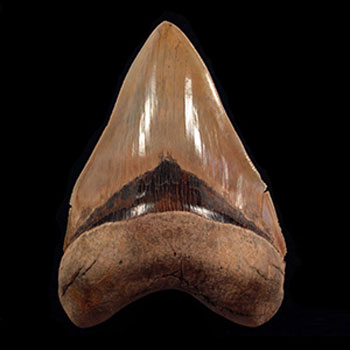
Few objects from Earth’s past have the power to command attention before a single word is spoken. A 6-to-7-inch Megalodon tooth is one of them. Massive, serrated, and millions of years old, it is the kind of relic that makes even seasoned fossil collectors pause in admiration. This is not simply a piece of ancient debris, it is a fragment of a predator that once ruled the oceans, a creature capable of crushing the bones of whales with a bite force of up to 180,000 newtons.
For collectors, this size range is not just a number on a ruler; it’s a meaningful distinction. It is a benchmark that represents the perfect intersection of rarity, history, and aesthetic appeal. These 7 inch Megalodon teeth for sale are pursued not just for their scale but for their ability to connect us to one of nature’s most formidable hunters.
And even within this elite category, only a small percentage of specimens reach what collectors and curators alike call “museum quality,” a distinction that signals the highest level of preservation, authenticity, and beauty.
Why the 6-to-7-Inch Range is the Collector’s Benchmark
Although Megalodon teeth can exceed seven inches in very rare circumstances, most that surface from rivers, ocean beds, and mine deposits are far smaller. Once a tooth reaches the six-inch threshold, it enters an elite class that comprises only a fraction of all recovered specimens.
The scarcity grows exponentially as size increases, with teeth between 6.5 and 7 inches becoming particularly prized. The odds are stacked against their survival; fossilization itself is rare, and over millions of years, teeth are subjected to currents, chemical erosion, and sediment abrasion.
The size of these teeth also speaks directly to the size of the animal they came from. A tooth of this magnitude likely belonged to a Megalodon that exceeded fifty feet in length, a predator that hunted whales, dolphins, and other large marine mammals. Holding such a tooth is to hold a direct, physical connection to a time when these massive sharks dominated the seas
What “Museum Quality” Really Means
In the world of fossil collecting, “museum quality” is not a casual compliment—it is an unofficial but respected standard that separates exceptional finds from the ordinary. Size alone is not enough to earn this label; the tooth must display a combination of superior preservation, minimal restoration, and strong visual appeal.
Preservation is key. A museum-quality tooth retains its original serrations, the fine cutting edges that can remain surprisingly sharp after millions of years. The root should be complete and structurally sound, with the blade free from major chips, cracks, or missing enamel. Minimal restoration is equally important.
Where the Giants Are Found
Large, well-preserved Megalodon teeth are not scattered evenly across the globe. They tend to appear in specific fossil-rich deposits, many of which are now either difficult to access or closed to collectors entirely. North Carolina is renowned for producing large teeth from phosphate mines and coastal dredging, often with excellent preservation.
The origin of a tooth often influences its desirability. Specimens from sites that are now restricted or depleted are especially valuable, not just for their condition but for their scarcity in the modern market.
The Collector’s Journey
For many collectors, owning a giant Megalodon tooth is the culmination of years of searching, whether in the field or through specialized fossil dealers. Some pursue the thrill of discovery themselves, diving in murky rivers or dredging offshore fossil beds in search of that one exceptional specimen. Others build relationships with trusted dealers who can source high-quality pieces from around the world.
Regardless of the method, the story behind the tooth often matters as much as the specimen itself. Knowing the conditions under which it was found, the region it came from, and the challenges involved in recovering it adds a personal dimension to ownership. It transforms the tooth from an inert fossil into a narrative-rich treasure.
Caring for a Prehistoric Treasure
Preserving the integrity of a 6- to-7 inch megalodon tooth for sale is crucial to maintaining its value and beauty. These fossils should be kept in stable conditions, away from extremes of humidity, heat, and direct sunlight, all of which can cause cracking or fading.
Handling should be minimal and careful, ideally by gripping the root rather than the blade. Displaying the tooth in a UV-protected glass case not only protects it from environmental damage but also enhances its presentation, allowing the fine details of the enamel and serrations to be appreciated without risk.
Many serious collectors rotate their display pieces periodically to minimize prolonged exposure to light and dust, treating them with the same care afforded to valuable works of art. This approach ensures that the tooth will remain as striking for future generations as it is today.
The Deeper Meaning Behind the Chase
Beyond financial value and scientific interest, these teeth speak to something fundamental in the human fascination with the past. They represent the raw power of nature, the vastness of geological time, and the enduring beauty that survives against the odds. In their presence, it is impossible not to imagine the immense creature that once wielded them or the ancient oceans it once ruled.
Owning such a specimen is, for many collectors, a way to connect personally with a world long vanished. It serves as a reminder that our planet’s history is far older and more dramatic than the brief period occupied by human civilization. A 6-to-7-inch Megalodon tooth is not just a fossil—it is a tangible link to a chapter of Earth’s story written in serrated enamel and mineralized roots.
Final Thoughts
The pursuit of a 6-to-7 inch megalodon tooth for sale is about more than acquiring an object, it is about seeking a perfect blend of size, rarity, and condition that captures the essence of a vanished giant. Museum quality marks the pinnacle of that pursuit, ensuring that the tooth is not only impressive in scale but also exceptional in preservation and presentation.
Whether displayed in the glass case of a major institution or the private study of a passionate enthusiast, our tooth fossil collection carries the same message: that nature’s history is vast, awe-inspiring, and worthy of preservation.
As long as that story continues to inspire, the pursuit of these prehistoric giants will remain one of the most thrilling endeavors in the world of fossil collecting.






