

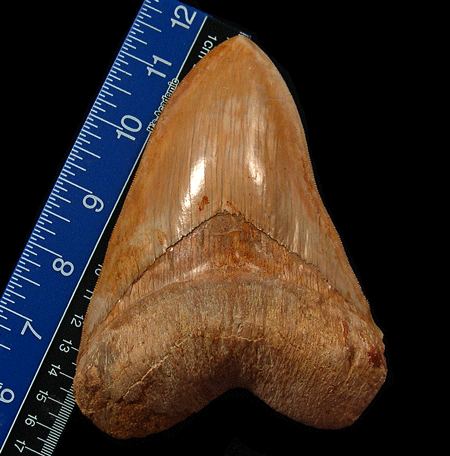
Beneath the waves of our modern seas lies the memory of a predator so immense that even the great white shark pales in comparison. The Megalodon, a giant among giants, was the undisputed sovereign of Earth’s oceans millions of years ago. Its sheer scale is not only captured in the fossil record but also in the relics it left behind—colossal teeth, each one a testament to the raw power and evolutionary mastery of this prehistoric apex hunter.
As enthusiasts, scholars, and admirers of the natural world, we are captivated by these extraordinary specimens not only for their scarcity but also for the knowledge they provide about ancient ecosystems. These teeth represent more than just fossilized remnants; they serve as historical records, composed of enamel and dentin, that chronicle the existence of a predator that influenced marine biodiversity. Amid this intrigue, a question naturally arises—what can the size of a megalodon tooth in centimeters reveal about the Earth’s distant history?
The teeth as measures of an ocean’s ruler
When we hold a Megalodon tooth in our hands, we are not merely holding a fragment of fossilized history; we are holding a scale model of ancient dominance. These teeth could reach lengths exceeding 18 cm—larger than an adult human hand. Even the smallest specimens, measuring around 7 cm, came from juvenile predators already capable of hunting formidable prey.
The difference in sizes tells us a story: smaller teeth speak of early life stages, revealing the nurturing nursery habitats where young Megalodons grew and thrived. The larger teeth, however, represent individuals at the height of their predatory powers, patrolling open waters with unmatched authority. This size spectrum provides us with a direct window into the life cycle of the species, and by extension, into the ecological balance of their time.
Unlocking the ocean’s ancient blueprints
Beyond their sheer size, these teeth help us reconstruct ancient marine environments. The prevalence of large teeth in certain fossil beds indicates regions where prey was abundant, suggesting prosperous and thriving oceanic ecosystems. Variations in size distribution across fossil sites reveal migratory patterns and nursery zones—critical pieces of the puzzle in understanding how the Megalodon shaped, and was shaped by, its habitat.
Furthermore, studying wear patterns and serration detail tells us about their feeding strategies. Larger teeth with blunted edges may have belonged to older sharks accustomed to tackling bigger, more robust prey. Smaller, sharper teeth likely belonged to younger individuals honing their hunting skills on swifter targets.
From predator to prized artifact
Today, these teeth have transcended their original purpose to become sought-after treasures for collectors worldwide. At Buried Treasure Fossils, we see each tooth not simply as a relic but as a physical narrative of life in an era when size dictated supremacy. The tactile weight of a Megalodon tooth connects us directly to a creature that swam our oceans over 3 million years ago.
Our collection includes specimens across the full range—from the modestly sized but perfectly preserved juvenile teeth to the massive, hand-sized crowns of mature predators. Each is a unique intersection of science, history, and art, offering our visitors a chance to engage directly with prehistory.
The craftsmanship of nature
When we look closely at a Megalodon tooth, we see the craftsmanship of nature at its finest. Every serration along the edge was honed by evolution to perfection, ensuring maximum efficiency in slicing through flesh and bone. The tooth’s curvature and thickness were engineered for a crushing bite force that may have exceeded 40,000 pounds.
This evolutionary design highlights the predator’s role in the marine food chain. It demonstrates how nature optimizes form to align with function—an engineering lesson that has developed over millions of years. Even in their fossilized state, these teeth maintain the sharpness and resilience that once made them essential for survival.
A timeline in enamel
One of the most remarkable aspects of megalodon teeth is their size, which can be measured in centimeters. Each size serves as a chronological record, reflecting different stages in the shark’s life. From their early years spent in sheltered coastal nurseries to their final years as dominant predators of the open ocean, each tooth size represents a distinct chapter in the megalodon’s life.
By assembling and studying these teeth, scientists can map population structures, track evolutionary changes, and pinpoint environmental shifts that may have contributed to the species’ eventual extinction. For us, this means that every specimen in our care is more than an object—it is a data point in a vast and still-unfolding story of Earth’s natural history.
Why size still matters
In the context of collecting, size continues to hold both scientific and aesthetic value. Larger teeth are rarer, making them particularly prized among enthusiasts. But even smaller specimens hold their allure; their rarity in specific locations can make them as valuable as their larger counterparts.
For our visitors, handling a large Megalodon tooth often sparks a visceral reaction. It’s not just about the measurement—it’s about the realization of standing in the shadow of a creature so formidable that its very existence redefined the term “apex predator.” In that moment, the abstract concept of prehistory becomes tangible and immediate.
Bridging the gap between past and present
Owning or even viewing a Megalodon tooth offers a personal connection to a world long vanished beneath the waves. These fossils bridge millions of years, bringing us face-to-face with a predator that shaped entire marine ecosystems.
In our collection, we strive to present each specimen not only as a collectible but as a chapter in Earth’s biography. Whether you are a seasoned collector or a first-time visitor, the experience of engaging with these fossils is one of awe, respect, and curiosity—qualities that remind us of our small place within the planet’s immense timeline.
Conclusion: Measuring the immeasurable
The size of a megalodon tooth, measured in centimeters, is not just a statistic; it represents a predator’s dominance, provides insight into the health of ancient oceans, and connects us to the deep past. Each tooth tells a unique story, from the nursery grounds where juveniles grew to the vast open ocean where mature giants ruled. As custodians of these artifacts, we regard them as both scientific treasures and pieces of natural art.
Exploring these teeth is not just about acquisition—it’s about embracing the enormity of Earth’s history and holding a piece of it in your hands. We invite you to discover this prehistoric legacy with us, to see for yourself how size can reveal the secrets of oceans long gone. Contact us today to experience the story of the Megalodon through its most iconic relics.






