

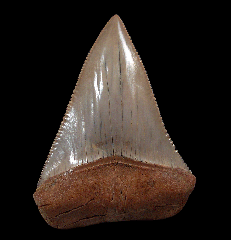
At Buried Treasure Fossils, we have the rare privilege of connecting our community to some of the most iconic relics of the prehistoric ocean — none more captivating than the fossilized Great White Shark tooth. These incredible remnants of a predator that has ruled the seas for millions of years are not only prized by collectors but also admired by marine enthusiasts and paleontology lovers alike. The Great White shark, known scientifically as Carcharodon carcharias, represents one of nature’s most formidable marine species. Although the modern Great White still patrols the world’s oceans, its fossilized teeth offer a glimpse into its ancient legacy and unmatched evolutionary power.
Let’s dive into the world of this majestic creature and uncover why so many people are fascinated by its fossil remains.
A Legacy That Spans Millions of Years
The story of the Great White shark begins around 16 million years ago. Evolutionary paths suggest that this fearsome fish likely evolved from the Mako shark lineage. Since then, the Great White has continued to thrive as an apex presence in our oceans.
One of the reasons we at Buried Treasure Fossils are so passionate about these creatures is the timeless nature of their remains. A fossilized Great White Shark tooth can span millions of years in age, offering a real and tangible link to a time when the oceans teemed with colossal predators.
Global Citizens of the Sea
Modern Great Whites inhabit all major oceans, from the chilly waters of the North Atlantic to the temperate coastlines of Australia. They favor coastal regions, making appearances near the shores of North America, South Africa, Japan, and even the Mediterranean.
South Africa's Dyer Island, often referred to as "Shark Alley," is perhaps the most famous Great White habitat. This region boasts the highest known population of Great Whites in the world. Despite their fierce reputation, these majestic creatures are essential to the marine ecosystem and continue to capture the fascination of researchers and explorers alike.
What makes them especially awe-inspiring is their versatility. While they are typically seen in shallower waters, they are known to venture into the deep ocean, showcasing their adaptability and endurance.
Power, Presence, and Precision
One cannot speak of the Great White shark without acknowledging its physical might. A fully grown adult can reach lengths of up to 20 feet and weigh around 4,000 pounds. The largest ever recorded weighed a staggering 7,328 pounds — a testament to the scale and strength of this marine titan.
But beyond size, the Great White’s biological abilities are just as impressive. Capable of swimming up to 35 miles per hour, these sharks use their speed and stealth to navigate vast stretches of the ocean. A single Great White consumes about 11 tons of food annually, and once it has eaten, it can go up to three months without another meal.
Their heightened senses are nothing short of remarkable. In addition to the traditional five senses, Great Whites possess electroreception — a special ability to detect the electrical fields produced by other living creatures. If close enough, they can even sense the heartbeat of potential prey. Their sense of smell is legendary; a Great White can detect a single drop of blood in the water from up to three miles away.
And their bite? It delivers a force equivalent to ten lion bites, cementing their place as one of the most powerful creatures in the animal kingdom.
Breaching the Ocean's Surface
Among the Great White’s most spectacular behaviors is breaching — the act of launching itself entirely out of the water. Some individuals have been observed leaping up to ten feet into the air. This sudden and dramatic burst of energy is not only a stunning sight but also another reason why this species continues to fascinate us.
At Buried Treasure Fossils, we are particularly captivated by how these physical feats have contributed to the shark’s survival over millions of years. Each fossilized Great White Shark tooth in our collection reflects that raw power and resilience, immortalized in stone.
A Lifetime in the Deep
Great White sharks are not fleeting visitors to the sea — they are long-term residents. It is believed that many of these sharks can live up to 70 years or more. Over such a long life, they travel vast distances, adapt to changing marine environments, and play a crucial role in maintaining ecological balance.
Their lifestyle is guided by instinct and evolutionary refinement. Great Whites are often more active just after dawn, taking advantage of low visibility conditions to thrive in their surroundings. These rhythms of nature are etched into the very enamel of their fossilized teeth, which we are proud to bring to light for collectors and enthusiasts.
Fossils as a Window to the Past
Fossilized shark teeth are among the most common vertebrate fossils found, but Great White shark teeth hold special significance. Their size, serrated edges, and elegant curves make them easily distinguishable. Each one is unique, shaped by age, location, and the geological conditions in which it was preserved.
At Buried Treasure Fossils, we believe these fossils do more than just appeal to collectors — they inspire curiosity and a deep appreciation for the natural world. Whether you are new to fossil collecting or a lifelong enthusiast, owning a fossilized tooth from such a legendary predator offers an unparalleled connection to Earth’s ancient history.
Experience the Wonder for Yourself
At Buried Treasure Fossils, we make it possible for you to experience this wonder firsthand. Discover the legacy of the Great White shark and connect with the powerful history of the oceans through our authentic collection.
Disclaimer: This blog is intended for informational purposes only. It does not encourage or endorse any unethical or illegal practices related to fossil collection. Please always adhere to local laws and regulations and practice environmental responsibility.






