

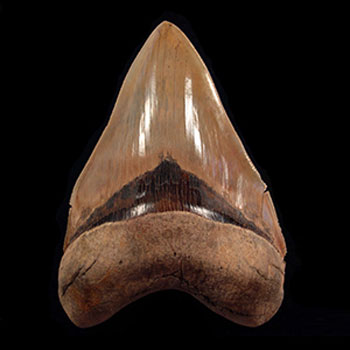
Some people find coins at the beach. Others might stumble on a lost flip-flop or the occasional angry crab. But every once in a while, someone strikes prehistoric gold. That’s exactly what happened when a man finds a Megalodon tooth and not just any tooth, but one so enormous and well-preserved that it made him question reality itself.
Imagine walking your dog, sipping your coffee, and suddenly spotting something poking out of the sand. You bend down, dust it off, and boom—you’re holding the fossilized weapon of a five-million-year-old ocean monster. Do you laugh? Do you panic? If you’re like this Florida man, you probably make a time travel joke and start wondering if you’ve just stepped into a portal to the past.
At Buried Treasure Fossils, we live for stories like this. Let’s dig deeper into what it really means when someone stumbles upon a Megalodon tooth and why these relics of the deep hold such awe-inspiring power.
The Megalodon: A True Ocean Titan
To appreciate the gravity of such a discovery, it helps to understand the creature behind the tooth. The Megalodon was not your average shark. This was an apex predator that reigned over Earth’s oceans millions of years ago. Think of a creature stretching nearly 60 feet in length with jaws capable of snapping whales in half.
It’s one thing to read about such a beast. It’s another to physically hold a part of it.
When you discover a Megalodon tooth, you're not just finding a fossil. You're making contact with a moment in time so distant it defies imagination. And that’s what makes this Florida man’s discovery such an exciting event for fossil lovers and beachgoers alike.
Why Is a Megalodon Tooth Such a Big Deal?
At Buried Treasure Fossils, we know the magic of Megalodon teeth comes down to four key elements: size, condition, color, and age. When all four align, you’ve got yourself something extraordinary.
The Florida man’s find checks all the boxes. It’s enormous, vibrantly colored, and shockingly well-preserved for something that has been buried under layers of earth and ocean for millions of years. Experts estimate this tooth is at least five million years old, a relic from the time when Earth looked vastly different.
But the most fascinating part? This tooth may be all that’s left of the Megalodon it belonged to. Since these sharks were made mostly of cartilage, their skeletons have not survived the test of time. Their teeth, on the other hand, are incredibly resilient. They’re like prehistoric daggers, forged by nature and sharpened by survival.
What Does It Feel Like to Hold Prehistoric Power?
Ask anyone who’s had the privilege of holding a Megalodon tooth, and they’ll tell you it’s a surreal experience. You feel a weight in your palm, both physical and symbolic. It’s not just a fossil. It’s a frozen fragment of time.
When this man finds a Megalodon tooth, he isn’t just holding a sharp object. He’s grasping something ancient, something powerful, something that once sat inside the mouth of a creature that ruled the oceans long before humans ever existed.
There’s a reason why so many people describe the moment as magical. It’s not just about the rarity or the size. It’s about being instantly connected to Earth’s wild, untamed past.
Where Stories and History Collide
What’s even more exciting about this Florida beach discovery is the ripple effect it creates. It turns an ordinary walk into a story worth retelling. One moment you’re enjoying the morning sun. The next, you’re on the news, showing off a fossilized tooth the size of your hand and joking about being a time traveler.
It’s the kind of moment that captures the imagination and fuels curiosity. At Buried Treasure Fossils, we believe that these stories remind us of the sheer wonder of the natural world. They spark questions. They inspire adventures. And sometimes, they completely change the way someone sees the world.
How Often Does Something Like This Happen?
While not an everyday event, Megalodon teeth have been discovered in several parts of the world, including coastal regions like Florida, the Carolinas, and parts of South America. But finding one by chance, in pristine condition, and right underfoot during a casual stroll? That’s the kind of serendipity that fossil lovers dream about.
It’s one thing to search for fossils. It’s another to have one find you.
And while it’s rare, it’s not impossible. The earth is always shifting. The tides are always moving. And every so often, they reveal something that has been hidden for ages.
Why These Teeth Matter to Us
At Buried Treasure Fossils, Megalodon teeth aren’t just artifacts. They’re bridges to the past. When someone finds one, especially in such a casual and unexpected way, it reinforces everything we love about what we do.
We don’t just deal in fossils. We celebrate discoveries. We cherish the moments when someone opens a box and gasps at the incredible piece of history they now hold. We understand that every tooth tells a story not just about the Megalodon, but about the person who finds it.
When a man finds a Megalodon tooth, we’re right there with him, imagining the thrill, the disbelief, the awe.
Final Thoughts: When the Past Finds You
You never know when history is going to reach out and tap you on the shoulder. Sometimes, it looks like an old coin. Sometimes, like driftwood. And sometimes, it’s a massive, razor-edged Megalodon tooth gleaming in the morning light.
So the next time you find yourself on a quiet beach or walking a familiar trail, keep your eyes open. Ancient wonders might be lying just beneath the surface.
And when you’re ready to bring a piece of prehistory into your own life, we at Buried Treasure Fossils are here to help you explore the world of ancient ocean predators, one incredible discovery at a time.
Ready to connect with prehistory?
Explore our exclusive collection of authentic Megalodon teeth and start your own fossil story today.
Disclaimer: This blog is intended for informational purposes only. It does not encourage or endorse any unethical or illegal practices related to fossil collection. Please always adhere to local laws and regulations and practice environmental responsibility.






