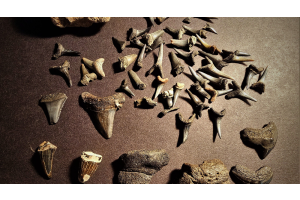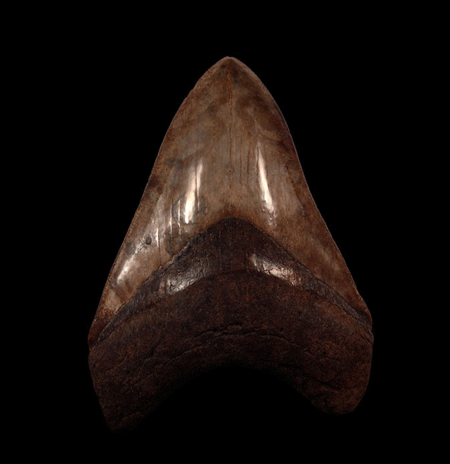
Few fossils inspire as much awe as a massive Megalodon tooth. These ancient remnants of Earth’s most powerful prehistoric shark captivate science-curious readers and collectors alike, and many visitors to our store often begin their journey by asking how to tell if a megalodon tooth is real—a question rooted in genuine passion for science and authenticity. At Buried Treasure Fossils, we share that same excitement, and one of the best ways to evaluate a specimen is by understanding the science behind fossilization itself. When you know what geological processes shape these teeth over millions of years, you can quickly learn how to tell if a megalodon tooth is real and distinguish authentic fossils from replicas with confidence.
How Fossilization Works: The Geological Story Locked Inside a Tooth
Long before a Megalodon tooth becomes a prized collectible, it undergoes a remarkable transformation. After the shark loses the tooth—which Megalodons did continuously throughout their lives—the tooth sinks into ancient seafloor sediment. Over time, layers of sand, silt, and clay bury it deeply. At this stage, oxygen levels drop, organic material breaks down, and minerals begin to seep into the tiny spaces within the tooth.
This long process, called permineralization, is at the heart of what makes fossil teeth so fascinating. Minerals such as phosphate, iron, manganese, and calcite gradually replace original biological material, reinforcing the tooth’s structure while altering its color and density. This natural mineral exchange not only creates a durable fossil but also leaves visual fingerprints that help collectors identify genuine specimens. When examined closely, these geological changes can reveal how to tell if a megalodon tooth is real.
Mineralization Patterns: Why Real Teeth Look the Way They Do
Collectors frequently notice that authentic teeth display rich variations of color—slate gray, jet black, sandy beige, or even streaks of mahogany or blue. These hues occur naturally as minerals bond with the tooth over millions of years. Because every location has a slightly different mineral profile, regional fossil beds produce distinct color signatures.
For instance, coastal rivers often yield darker teeth due to high levels of iron and manganese, while Miocene marine deposits may generate lighter or multicolored patterns. What matters for authentication is the irregularity: true mineralization is never uniform. A perfectly even color coating—especially one that looks glossy or artificial—is usually a red flag.
A keen eye for these mineral signatures helps collectors move beyond guesswork. When you understand how minerals infiltrate the tooth’s enamel and root, you can instantly rule out resin, plaster, or other composite materials commonly used in replicas. These materials lack the subtle depth and texture created by real geological processes.
Surface Texture: Nature’s Signature Through Time
Another hallmark of authenticity lies in texture. A real Megalodon tooth always tells a long geological story through tiny details: microscopic pits from sand abrasion, natural root porosity, and serrations softened by millions of years underground. These features collectively form a natural, weathered look that cannot be perfectly replicated.
Fake teeth often appear either too smooth or strangely polished. Their surfaces may show machine-cut edges or artificial scratch patterns meant to mimic age. But collectors who study paleo-textures often find that genuine alterations occur randomly, not uniformly. Even the finest restorations—common in high-grade teeth—preserve some natural irregularities that only true fossils develop.
Density and Weight: What Your Hands Can Tell You
Because fossil teeth undergo heavy mineralization, they tend to feel denser than their modern or artificial counterparts. The transformation from biological tissue to mineral matrix increases weight while preserving shape. When holding a real tooth, especially a large one, the heft often surprises beginners.
Fake teeth, particularly resin reproductions, may appear accurate in color and shape but feel noticeably light. This is where hands-on experience proves invaluable. Over time, collectors develop an intuitive sense of fossil weight relative to size, making it easier to spot inconsistencies.
One important reminder: weight alone is not definitive, but when combined with mineralization clues, surface texture, and serration patterns, it becomes a powerful diagnostic tool.
Blade and Serrations: Evolutionary Clues That Help Authentication
Megalodon teeth are known for their iconic triangular blades and serrated edges built for slicing through massive prey. These serrations, though ancient, are often still visible, especially on well-preserved specimens. Because serrations are a biological feature—not a product of fossilization—they provide direct, physical evidence of authenticity.
What should collectors look for?
● Serrations that run evenly along the blade
● Minor wear consistent with age
● Transitions between enamel and serrations that look seamless, not glued or carved
Replicas frequently miss these subtleties. Their serrations may be too perfect, too sharp, or too shallow. Some molds even duplicate serration defects repetitively across multiple fake teeth—something nature would never produce.
Root Characteristics: Where Many Fakes Fail
The root of a Megalodon tooth provides some of the strongest evidence of authenticity. Fossil roots often show nutrient foramina (small holes), natural pitting, and subtle cracks formed during mineralization. These details are hard to reproduce accurately because their formation depends on complex biological structures and geological processes.
The root is also where many counterfeiters attempt repairs or enhancements. A resin-filled root may feel smoother or look glossier than the surrounding fossil material. In contrast, natural roots exhibit consistent texturing that matches the geological signature of the enamel.
Color Zoning and Sediment Imprints: Hidden Clues From Burial Layers
During fossilization, sediment plays a crucial role. When collectors examine the base of a tooth, tiny sediment inclusions or matrix remnants often remain attached. These can help determine the locality where the specimen was found. Genuine fossils may display color zoning: a shift from one mineral layer to another, reflecting shifts in burial conditions over time.
Color zoning is difficult to imitate authentically. Replicas often show abrupt, unnatural color transitions, whereas natural transitions typically appear subtle and gradual.
Why Understanding Fossilization Helps You Spot Authentic Teeth
Knowing the science behind how real fossils form empowers collectors to make more informed choices. It also deepens appreciation for each specimen’s journey—from ocean floor to discovery. At Buried Treasure Fossils, we are committed to educating collectors because authenticity is the heart of fossil appreciation. When you confidently identify features created by real geological processes, you not only protect your investment—you also connect more deeply with Earth’s ancient history.
Conclusion
Understanding the mineralization patterns, geological changes, and natural textures found in fossilized shark teeth makes it far easier to recognize authenticity. This grounding in science allows collectors to know how to tell if a megalodon tooth is real, and we’re always excited to help science-minded enthusiasts explore further. If you’re wondering how to know if a megalodon tooth is real or want expert guidance in choosing verified specimens, we invite you to explore our collection, ask questions, and dive deeper into the prehistoric world with us. Your subsequent authentic fossil discovery may be just a conversation away—let us help you find it.