

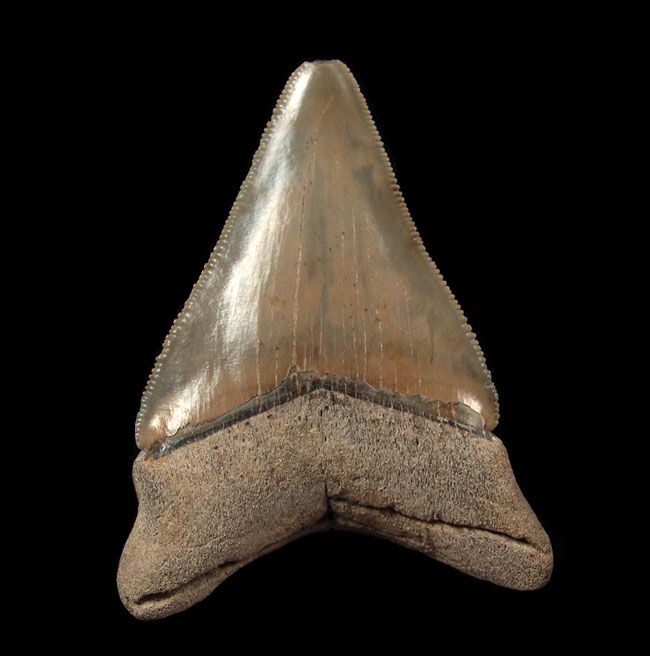
You spot it before you even know you’re looking for it. Past the glass cases lined with ammonites and the tidy rows of trilobites, there it sits—bigger than your fist, older than every human civilization combined, and radiating a confidence only a true rarity can own. You lean closer. The enamel has that impossible smoothness, the bourlette is dark and rich, and the serrations catch the light like they were sharpened yesterday. You don’t just want it—you feel it calling you. That’s the magnetic pull of an Aurora Megalodon tooth, and once you’ve seen one in person, you’ll understand why it’s the one collectors chase.
The Story Beneath the Surface
Every collector knows that Megalodon teeth aren’t exactly rare. Rivers, beaches, dive sites—they turn up worldwide. But the Aurora specimens? They’re different. They come from the Lee Creek Mine in North Carolina, specifically the Pungo River Formation. We’re talking about a geological layer from the Miocene Epoch, roughly 14.5 million years old.
That’s ancient ocean floor, locked away under just the right mineral conditions to create teeth with preservation that borders on miraculous. The colors alone—warm tans, sunlit golds, deep browns—make them stand apart. And when a tooth combines that coloring with symmetry, an intact bourlette, and untouched serrations, you’ve found something other collectors will envy.
Why Aurora Is a Collector’s Status Symbol
In fossil circles, the word “Aurora” carries weight. You could be halfway across a convention hall, overhear someone say it, and know instantly they’re talking about Lee Creek finds. The mine’s closure to public collecting years ago turned these teeth from exciting discoveries into finite treasures.
That scarcity is more than just a number. It means that every single Aurora tooth in private hands is part of a closed club. No new ones are coming from the source, and that sense of finality fuels the collector’s drive. When you own one, you’re not just buying a fossil—you’re holding a piece of a site that’s now off-limits forever.
Bigger Isn’t Always Better
It’s easy for new collectors to get swept up in size. A six-inch Megalodon tooth looks dramatic in photos, but veteran collectors know the real prestige comes from condition. In the Aurora world, perfection is balance: flawless enamel, deep bourlette color, even root lobes, and serrations sharp enough to make you pause.
A four-inch lower-jaw tooth with every detail intact will outshine a larger one with chips, repairs, or weathering. And unlike mass-produced collectibles, there’s no “just get another one” when it comes to Aurora. Every piece is unique.
Anatomy of an Exceptional Aurora Tooth
The difference between a good tooth and a grail-worthy one is all in the details. Elite collectors look for:
● Color contrast that makes the bourlette stand out from the enamel
● Symmetry across the crown and root lobes
● Complete bourlette without fading or erosion
● Serrations that remain sharp and evenly spaced
● Root condition with minimal hydration cracks and that distinct Aurora texture
● No repair or restoration, keeping the tooth fully authentic
When all of these align, the value isn’t just in the price tag—it’s in the way the tooth commands attention from anyone who sees it.
The Collector’s Hunt
Ask any serious fossil hunter, and they’ll tell you that the chase is half the thrill. Scanning dealer tables, scrolling through listings, comparing photographs—it’s an adrenaline loop. And when it’s an Aurora you’re after, patience is the currency. The best ones don’t appear often, and when they do, they rarely linger unsold.
For competitive collectors, there’s a satisfaction in securing the piece others missed or hesitated over. It’s not just ownership—it’s victory.
Market Trends and the Aurora Advantage
From an investment standpoint, Aurora teeth have a track record most collectibles would envy. Limited supply plus high demand is a simple formula for stability, but these fossils offer something more: provenance. Knowing exactly where and when a specimen was collected—especially from a famous site—gives it a credibility that generic finds can’t match.
Add to that the rising global interest in paleontological collecting, and Aurora teeth are likely to remain highly sought after for years to come.
Displaying an Aurora Masterpiece
An elite specimen deserves more than a dusty shelf. The right display not only protects your investment but also elevates its presence. UV-protected cases can preserve the colors for decades, while soft LED lighting brings out the enamel’s natural glow.
Some collectors prefer acrylic stands that allow the tooth to “float” visually. Others go for shadow boxes with descriptive plaques, turning the display into a mini-museum exhibit. Either way, the goal is to make sure the piece tells its story at a glance.
Caring for Your Prize
These teeth have survived millions of years, but they’re still vulnerable to the wrong conditions. Avoid direct sunlight, extreme humidity, and fluctuating temperatures. When handling, gloves are ideal to prevent oils from your skin from dulling the surface over time.
While it’s tempting to pass it around at gatherings, think twice—one slip and you could lose more than just value.
The Psychology of Owning the Grail
In collecting, certain pieces change the way you see the rest of your collection. An Aurora Megalodon tooth does precisely that. Once it’s in your possession, the bar is forever higher. Other acquisitions are compared to it, measured against its quality and rarity.
It’s not about overshadowing the rest of your fossils—it’s about having that crown jewel, the one you pull out when someone asks, “What’s the best thing you own?”
How We Help You Land the Right One
We understand that not all Aurora teeth are created equal. Our network allows us to source specimens that meet the highest standards of preservation and authenticity. Every piece is inspected, documented, and described with the detail a serious collector demands.
When you work with us, you’re not guessing—you’re getting a fossil that’s been chosen because it’s worthy of being in a top-tier collection.
The Moment That Seals It
Picture the scene: you’re at home, unwrapping a package that’s heavier than you expected. The last layer of protective wrap comes off, and there it is. The colors are even richer in person, the serrations sharper, the root texture exactly as described. You’re holding millions of years of history in your hands, and it’s perfect. That’s the feeling an Aurora delivers.
Closing Thoughts
An Aurora Megalodon tooth isn’t just another addition to a fossil shelf—it’s a piece that shifts your entire collection’s center of gravity. It carries the story of an ancient predator, the signature of a legendary site, and the kind of rarity that sparks competition among the most seasoned collectors.
When you finally own one, you’re not just buying a fossil. You’re claiming a deep-sea grail, the one others talk about when they think you’re not listening. And if you’ve been waiting for the right time, here’s the truth: the best Auroras don’t wait for you. They go to the collector who’s ready.






