

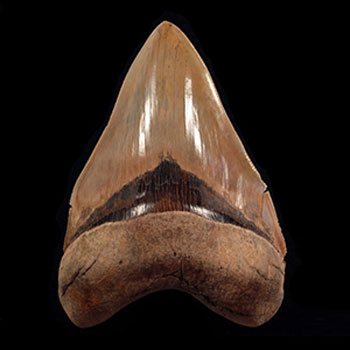
For centuries, mysterious fossilized objects washed up on shores and emerged from rocky cliffs, sparking endless speculation. Some believed they were remnants of mythical beasts, others thought they were celestial fragments fallen from the moon. Among the most captivating of these relics is the real megalodon tooth, a specimen that bridges folklore with science and continues to fascinate collectors and researchers alike. As our understanding grew, these fossils transformed from misunderstood curiosities into powerful evidence of one of the ocean’s most extraordinary predators.
The First Misunderstandings: Dragon Tongues and Mythical Beasts
Long before marine science existed as a formal discipline, natural historians and villagers alike tried to make sense of unusual stone objects. Large fossil teeth, often discovered in Europe and Asia, were frequently interpreted as “dragon tongues.” Their triangular, serrated shape lent itself to comparisons with mythological creatures. In medieval times, these fossils were worn as protective charms, believed to hold magical powers that could ward off poisons or evil spirits.
In the grand halls of aristocratic estates, it was quite common to find these remarkable teeth elegantly showcased in ornate cabinets of curiosity. Here, nobles and avid collectors proudly displayed them as captivating tokens of the natural world's mysterious splendor. At that time, the notion that these formidable relics once belonged to a colossal shark, gliding through the ancient, uncharted oceans of Earth millions of years prior, was a concept that eluded the imagination of all who gazed upon them.
A Turning Point in the 17th Century
The leap from superstition to scientific recognition came in the 1600s. Danish naturalist Nicolaus Steno, a pioneer in anatomy and geology, studied these fossilized teeth carefully. In 1666, after dissecting a modern shark head, he made a groundbreaking connection—the fossilized specimens resembled shark teeth in structure and design. His conclusion was bold for the time: these so-called “dragon tongues” were in fact the teeth of ancient sharks.
Although Steno’s insights were not widely accepted immediately, they planted the seed for a scientific revolution. His work shifted the narrative from mythology toward a framework of natural history. This marked the beginning of the journey that would eventually identify the true origins of the real megalodon tooth.
The 18th and 19th Centuries: Naming the Giant Shark
As natural sciences matured in the 18th and 19th centuries, paleontologists began piecing together the story behind these fossils. By comparing them with modern shark teeth, scientists deduced that the ancient owner must have been vastly larger.
In 1835, Swiss naturalist Louis Agassiz officially named the species Carcharodon megalodon, meaning “giant tooth.” This classification highlighted not only the immense size of the shark but also the critical role its fossilized teeth played in reconstructing its existence. Scientists realized that sharks, being cartilaginous, left little behind after death except for durable teeth and occasional vertebrae. Without these teeth, the very idea of Megalodon might never have come to light.
By the mid-19th century, paleontologists could confidently state that Megalodon was an apex predator, dwarfing even the largest modern great whites. Their research helped build the foundation for modern marine paleontology.
Fossil Evidence and Global Distribution
One of the most exciting revelations about Megalodon teeth is their widespread discovery. From the coastal cliffs of Europe to the riverbeds of North America, from the sands of South America to the depths of Asia, these fossils have been unearthed on nearly every continent. Their abundance underscores the global dominance of this prehistoric shark.
Sharks shed thousands of teeth during their lifetimes, and Megalodon was no exception. Some teeth measure over seven inches in length—an awe-inspiring reminder of the shark’s size and power. Each real megalodon tooth serves as both a collector’s treasure and a vital scientific clue about marine ecosystems millions of years ago.
Modern Marine Science: Reconstructing a Prehistoric Predator
With advancements in paleontology and marine biology, scientists have been able to reconstruct much of Megalodon’s life history. Bite marks on fossilized whale bones reveal how this predator attacked massive prey. Studies of tooth morphology demonstrate serrated edges designed to slice through blubber and bone.
Today, computer models and bite force simulations estimate Megalodon could exert pressures up to 180,000 newtons—enough to crush almost anything in its path. Combined with body length estimates of up to 60 feet, these findings establish Megalodon as one of the most formidable predators in Earth’s history.
Cultural Fascination and Collecting Today
Beyond science, Megalodon continues to capture popular imagination. Its teeth are prized by fossil collectors, historians, and enthusiasts. Holding one is like holding a piece of time, a tangible fragment of a predator that dominated the seas millions of years ago.
At Buried Treasure Fossils, we share in this passion. Since 2000, we have made it possible for both beginners and seasoned collectors to access authentic fossils, including extraordinary Megalodon teeth. Our catalog spans everything from budget-friendly specimens under $50 to museum-grade pieces that inspire awe. Every fossil we offer comes with authenticity guaranteed, making the collecting experience both exciting and trustworthy.
Why Authenticity Matters
In a marketplace where replicas and fakes sometimes circulate, owning a real megalodon tooth carries unmatched value. Authentic fossils are not just collectibles—they are scientific artifacts that tell a story millions of years in the making. That’s why we emphasize legality, quality assurance, and detailed provenance for every specimen we present.
For history buffs and marine science readers, authenticity ensures that the fossil in your collection truly connects you to Earth’s prehistoric past. Whether it’s a massive seven-inch specimen or a smaller, beautifully preserved tooth, each piece carries unique educational and historical significance.
Beyond Megalodon: A Fossil Catalog to Explore
While Megalodon teeth remain a highlight, our offerings go far beyond. We present dinosaur fossils such as T. rex and Triceratops teeth, ammonites with dazzling natural patterns, trilobites preserved in remarkable detail, and even rare penguin skulls. Each fossil is selected not only for its quality but also for its ability to inspire curiosity and wonder.
By including detailed educational context with each listing, we make sure that every fossil isn’t just a purchase—it’s a journey into prehistoric life. For us, sharing the beauty of fossils is about more than collecting; it’s about sparking imagination and helping others connect with deep time.
Conclusion: A Timeline Written in Stone
The story of the real megalodon tooth is a story of transformation—from dragon tongues and myths to scientific evidence of Earth’s largest shark. Each fossil discovered brings us closer to understanding the power, scale, and mystery of the oceans millions of years ago.
At Buried Treasure Fossils, we feel privileged to share these incredible pieces of history with you. Whether you’re a first-time collector or a lifelong enthusiast, there’s something truly unforgettable about holding a Megalodon tooth in your hand. Explore our carefully curated collection today and let a piece of prehistory inspire your imagination and enrich your collection.






