

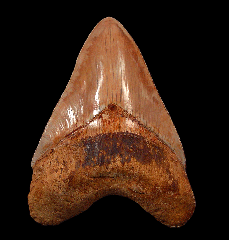
The mysteries of Earth’s ancient seas rarely arrive in complete form. Instead, they appear as fragments—sharp, mineralized memories hidden in riverbeds, cliffs, and deep-sea sediments. Within the first handful of these discoveries are clues that shape entire scientific stories, including those drawn from the legendary megalodon shark tooth we uncover through our work at Buried Treasure Fossils, along with the rare Megalodon shark teeth collectors treasure today.
The Story the Ocean Forgot
Long before humans mapped coastlines or imagined the deep, the oceans were ruled by giants. Among them was the prehistoric Megalodon, a shark so massive that its shadow would have stretched the length of a school bus. Yet, astonishingly, nearly all physical evidence of its existence has vanished. Because sharks are mostly cartilage, their bodies dissolve long before fossilization can occur. What remains are their teeth—millions of them—each acting like a time capsule.
We’ve spent decades helping collectors and young scientists discover authentic fossil specimens, and nothing sparks awe quite like holding a Megalodon tooth for the first time. These fossils are more than relics; they are scientific instruments, carrying information about size, diet, migration, and even ancient ocean temperatures. Scientists use these fossils to rebuild the world that this apex predator once ruled.
Teeth as Blueprints of an Ancient Giant
One of the most exciting aspects for STEM learners is that a single tooth can reveal the size of the entire animal. Because tooth dimensions scale proportionally with total body length, researchers use equations based on modern sharks to estimate Megalodon’s size. A tooth over six inches—something we proudly offer in our catalog—suggests an animal around 50 to 60 feet long.
Seeing these enormous teeth up close is a revelation. Their serrated edges resemble prehistoric saw blades, designed for slicing through whale bone. Their triangular shape and thickness hint at the bite force—nearly 180,000 newtons—required to hunt massive prey. That’s ten times the power of a Great White. To a budding marine scientist, this is not just impressive; it’s a clear demonstration of how form directly mirrors function in evolution.
Mapping Ancient Migration Routes
But size is just the beginning. Scientists also study tooth chemistry—specifically oxygen isotopes preserved in the enamel—to understand where these giants traveled. The oxygen signature depends on the water temperature in which the shark lived. Warmer water leaves a different chemical fingerprint than colder water.
By analyzing dozens of teeth from different locations, researchers can trace the routes Megalodon followed during feeding seasons or migrations. Some discoveries show that young Megalodons stayed in shallow, protected nurseries, similar to modern sharks. Others reveal long-distance travel patterns across prehistoric oceans, with teeth found from Chile to California, Morocco to the Southeast United States.
We are truly excited to support collectors in exploring the captivating stories behind our diverse collection of teeth. Each piece is carefully sourced from amazing locations like Florida’s sunny beaches, Peru’s vibrant landscapes, Georgia’s picturesque views, and the iconic Sharktooth Hill in California. Every tooth carries a unique tale, echoing the secrets of the oceans it once belonged to and reflecting the rich history and lively ecosystems of the sea. Join us on this incredible journey of discovery!
Fossils as Climate Time Machines
One of the most mind-stretching scientific uses of shark teeth involves paleoclimate reconstruction. The same oxygen isotopes that reveal migration also indicate water temperature at the time the tooth formed. This allows scientists to compare prehistoric climates across eras such as the Miocene and Pliocene.
By examining patterns in thousands of teeth, paleontologists can determine whether oceans were warming or cooling, how currents shifted, and how ecosystems adapted. For young STEM enthusiasts, this is a powerful lesson: fossils are not just old—they are active instruments for studying Earth’s climate system.
When we handle and prepare specimens, we always keep this scientific context in mind. Every item we provide carries its own piece of Earth’s environmental history, waiting for curious minds to decode it.
Rebuilding Lost Ecosystems
Teeth also reveal what Megalodon ate. Broad, robust teeth indicate a diet heavy in marine mammals. Fine serrations show the ability to slice through flesh quickly. And bite-marked whale bones—some found with deep, crescent-shaped cuts—confirm Megalodon’s role as the apex predator of its time.
Because Megalodon lived across multiple continents and warm oceans, its fossils give researchers incredible insight into ancient food webs. In many coastal regions, scientists have pieced together entire ecosystems using only teeth and partial jaw fragments from different species.
At Buried Treasure Fossils, we regularly work with collectors who want specimens from a specific locality because it represents a unique ancient habitat. Whether it’s a tooth from a shallow nursery region or from a deep-water hunting ground, each fossil tells a different chapter of ocean history.
From Discovery to Display: Why Collectors Love Megalodon Teeth
For young scientists, collectors, educators, or anyone with a fascination for the ancient world, Megalodon teeth hold irresistible appeal. Their sheer size makes them unlike any other fossil in existence. Their durability means they can remain intact for millions of years. And their scientific value makes them perfect tools for teaching evolution, adaptation, geology, and paleobiology.
We offer entry-level pieces for new collectors, museum-grade specimens for investors, and a wide range of localities and colors that reflect the conditions under which each tooth fossilized. Some are jet black from riverbed minerals, others rust-orange from iron-rich sediments, and some shimmer with colorful hues found only in unique coastal deposits.
STEM students especially love comparing teeth of Megalodon ancestors—Chubutensis, Angustidens, Auriculatus—and tracking how adaptations shifted over time. Each fossil becomes part of a much larger evolutionary puzzle.
The Wonder of Holding Ancient Oceans in Your Hands
Imagine opening your palm and seeing a structure once inside the jaw of a 60-foot shark. Imagine realizing that this tooth traveled through millions of years, surviving geological shifts, mass extinctions, and ancient sea changes. It is both a scientific artifact and a piece of art created by nature itself.
This is why we are so passionate about sharing authentic fossils. Every time someone purchases a specimen from us, they are not just buying an object—they’re bringing home a piece of deep time, a window into oceans long erased.
Conclusion: Carry the Story Forward
In the end, each megalodon shark tooth teaches us how to read the past—how to measure ancient giants, map forgotten seas, understand prehistoric climates, and rebuild complex marine ecosystems. These fossils inspire curiosity, fuel scientific imagination, and remind us how much of Earth’s story still lies buried, waiting to be rediscovered. If you’re ready to explore these ancient worlds for yourself, we’d love to help you begin or grow your collection. There’s an entire ocean of prehistoric stories waiting for you to uncover, one fossil at a time.






