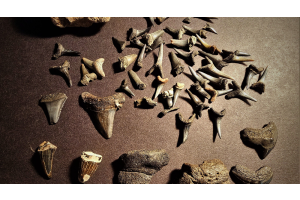
Few prehistoric animals captivate our imagination quite like the gigantic predator that once ruled the oceans millions of years ago. This remarkable ancient shark fascinates both scientists and fossil enthusiasts, not only because of its enormous size—believed to reach lengths of over 60 feet—but also due to the significant legacy it left in the form of its fossilized teeth. These extraordinary remnants, each serving as a testament to its incredible strength and presence, provide more than just scientific knowledge; they represent the awe and magnificence of an era when this mighty hunter dominated the seas. Through these extraordinary remains, the captivating story of the megalodon continues to resonate, inviting us to explore the depths of our planet’s prehistoric past.
The prehistoric apex predator
At an estimated length of up to 60 feet, this colossal shark dominated the seas between 23 and 3.6 million years ago. With jaws strong enough to crush bone and teeth that could reach over seven inches in length, the predator sat at the very top of the marine food chain. While no complete skeleton has ever been recovered—cartilage simply does not fossilize well—the discovery of fossilized teeth allows us to piece together both the sheer scale and the predatory dominance of the megalodon.
Fossilized teeth: Nature’s time capsules
The fossilized teeth that remain today are more than just remnants of an extinct animal; they are time capsules that connect us directly with Earth’s deep history. Their mineralized enamel, serrated edges, and often impressive size offer clues to feeding patterns, evolutionary adaptation, and even ancient oceanic environments. Collectors and scientists find themselves equally fascinated, because each tooth tells a story about the creature that once wielded it.
These teeth are also among the most durable fossils known to exist. Their resilience is why we can still hold a genuine tooth millions of years after it fell to the ocean floor. The durability of enamel, combined with the unique conditions of sedimentary burial, created an environment that preserved these relics with extraordinary clarity.
Why collectors treasure authentic specimens
Beyond their scientific value, fossilized megalodon teeth are highly sought after by collectors. They carry a certain mystique—part artifact, part natural treasure. Some collectors focus on perfect serrations, while others value unique coloration caused by the minerals of the burial site.
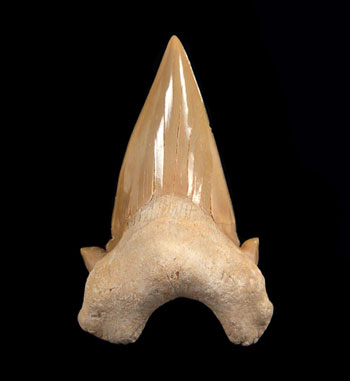
For example, a large, gray-colored tooth from South Carolina stands out not only for its size, but also for its remarkable condition. This specific tooth features strong enamel, minimal damage, a strikingly preserved bourlette, and a complete root. With serrations still evident, despite some natural wear, this specimen embodies everything collectors hope for in an authentic fossil. Holding such a piece is more than a purchase—it’s like having a piece of the ocean’s greatest predator in the palm of your hand.
The role of geography in fossil coloration and condition
What makes megalodon teeth so visually striking is the diversity in their appearance. Depending on where the fossil was found, the coloration can range from deep black to hues of blue, gray, or even reddish tones. For instance, coastal riverbeds in the southeastern United States are known for producing teeth with bold, dramatic colors that enhance their appeal to both collectors and researchers.
South Carolina, in particular, is famous for yielding spike-like anterior teeth that highlight the precision and adaptability of the shark’s bite. These geographic differences remind us that each fossil is unique—no two teeth are the same.
The science behind authenticity
With the increasing popularity of fossilized teeth, ensuring authenticity has become more critical than ever. Genuine specimens show hydration cracks, natural wear on the serrations, and mineralized textures that cannot be artificially replicated. An authentic tooth carries the reassurance that it is not a restored or manufactured replica, but a genuine relic of the megalodon’s reign.
Collectors are advised to look for key signs: enamel quality, bourlette preservation, serration sharpness, and root integrity. When these align, the result is not just a fossil but a prized possession that links us directly with prehistory.
Our passion for fossils
At Buried Treasure Fossils, we take pride in offering specimens that tell a story of survival spanning millions of years. Our collection highlights not only the scale of the ancient predator but also the artistry of nature in preserving its legacy. Each fossilized tooth we provide comes with a guarantee of authenticity, giving collectors peace of mind while fueling their passion for natural history.
The legacy lives on
The megalodon may have vanished from the seas long ago, but its presence endures through every fossilized tooth that is unearthed. Each specimen represents a fragment of the giant’s story—its immense size, its dominance in ancient oceans, and its role as one of nature’s most formidable predators. Fossilized teeth are not mere curiosities; they are enduring symbols of a world that existed long before ours.
Through these extraordinary discoveries, the shark’s legacy continues to inspire wonder in collectors, scientists, and enthusiasts alike. The fascination is not just about studying an ancient predator—it’s about connecting with a time when the oceans were ruled by something almost beyond imagination.
Conclusion: The story in every tooth
Every authentic fossilized tooth carries the spirit of the past into the present, keeping alive the memory of a predator that once defined the oceans. For collectors, researchers, and anyone captivated by natural history, these fossils are far more than collectibles—they are treasures of deep time.
The megalodon may be gone, but its story continues with every discovery, every collector’s display, and every fossil passed from one generation to the next. If you are ready to explore this legacy and hold a piece of history for yourself, contact us today to discover more about extraordinary fossilized teeth and their enduring connection to one of Earth’s greatest giants.