

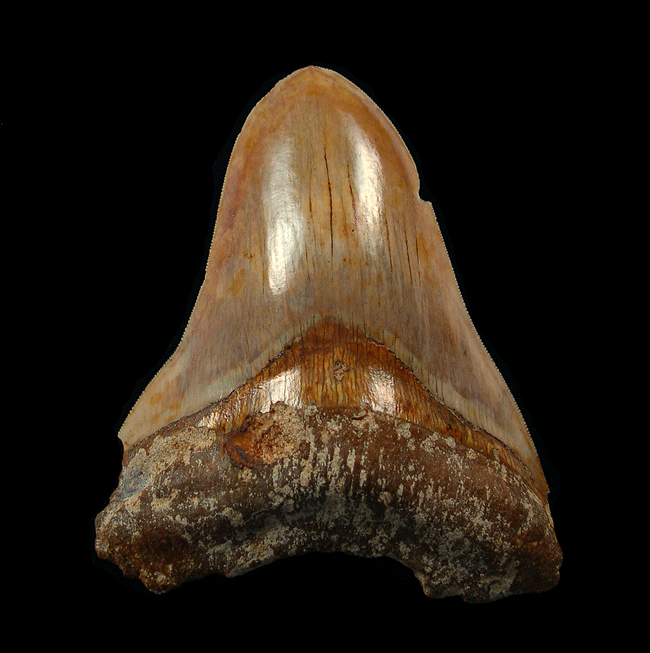
When we uncover a truly massive Megalodon tooth, it can spark excitement for us as collectors and researchers alike. One of the most prominent megalodon teeth we have examined, discovered in West Java, Indonesia, is giving our work new insight into how large Carcharocles megalodon may have grown.
This rare specimen is not only extending the known range of tooth size but is also encouraging us to re-examine established ideas about prehistoric shark dimensions.
A Premier Fossil from West Java
The tooth, listed as IN63, was recovered from limestone deposits in West Java and measures approximately 3 11/16 inches (~9.4 cm) in slant height. While it is smaller than the record-breaking seven‑inch specimens, its condition and features are remarkable. The enamel has retained a glass‑like finish, the serrations remain sharp and intact, and the color combination of tan crown and red‑brown bourlette stands out. No restoration or repair has been applied, although slight root erosion can be seen, which is typical for fossils from this location.
This specimen has been preserved in a unique sedimentary environment. Being buried in limestone has helped the enamel remain in exceptional condition, and the serrations are unusually long, in some cases extending onto the root. This consistent pattern across Indonesian examples is providing valuable information about local preservation conditions and tooth morphology.
Why This Tooth Matters
Size continues to play a critical role in reconstructing Megalodon biology. Even though IN63 is under four inches, it still indicates the presence of large adults in regions where fewer specimens have been documented. Each huge tooth can add to the dataset used to estimate overall shark length. Because body size projections rely heavily on tooth measurements, finds like this can suggest that Megalodon may have reached greater lengths in certain regions than previously calculated.
Indonesian specimens such as IN63 are pointing toward a local population capable of producing teeth of notable size and exceptional condition. This may reflect environmental differences or prey availability that could have influenced growth patterns.
Reassessing Size and Bite Force Models
Current reconstructions often estimate Megalodon at around 60 feet in length, with bite forces ranging between 108,500 and 180,000 newtons. These calculations are typically based on modern shark scaling and tooth dimensions. The elongated serrations on West Java teeth, however, are prompting new considerations for functional analysis. If these serrations extended the effectiveness of a bite, they could have allowed for more efficient feeding strategies, possibly adapted to specific prey types in the region.
Well-preserved morphology in specimens like IN63 is offering a basis for refining how tooth shape and serration length are factored into bite mechanics. Understanding these relationships helps to clarify how different Megalodon populations may have interacted with their environments.
Regional Variation in Megalodon Size
The West Java site has been producing a steady stream of high‑quality teeth at impressive sizes. This is particularly noteworthy because fossil yields from historically productive sites—such as Chile, Peru, and specific U.S. locations—have declined in recent years. The Indonesian finds are giving researchers fresh material to study Megalodon distribution and size variation.
These discoveries suggest that growth limits may not have been consistent worldwide. Environmental factors like water temperature, prey density, and habitat conditions could have supported larger individuals in some regions. The West Java fossils are prompting a reassessment of earlier models that were based on narrower geographic samples.
Average Versus Maximum Growth
Many size estimates have focused on averages, often placing typical Megalodon length at around 10.5 m (~34 feet), with maximum sizes between 14 and 20 m. However, specimens like the IN63 are broadening the known size range. Even without approaching the largest megalodon tooth ever recorded, these examples are credible indicators that enormous individuals were not uncommon.
When fossil evidence shifts the extremes of a data range, researchers are encouraged to consider whether earlier figures underestimated the actual growth limits. The West Java specimens are reinforcing the importance of integrating geographically diverse finds into size assessments.
Ecological and Behavioral Context
Large teeth are evidence of a predator capable of targeting substantial prey. The structure and preservation of IN63—with complete enamel, intact serrations, and a robust root—suggest a shark built for immense biting force. This fits the established view of Megalodon as a hunter of whales and other large marine mammals, able to pierce bone and thick flesh.
If the size indicated by these Indonesian specimens represents actual body proportions, then the waters of West Java during the Late Miocene to Pliocene supported an ecosystem capable of sustaining one of the ocean’s most formidable predators.
A Fossil That Reshapes Assumptions
The IN63 Megalodon tooth is serving as more than a collector’s item—it is a tangible piece of evidence that is challenging earlier perceptions of maximum shark size. While it does not surpass the largest known specimens, its discovery in a region with a growing record of substantial finds points to a possible concentration of large individuals in Indonesian waters.
Such evidence highlights the importance of continuing to examine new fossil sites, as each well-preserved tooth has the ability to refine knowledge of growth patterns, feeding adaptations, and the ecological role of prehistoric sharks.
Final Thoughts
The West Java specimen is adding weight to the argument that Megalodon's size was not strictly limited by earlier estimates. Its dimensions, preservation, and distinctive serration pattern are encouraging a closer look at how environmental conditions may have influenced the growth of this giant shark.
Each discovery like IN63 is enriching the fossil record and encouraging a rethinking of established models—reminding researchers that the story of the largest megalodon tooth ever found is still evolving, one remarkable tooth at a time.






