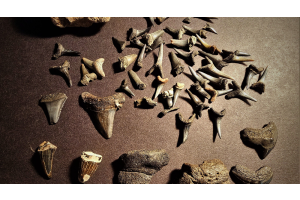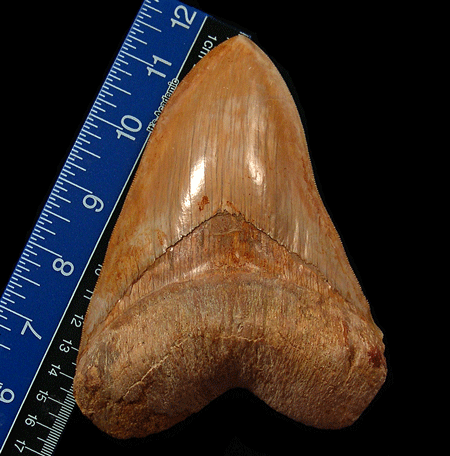
Some fossils inspire curiosity, and then there are fossils that command awe. Among the relics of Earth’s prehistoric oceans, few artifacts capture the imagination quite like the teeth of Otodus megalodon, the ocean’s greatest predator. These massive serrated blades are more than mineralized remnants, they are the keys to unlocking the scale of a shark that once ruled the seas.
In the world of paleontology, numbers matter. Every centimeter etched into the enamel of a Megalodon tooth isn’t just a statistic, it’s a clue. In recent decades, one measurement in particular has shifted the way scientists estimate the maximum size of this leviathan: the discovery of teeth exceeding 7 inches (approximately 18 cm).
These colossal specimens didn’t merely add to collections, they forced researchers to redraw the upper limits of Megalodon’s possible length and power. As one explores our corridors, the megalodon tooth size cm scale transforms from mere measurement into a metric of monstrosity, showcasing specimens from 7 cm to 18 cm and beyond.
The Tooth as a Metric of Monstrosity
Unlike bones, which often decompose or scatter, shark skeletons rarely fossilize due to their cartilage composition. What remains, enduring through millions of years, are the teeth, armored witnesses of a vanished age. In the case of Megalodon, the teeth are not just souvenirs of evolution but yardsticks of scale.
At Buried Treasure Fossils, one can browse teeth ranging from the compact but still formidable 7 cm specimens, likely from juvenile sharks, to gargantuan 18 cm+ giants that hint at predators of unimaginable proportions. Each size tells a story. The smaller teeth offer glimpses of a young Megalodon learning to navigate a world of marine giants, while the larger ones whisper of seasoned hunters capable of splitting whales in a single strike.
The “7-Inch Benchmark”
For decades, paleontologists debated Megalodon’s true maximum size. Early estimates often erred on the conservative side, suggesting lengths of 40–50 feet (12–15 m). Yet as more teeth surfaced, especially those surpassing 7 inches, the scale had to be reconsidered.
Why was this number so transformative? Because when tooth size is correlated with body length through established shark scaling formulas, a 7-inch tooth suggests a Megalodon stretching past 60 feet (18+ m). Such a creature wasn’t just big, it was apex perfection, dwarfing even the largest modern great whites by more than double.
This threshold reframed Megalodon not simply as an oversized shark but as an oceanic outlier—an evolutionary experiment in gigantism.
Measuring the Beast: From Enamel to Expanse
Scientists use a variety of formulas to project body size from tooth dimensions, many of which are derived from modern great whites, the closest living analog. The general principle: the taller the crown of the tooth, the longer the shark.
Teeth under 10 cm → Juveniles or smaller adults, perhaps 30–35 feet long.
Teeth in the 12–15 cm range → Mature predators, nearing 50 feet in length.
Teeth exceeding 18 cm (7 inches) → True behemoths, pushing 60–65 feet or more.
Thus, every monumental tooth doesn’t just fill a collector’s cabinet; it challenges scientists to refine their models of Megalodon’s biology, growth, and ecological role.
Growth Trajectories Encoded in Enamel
One fascinating aspect of Megalodon teeth is the way they map the shark’s growth stages. Much like tree rings record seasonal cycles, tooth sizes across collections suggest a life history in layers.
Juvenile Stage: Teeth averaging 7–10 cm, reflecting young sharks preying on fish and smaller marine mammals.
Adolescent Stage: Teeth ranging 11–14 cm, evidence of a transitional predator honing skills on mid-sized whales.
Mature Stage: Teeth over 15 cm, denoting full-grown titans dominating global oceans.
This natural progression allows researchers and collectors alike to trace Megalodon’s journey from formidable youth to unparalleled apex predator.
Collectors as Custodians of Science
While museums showcase iconic specimens, private collections often expand the frontier of discovery. Enthusiasts and fossil hunters frequently unearth teeth that contribute directly to scientific discussions about size ranges and geographic spread.
The corridors of Buried Treasure Fossils exemplify this intersection of passion and science. Their catalog spans from modestly sized juvenile teeth to record-breaking 7-inch specimens, each piece reinforcing the narrative of a shark that defied the limits of scale.
Collectors thus serve as custodians of deep time, ensuring that these fossils are preserved, studied, and appreciated not just as commodities, but as clues to an ocean that is long gone.
Redefining Maximum Length: Why It Matters
At first glance, the difference between a 6-inch and a 7-inch tooth may seem like a mere inch of enamel. But that Megalodon tooth size cm scale difference represents a leap in estimated body length, sometimes 10 feet or more. The shift is not trivial; it reshapes how we understand Megalodon’s predatory dominance.
Ecological Impact: A 60-foot shark required colossal amounts of food, likely preying on entire pods of small whales.
Evolutionary Implications: Its size placed unique evolutionary pressures on marine ecosystems, driving adaptations in prey species.
Comparative Gigantism: It establishes Megalodon as not just the largest shark ever, but arguably one of the largest marine predators in Earth’s history.
By redefining its maximum length, the 7-inch benchmark underscores Megalodon’s role as the pinnacle of predatory evolution.
Conclusion: The Legacy of the 7-Inch Tooth
The discovery of 7-inch Megalodon teeth did more than break records; it recalibrated humanity’s vision of the shark’s possible size. These fossils proved that Megalodon was not a myth inflated by imagination, but a tangible reality of evolution’s boldest experiment in marine predation.
The next time you encounter a megalodon tooth size cm range, these giants of enamel, remember: it is not just a fossil. It is a measurement of monstrosity, a relic of an apex predator whose legend was written in serrated stone. And thanks to the benchmark of the 7-inch tooth, we now understand that legend on an even greater scale.
If the story of Megalodon’s might inspire you, why not make it tangible? Explore the curated collection, where authentic Megalodon teeth, ranging from juvenile specimens to awe-inspiring 7-inch giants, are waiting to be discovered. Whether you’re a seasoned collector or simply captivated by Earth’s greatest predator, these fossils allow you to hold history in your hands.