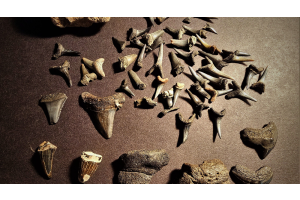
Fossil collectors know that every tooth, bone, or shell carries a story. Some are tales of survival, others of extinction, and a few are nearly unbelievable. Imagine Kansas’s landlocked plains. Originally a part of the Western Interior Seaway, a warm, shallow ocean that spanned North America, it now consists of wheat fields and boundless skies. That unlikely history explains why fossils like megalodon teeth in Kansas continue to capture the imagination of collectors everywhere. A simple tooth discovered in the middle of farmland isn’t just a relic—it’s a rare bridge between sea and soil, and that is what makes it collector gold.
What makes these teeth, buried far from any modern coastline, so captivating? It’s not just their size or sharpness. It’s the riddle they pose: how did the remains of one of Earth’s most famous marine predators end up beneath Midwestern soil? Let’s dig in—figuratively, of course—because when you combine rarity, history, and intrigue, you get collector gold.
The Ocean That Covered Kansas
Imagine driving across Kansas today, then strip away the highways, silos, and small towns. Replace them with a turquoise sea teeming with life—giant marine reptiles, sharks with jaws built for slicing, and schools of fish darting in every direction. That was the Western Interior Seaway some 80 to 90 million years ago.
This ancient sea explains why marine fossils are now scattered beneath the prairies. From mosasaurs to ammonites, the record of life here is staggering. But the crown jewels for many collectors are shark teeth. The sheer improbability of pulling a predator’s tooth from a Kansas field adds an irresistible layer of mystery.
Why Megalodon Still Commands Awe
The megalodon is the celebrity of the fossil world. Its teeth can reach over 7 inches long, and its legend has outgrown even the fossil record. Technically, Kansas was more famous for species like Cretoxyrhina mantelli (often nicknamed the “Ginsu shark”) and the odd, crushing-toothed Ptychodus. Still, when collectors talk about megalodon teeth in Kansas, they’re usually pointing to the allure of big shark teeth being found in unexpected places.
The fascination is twofold. On one hand, megalodon represents the peak of shark evolution—a predator that dwarfed great whites. On the other hand, Kansas is nowhere near an ocean today. That contradiction makes the hunt feel more magical, even when the tooth in your hand belongs to a slightly different ancient shark. For collectors, it’s about the story as much as the species.
Storytelling Value for Collectors
A fossil without context is just an object. Add a location, a time period, and a dramatic backstory, and suddenly it becomes a showpiece. Fossil collectors thrive on storytelling value. You aren’t just displaying a tooth; you’re sharing the tale of a massive predator who prowled an inland sea that no longer exists.
When friends or fellow collectors ask, “Where did you get this?” saying “Kansas” is guaranteed to spark surprise. That geographical twist makes these teeth far more than specimens. They become conversation starters, educational tools, and living connections to Earth’s deep past.
Rarity and the Collector’s Instinct
Collectors know that rarity fuels desire. You can find megalodon teeth along coastal areas such as South Carolina or Florida with some persistence, but finding significant shark fossils in Kansas requires timing, patience, and often a little luck. The matrix conditions here mean preservation is sometimes exceptional, and a pristine specimen feels like striking buried treasure—quite literally.
For serious collectors, rarity isn’t just about how many specimens exist. It’s about how many are in circulation and how well they’re preserved. A tooth pulled from Kansas limestone isn’t just rare in number; it’s rare in story, making it more desirable. That’s why when high-quality specimens become available, they’re quickly snapped up.
The Thrill of Authenticity
Let’s be honest—there’s a lot of replica material floating around the fossil market. That’s why authenticity is everything. When you know that your fossil was pulled from Cretaceous layers in Kansas, the provenance becomes part of the magic. Collectors care about that chain of trust.
We make it a point to guarantee authenticity for every piece. You’re not just buying a fossil—you’re investing in history, preserved in enamel and mineralized perfection. That level of assurance transforms ownership from casual collecting to curating.
Size, Condition, and Coloration
Not all shark teeth are created equal. The biggest teeth aren’t always the most beautiful, and condition often matters more than size. Kansas specimens, thanks to their unique mineralization, often display striking coloration—creamy whites, earthy browns, and subtle marbling. These colors are nature’s signature, and they add character that makes one specimen stand apart from another.
For collectors, the details matter. Serrations, root integrity, and enamel quality all affect value. That’s why examining Kansas material can feel like opening a treasure chest. You never quite know what visual surprises the soil has been keeping secret for millions of years.
Beyond Fossils: Why Collectors Keep Coming Back
Collecting is rarely about owning just one piece. It’s about the excitement of the chase, the delight of finding something new, and the fulfilment that comes from sharing tales that transport us to bygone eras. Kansas fossils feed all of these instincts. Each tooth isn’t just a relic; it’s a reminder that Earth’s landscapes can change so dramatically that a sea once covered farmland.
Collectors return to Kansas fossils because they feel improbable. They make you pause, tilt your head, and smile at the wonder of it all. That feeling is what makes a good collection great.
Why We Provide What Collectors Want
We understand collectors because we are collectors. We know the joy of holding a specimen that feels both improbable and inevitable, as if history itself placed it in your palm. That’s why our selection focuses on quality, authenticity, and storytelling potential.
When you browse our Kansas shark teeth, you’re not scrolling through generic fossils. You’re seeing curated history. From Cretoxyrhina to Ptychodus, each tooth is chosen for its preservation and character. And while the legend of the megalodon looms large, the truth is that Kansas fossils stand on their own as some of the most fascinating in the world.
We connect you with the excitement of owning a physical piece of Earth’s old ocean, and we do more than just sell fossils. Collectors return for this reason.
Final Thoughts: From Sea to Soil
Kansas may not be the first place you’d think to find marine predators, but that’s precisely the appeal. The Western Interior Seaway left behind a treasure trove, and every tooth pulled from that soil carries the weight of both science and story. For collectors, that combination is priceless.
Whether you’re fascinated by the sheer size of shark predators, the rarity of inland finds, or the storytelling value of a fossil that surprises everyone who sees it, megalodon teeth in Kansas represent the perfect blend of wonder and collectability.
We invite you to explore our selection and find a piece that speaks to you. Because in the end, it’s not just about owning a fossil—it’s about holding history in your hand and becoming part of its story.