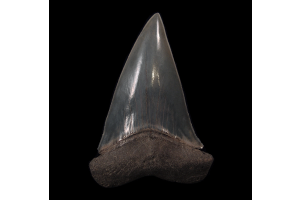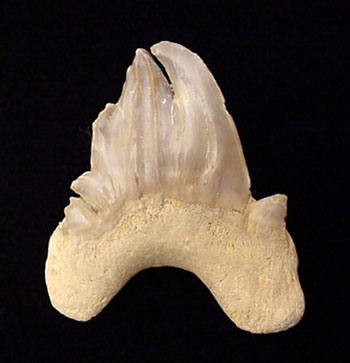
You probably didn’t set out today looking to uncover a prehistoric dental anomaly. But now that you’re here, it’s worth leaning in.
Somewhere beneath the sediment-heavy layers of Morocco’s phosphate-rich terrain, a story has been waiting. It isn’t told in words. It’s etched in enamel, twisted in form, compressed in angles that feel both deliberate and accidental. A tooth, once nestled in the jaw of a megalodon—the ocean’s most formidable predator—emerged with an unexpected shape. Warped at the crown and compressed at the base. Split cleanly down the center like a rift in time.
At first glance, it might look broken. Imperfect. But these deviations aren’t mistakes. They’re pathologies—developmental mutations caused by trauma, spatial pressure, or biological quirks deep within the shark’s physiology. They’re rare, raw, and completely natural. And when you see a pathological megalodon tooth for sale, you’re not just looking at a fossil. You’re looking at a prehistoric record of biological disruption preserved in stone.
These aren’t mass-market showpieces, polished into commercial submission. They’re remnants of something that didn’t grow as expected—fossilized irregularities that challenge our assumptions of what a megalodon tooth should look like. And therein lies their power. Because where most teeth tell us how the shark lived, these hint at something more complex: how it adapted, how it endured, and how even the most perfect predator had flaws written in its bones.
What Went Wrong? Everything—and That’s Why It’s Fascinating
Let’s rewind a few million years.
The megalodon was the top predator in Earth’s oceans. Think bigger than a school bus, with jaws that could snap whales like celery. Its teeth were its currency—sleek, triangular, saw-edged blades of death.
But just like even the slickest machines can jam, nature occasionally glitched.
Maybe the tooth grew too close to another. Perhaps the shark took a hit to the jaw. Maybe there was a quirk in the shark’s DNA. Whatever the cause, a few of these teeth came out wrong. Some twisted. Some compressed. Some split down the center like the enamel equivalent of a double espresso gone wrong.
These are known as pathologic teeth. And they didn’t slow the shark down one bit. That’s the wild part. This apex predator just kept cruising the oceans like nothing happened—leaving behind a bite record that would, millions of years later, make fossil collectors giddy.
What Makes Them So Rare?
Most megalodon teeth are impressive. No doubt. But they’re also...common. For every collector showing off a textbook-perfect specimen, there are another dozen with similar ones.
But a warped one? A tooth that’s bent, buckled, or bisected, like it couldn’t decide what shape to be? That’s a whole different league.
These don’t pop up often. Especially not complete, untouched, and unrepaired. So when one hits the market—no glue, no cosmetic fixing, just raw prehistoric weirdness—it’s like stumbling across a Picasso that painted itself.
Here’s the kicker: we don’t alter them. What you see is exactly what nature left behind. We’re just the ones who carefully pluck it from the earth and say, “You’ve got to see this.”
From Moroccan Mines to Your Hands
Let’s pull the curtain back on how these oddities make their way to you.
The Khouribga phosphate mines in Morocco aren’t your average dig sites. They’re rugged. Ancient. Fossil-rich. But you’ve got to know where to look. And you’ve got to know what to look for.
Pathological teeth don’t shout. They whisper. Their abnormalities can be subtle—until you hold one in your hand. Then suddenly, you see it. The twist. The shift. The malformed elegance of a tooth that didn’t get the memo on how it was supposed to grow.
We work with trusted field experts to ensure every fossil is legit. That means no guesswork. No filler and no passing off damage as pathology. You’re getting a verified, authentic piece of megalodon history—flaws and all.
Why Collectors Love the Weird Ones
There’s something magnetic about imperfection.
Perfect teeth? They’re impressive. They say, “Here’s what the megalodon looked like at its best.”
But the pathological ones? They say, “Here’s what it looked like when things got messy.” And messy, let’s be honest, is more fun.
Collectors aren’t just buying fossils. They’re buying stories. A pathological megalodon tooth for sale doesn’t just reveal how old it is or how massive the shark might have been. It invites you to picture the exact moment something changed — when the growth faltered, when the symmetry broke, when a rare deformity took root in a predator built for perfection.
Owning a fossil like that means you’re not just collecting history — you’re collecting the anomaly. The unexpected. The fossil that refused to follow the rules. And that kind of tooth? It doesn’t sit quietly. It starts conversations the second it’s unwrapped.
It’s Science. It’s Art. It’s Kinda Wild.
Every pathological tooth is a little sculpture made by time. Split tips, compressed crowns, twisted roots—they’re nature’s way of saying, “Let’s shake things up.”
Some resemble twin blades, as if nature had started forging a fork and changed its mind halfway. Others look pinched or folded. And some are so subtly warped, you don’t notice until you turn them in the light and realize: this tooth doesn’t follow any rules.
We don’t polish these into submission. We let the weirdness live.
And that’s what makes them special.
It’s Not Just a Fossil. It’s a Glitch in the Matrix.
You can call it a collector’s piece. A relic. A conversation starter. But we like to think of it as a prehistoric loophole. A moment when nature got distracted, hiccuped, and handed us something we can’t stop staring at.
You don’t need a museum to own one. We’ve made it simple. Browse, pick, and we’ll ship. No filler. No filters. Just fossilized honesty from deep time. Sometimes the best fossils aren’t the sharpest or the biggest. They’re the ones with the wildest backstories.
The Story Doesn’t Stop at the Jaw
Some fossils are easy to forget. They check the boxes—sharp, symmetrical, nicely preserved—but they tell you exactly what you expect. Nothing more. No mystery. No pause.
Then there are the others.
You hold them, and something feels different. The shape isn’t quite right. The edge folds in on itself. There’s a split down the crown, a compression along the root. You don’t walk away from that fossil. You lean in.
That isn’t just a tooth. That’s tension preserved in enamel. Something happened in the body of a predator millions of years ago—an injury, a deformity, maybe even a fight—and the result didn’t get polished away. It stayed. It fossilized. Now it’s here, in front of you. That’s what a pathologic specimen carries. It doesn’t shout. It doesn’t sparkle. But it holds onto its story. It holds tightly.
So if you’re eyeing a “pathological megalodon tooth for sale”, understand this: you’re not just selecting a specimen. You’re choosing the outlier. The one that refused to conform, even after millions of years underground. The one that stayed wild. And that choice? That says something about the kind of collector you are — bold enough to embrace the rare, and smart enough to know it matters.