

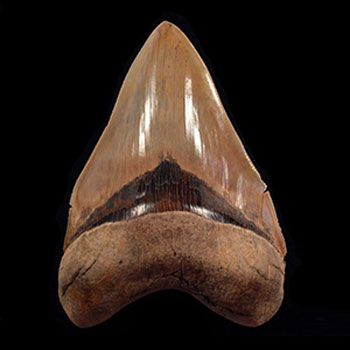
Across the vast expanse of time, fossils connect us to worlds we can only imagine. They whisper stories of enormous creatures, endless seas, and the constant rhythm of life and extinction. Among the most fascinating of these relics lies something small in size but rich in meaning: the baby megalodon tooth.
Though it may appear modest compared to the massive jaws its adult counterparts carried, it carries with it the mystery of how these prehistoric predators began their lives. Holding one in your hand is like possessing a fragment of history that has survived for millions of years beneath layers of sand, silt, and water.
These delicate fossils bridge curiosity with awe, reminding us that even the most colossal of predators once started small. From there, the imagination quickly drifts toward the oceans that nurtured them.
The rise of the megalodon
The megalodon reigned as the ultimate predator of the ancient seas, approximately 23 to 3.6 million years ago. Stretching up to sixty feet long, it dominated warm coastal waters, consuming whales, large fish, and even smaller sharks. What makes the megalodon especially fascinating is not simply its size but the span of its reign. For millions of years, this shark shaped the very balance of ocean ecosystems.
When we think about fossils, size often overshadows subtler details. Yet even small remnants, such as an early-stage tooth, give insight into the developmental life of these giants. These clues allow paleontologists to reconstruct not only the behavior of the species but also the delicate beginnings of one of nature’s largest predators.
Why the smallest fossils matter
Teeth are the most common fossils from sharks because their skeletons were made of cartilage, which rarely fossilizes. But teeth? They are dense, mineral-rich, and built to withstand harsh conditions. A tooth from an adult megalodon could reach more than seven inches long, dwarfing the teeth of modern great whites. But even smaller teeth have something essential to share.
A fossil from a young megalodon indicates where nurseries once existed. These were safe coastal areas where mothers gave birth and young sharks had protection while they grew. Discoveries of juvenile teeth clustered in ancient river mouths and shallow seas indicate that these locations served as shark nurseries millions of years ago.
Ancient nurseries and their importance
Imagine a shallow bay, teeming with fish, bordered by mangroves and coral. For a newborn megalodon, this environment provided food and a degree of shelter from larger predators. Fossil evidence shows that juvenile megalodons were likely raised in such regions before venturing into deeper, open waters.
Understanding these nurseries helps us see parallels with modern shark behavior. Today, species such as tiger sharks and lemon sharks still rely on similar protected environments to survive their vulnerable early years. In this way, a single fossilized tooth is more than an object—it is a window into behavior that continues to shape the evolution of sharks.
Discovering history in your hand
For many, finding a fossilized tooth is a moment of wonder. It’s not simply about size; it’s about connection. A smaller fossil invites reflection because it once belonged to a predator at the very beginning of its life. These ancient remains become keepsakes that link us to eras before human memory, reminding us of nature’s cycles of birth, growth, and transformation.
Collectors and enthusiasts often treasure these finds for their rarity and uniqueness. While large teeth may feel dramatic, the smaller ones hold a quiet charm. They tell the story of beginnings rather than dominance, and in doing so, they spark curiosity about what it means to grow into greatness.
The journey of a fossil
The process of fossilization is as remarkable as the creature itself. When a tooth fell to the ocean floor, it could be buried in sediment almost immediately. Over thousands of years, minerals such as iron and phosphate would seep into the enamel and dentin, slowly replacing the organic material. The result was a fossil that could endure millions of years of pressure, tides, and shifting land.
The variation in colors—from earthy browns to deep blacks and even blues—comes from the minerals absorbed during this long process. Each fossil’s hue reflects the unique environment in which it rested. A single tooth becomes not only a biological record but also a geological one.
Learning through collecting
Collectors often describe their interest as both scientific and personal. Each fossil becomes a lesson, an artifact, and an art piece rolled into one. It is no surprise that shark teeth, especially those of the megalodon, are among the most sought-after fossils in the world.
Smaller fossils, although sometimes overlooked, often provide the most intimate glimpse into the past. Their size suggests fragility, yet their survival proves resilience. For those who enjoy collecting, adding one of these rare finds can round out a collection, offering depth and perspective beyond the apparent grandeur of larger specimens.
Caring for a fossil
Once discovered or acquired, fossils deserve care to preserve their form and history. Storing them in a stable environment, free of humidity and direct sunlight, helps prevent damage. Some collectors display their finds in cases or frames to both protect and showcase them.
Touching the fossil with care is also essential. Oils from human skin can slowly dull the sheen of fossilized enamel. Treating it gently ensures it remains a lasting connection to a world long gone.
Why fascination continues
The allure of the megalodon will likely never fade. Its size and dominance create an image that inspires awe, while its extinction leaves behind questions that scientists continue to explore. Did climate changes, competition from other predators, or loss of prey drive its disappearance? These mysteries keep both researchers and enthusiasts engaged.
A smaller fossil amplifies the intrigue. It points to a creature not yet fully formed, still navigating the early stages of survival. It makes us pause and reflect on how even the mightiest predator once relied on the same cycle of growth that connects all living things.
Conclusion
To hold a baby megalodon tooth is to have a moment in natural history—a reminder that greatness begins in small, fragile forms. These fossils provide insight into the behavior, habitats, and life cycle of one of the ocean’s most legendary creatures. Their story is as much about the beginning of life as it is about the might of adulthood.
If you’ve ever felt the pull of history through objects, consider adding a fossil to your collection. Not only does it bring the ancient seas into your hands, but it also nurtures a sense of wonder that grows every time you look at it.
Take the next step in exploring prehistoric life, and let a single fossil spark your imagination.






