

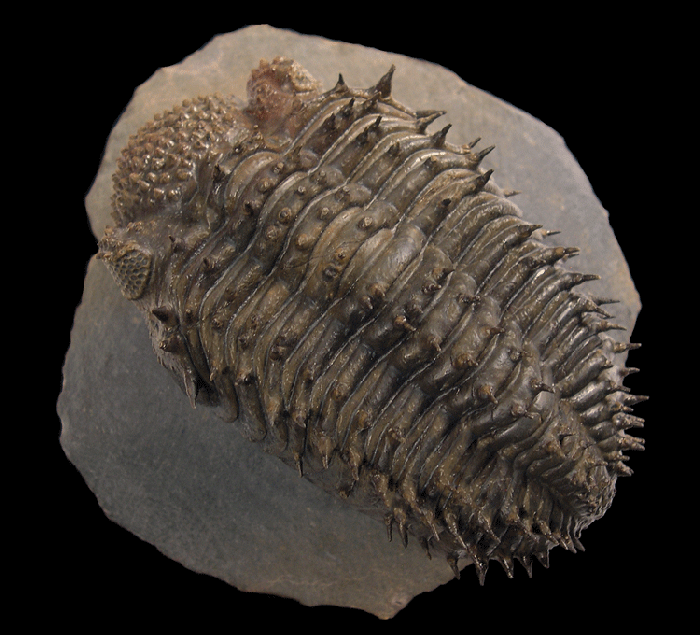
In the remote fossil beds of the Atlas Mountains in Morocco, a remarkable creature has captured the awe of both paleontologists and collectors alike. This extraordinary arthropod, Erbenochile erbeni, wasn't just another ocean-dwelling organism from the Devonian period—it was a visual marvel. Known for its dramatic spines and stunning eye architecture, this species has brought renewed attention to the beauty and scientific importance of the trilobite fossil. For those fascinated by ancient life, our collection offers both scientific insight and genuine excitement, especially with a variety of trilobites for sale.
A Fossil That Changed the Way We See Ancient Eyes
Trilobites, some of the earliest and most fascinating arthropods, burst onto the scene during the Cambrian explosion, thriving for an astonishing span of over 270 million years. Their remarkable and extensive fossil record serves as a crucial window into the evolutionary journey of exoskeletons, the process of molting, and the development of visual systems over prehistoric time. Among these ancient marine dwellers, few specimens have revolutionized our scientific understanding as dramatically as Erbenochile erbeni.
Unearthed from the picturesque Jbel Gara el Zguilma region in Morocco, this Lower Devonian trilobite is celebrated for its extraordinary compound eyes—towering structures rising above its body, resembling miniature skyscrapers that provided an almost panoramic 360-degree field of vision.
While many trilobites sported compound eyes with varying degrees of sophistication, Erbenochile’s optical apparatus reached astonishing evolutionary heights. Each of its enormous, vertically stacked lenses formed an intricate visual tapestry, granting not only an extensive view of its surroundings but also the rare capability to perceive the world behind it—over its own armored thorax. This remarkable adaptation hints at a creature that was highly alert and aware, likely requiring such a broad spectrum of vision to detect lurking predators in its vibrant, shallow marine habitat.
The Science Behind the Sight
The optical towers perched atop Erbenochile’s head were a marvel of evolutionary design, standing apart not only from other trilobites but from most arthropods, both ancient and modern. These remarkable eyes didn’t merely jut out; they soared upward like miniature periscopes, allowing the trilobite to maintain a hidden presence beneath layers of sediment or amid rocky outcrops while still vigilantly surveying its environment. In essence, Erbenochile exemplifies one of the earliest known instances of evolutionary adaptation geared toward advanced sensory awareness.
Scientific investigations have revealed that each of these intricate lenses housed its own calcite crystal, functioning as a tiny eye within a larger eye—an astonishing feat of nature’s engineering. The density and precision of these crystalline structures are nothing short of extraordinary, pushing the boundaries of what we understand about visual acuity in ancient creatures. Unlike the flat, simplistic eyes characteristic of most trilobites, Erbenochile's ocular towers were elegantly curved and elevated, maximizing its ability to perceive its surroundings in three dimensions. This architectural marvel likely enabled it to detect both aerial threats and elusive prey—perhaps even rival trilobites gliding through the ancient seas.
This sophisticated visual system has fundamentally transformed our comprehension of how early arthropods interacted with their environment. Instead of being mere passive inhabitants of the seabed, trilobites like Erbenochile reveal themselves as active, alert creatures, relying on their intricate sensory faculties to navigate and thrive in the fiercely competitive marine ecosystems of their time..
Beyond Biology: The Collector’s Perspective
The story of Erbenochile doesn’t stop at biology. For fossil collectors, it is the crown jewel among trilobite specimens. At Buried Treasure Fossils, we’ve had the privilege of offering some of the finest Moroccan Erbenochile fossils available. Their dramatic exoskeletons, thorn-like thoracic spines, and above all, those famous eyes, make them not only scientifically significant but visually stunning.
High-end collectors seek Erbenochile fossils because they blend evolutionary rarity with natural artistry. A well-preserved specimen, expertly prepared to highlight its eye towers and intricate body structure, is a showpiece in any collection. It embodies the intersection of ancient biology and aesthetic appeal. The rarity of authentic specimens also adds to their value—especially those that are free of repair or reconstruction.
The fossil preparation process is equally impressive. Skilled technicians, particularly in Germany and Morocco, spend countless hours delicately removing matrix material to expose each detail without damaging the fossil. This level of care ensures that each trilobite fossil is not only authentic but museum-quality.
Moroccan Marvels and Global Appeal
Morocco is known for yielding some of the world’s most impressive trilobites, and Erbenochile is at the forefront. The geological richness of the Timrhanrhart Formation, along with limited and carefully managed access, ensures that only a select few Erbenochile fossils enter the global market each year. We proudly offer these rare specimens with guaranteed authenticity and detailed provenance, making them ideal for educators, enthusiasts, and serious collectors alike.
And for those just starting their fossil journey, we provide a wide variety of trilobites for sale from different species and localities, including Russia and the United States. Whether you’re searching for ornate Moroccan species or classic North American trilobites, we make ancient history accessible—and exciting—for everyone.
Our catalog ranges from beginner-friendly pieces under $50 to high-end Erbenochile specimens, giving you a chance to explore the depth of trilobite diversity at your own pace and interest level. Each listing includes age, locality, species name, and relevant scientific context, allowing you to build a collection that’s both meaningful and educational.
Ancient Vision, Modern Wonder
In conclusion, the discovery and study of the Erbenochile trilobite fossil have profoundly expanded our understanding of prehistoric sensory systems. Its towering eyes serve as a reminder that nature’s innovations often appear in the most unexpected forms—and sometimes, they’ve been hiding in the earth for over 400 million years. These fossils that are now up for sale, are more than petrified remains; they’re glimpses into a once-living organism that evolved extraordinary traits to thrive in its world.
We’re passionate about connecting people with these prehistoric wonders. Whether you're a lifelong paleontology enthusiast or a teacher hoping to spark curiosity in your students, our expertly curated collection is here to inspire. If you’re ready to hold ancient innovation in your hands, now’s the perfect time to explore our available trilobites and add an Erbenochile to your collection.






