Search results for: 'line bartkowski non sloth'
- Did you mean
- lion bartkowski non sloth
- like bartkowski non sloth
- Related search terms
- none me of new postag by enabl lamna nasus
- none and good gem shows
- none and good gem sh02
- none and good gem sh01
- none and good gem show
- Rolfodon ludvigseni$0.00
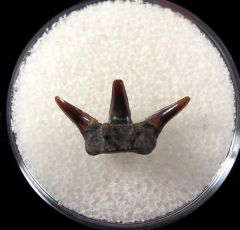
A Very Rare, Top Quality (Gem) Rolfodon ludvigseni tooth from Hornby Island, British Columbia, Canada. An August Fossil of the Month. This is a new genius of Frill shark from the Late Cretaceous deep water Northumberland Formation deposit. A unique species of Chlamydoselachiform shark, the Frill shark. These teeth exhibit classic Frill shark design with a central cusp flanked by two lateral cusps. The crown is near complete (central cusp end damage) and the root is complete. Note - two crown ends were very neatly reattached without fill or gaps which is typical for a matrix free specimen. Crack lines are hard to see without magnification. Highest quality enamel. No repair. A very difficult tooth to locate and an excellent collector's tooth. Authenticity guaranteed. This incredible specimen is from a 20 year old collection. A fantastic Frill shark specimen!
CD91 SIZE: 5/8" Wide
Note - Adding 64 Hornby Island deep water shark teeth. -> Link to all Hornby Island shark teeth.
Learn More - Rolfodon ludvigseni$0.00
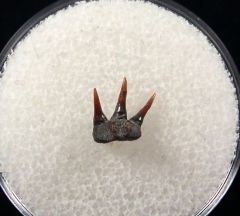
A Very Rare, Top Quality (Gem) Rolfodon ludvigseni tooth from Hornby Island, British Columbia, Canada. An August Fossil of the Month. This is a new genius from the Late Cretaceous deep water Northumberland Formation deposit. A unique species of Chlamydoselachiform shark, the Frill shark. These teeth exhibit classic Frill shark design with a central cusp flanked by two lateral cusps. A lateral tooth. The crown is complete and the root is complete. Note - two crown ends were very neatly reattached without fill or gaps which is typical for a matrix free specimen. Crack lines are hard to see without magnification. Highest quality enamel. No repair. A very difficult tooth to locate and an excellent collector's tooth. Authenticity guaranteed. This incredible specimen is from a 20 year old collection. A fantastic Frill shark specimen!
CD92 SIZE: 5/16" Wide
Note - Adding 64 Hornby Island deep water shark teeth. -> Link to all Hornby Island shark teeth.
Learn More - Carcharodon carcharias$0.00
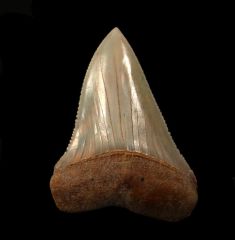
An ULTRA RARE, MONSTER Great White shark transition tooth, Carcharodon hubbelli from Chile. A BIG upper jaw lateral tooth. A June Fossil of the Month. This tooth has a tan colored crown, a distinct gum line, and a brown root. Good color! Highest quality enamel with little hydration cracks and no peeling. This C. hubbelli tooth has medium serrations at the base of the cutting edge, transition to fine serrations at mid crown and disappear towards the tip. Serrations are large at the base with a good tip serration. The root is extra wide. Note - the root root lobe was cracked and probably reatttached - hard to see. Excellent preservation - note nutrient hole on root. No repair or restoration. An exceptional Great White transition form! It will be extremely difficult to locate Carcharodon hubbelli. A super rare collector's tooth. Authenticity guaranteed.
C201 BoP Size: 2-3/4" (2" W)
Note - Adding 32 Chilean Great White teeth in June 2021 Link to Great White shark teeth
Learn More - Edestus heinrichi$0.00
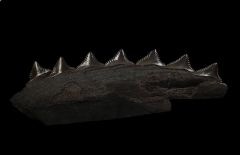
An ultra rare, LARGE Top Quality Edestus heinrichi shark whorl with 7 big crowns, from Herrin, Illinois. An October Fossil of the Month. This is a Paleozoic shark that lived in swamps that our now underground coal deposits. Excellent preservation and serrations. This whorl is incredible teeth detail - the first 5 crowns are all natural and the the last two have some top repair. One of the finest whorls that I have had. The Edestus shark would have an upper and lower tooth whorl that are vertically opposed. Research showed that they could use their opposing teeth in a scissor-like motion to cut prey. It is the first animal to cut vertically. A very strange looking and unique acting shark. Shark recreation image is credited to Julio Lacerdo. These rare teeth are Pennsylvanian age from Illinois. Note - Two crown tips were professionally retored. Authenticity guaranteed. Seven plus crown whorl sections are ultra rare! The BEST.
I01 BoP3 SIZE: 1-3/4" teeth (Whorl : 10-1/4" length)
Adding 11 Edestus shark specimens in October 2021. Link to Edestus shark.
Learn More - Edestus heinrichi$0.00
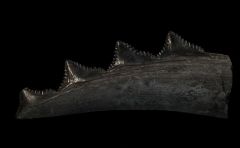
An ultra rare, Top Quality EXTRA LARGE Edestus heinrichi shark whorl section with 4 big crowns, from Sparta, Illinois. An August Fossil of the Month. This is a Paleozoic shark that lived in swamps that our now underground coal deposits. Excellent preservation and serrations. Note - extra long root whorl section with 4 extra large crowns - very rare. The Edestus shark would have an upper and lower tooth whorl that are vertically opposed. Research showed that they could use their opposing teeth in a scissor-like motion to cut prey. It is the first animal to cut vertically. A very strange looking and unique acting shark. Shark recreation image is credited to Julio Lacerdo. These rare teeth are Pennsylvanian age from Illinois. No repair or restoration. Authenticity guaranteed. Four crown whorl sections are extremely rare!
I01 BoP SIZE: 2" teeth (Whorl 6")
Adding 15 Edestus shark specimens in August 2020. Link to Edestus shark.
Learn More - Edestus heinrichi$0.00
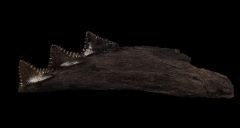
An ultra rare, Top Quality EXTRA LARGE Edestus heinrichi shark whorl section with 3 big crowns, from Herrin, Illinois. An April Fossil of the Month. This is a Paleozoic shark that lived in swamps that our now underground coal deposits. Excellent preservation and serrations. Note - extra long root whorl section with 3 extra large crowns - very rare. The Edestus shark would have an upper and lower tooth whorl that are vertically opposed. Research showed that they could use their opposing teeth in a scissor-like motion to cut prey. It is the first animal to cut vertically. A very strange looking and unique acting shark. Shark recreation image is credited to Julio Lacerdo. These rare teeth are Pennsylvanian age from Illinois. Note - Two crown tips were professionally retored. Authenticity guaranteed. Three crown whorl sections are rare!
I01 BoP2 SIZE: 1-3/4" teeth (Whorl 7-1/4")
Adding 15 Edestus shark specimens in April 2021. Link to Edestus shark.
Learn More - Kayserops sp.$225.00
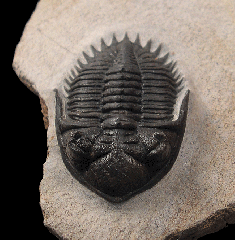
An Top Quality Kayserops sp. trilobite. Preparation is German directed with all original colors and no restoration. Excellent preservation and condition. Beautifil black shell. Excellent detail in the compound eyes. This specimen is fully exposed on a pedestal of original matrix. A Middle Devonian (380 mya) from the Djebel Issoumour area, Atlas Mts., Morocco. Authenticity guaranteed. An incredible amount of preparation was required for this fantastic display piece.
XM38 Size: 2-1/4" (1-3/8 wide)
Adding 31 quality Moroccan trilobites in April 2025. Link to Moroccan trilobites.
Learn More - Otodus obliquus (Auriculatus ancestor)$0.00
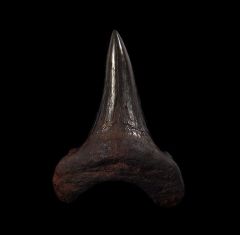
A very rare, Otodus obliquus tooth from the copper-red site of No. Carolina. The crown has no serrations. Typical Otodus side cusps. Complete root. Early Eocene - Ypresian age. A very rare collector's tooth. Very few Otodus teeth found at this site!
NC251 SIZE: 2-3/16"Note - Adding 9 early NC red site early Rics, transition teeth, and later Rics in June 2020. Link to NC Auriculatus teeth
Learn More - Otodus aksuaticus (Early Eocene form)$0.00
A very rare, Otodus aksuaticus tooth from the copper-red site of No. Carolina. The crown has coarse serrations over the lower 2/3 of crown that disappear in the top 1/3 of crown. The side cusps are typical of the Otodus obliquus. Complete root. Early Eocene - Ypresian age. A very rare collector's tooth. Very few Otodus aksuaticus teeth found at this site!
NC252 SIZE: 2-3/8"Note - Adding 9 early NC red site early Rics, transition teeth, and later Rics in June 2020. Link to NC Auriculatus teeth
Learn More - Otodus auriculatus (Early Eocene form)$0.00
A very rare, Otodus auriculatus tooth from the copper-red site of No. Carolina. The crown has coarse serrations. The side cusps are typical of the Otodus obliquus. Complete root. Early Eocene - Ypresian age. A very rare collector's tooth. Very few Otodus auriculatus teeth (early form) found at this site!
NC253 SIZE: 2-1/2"Note - Adding 9 early NC red site early Rics, transition teeth, and later Rics in June 2020. Link to NC Auriculatus teeth
Learn More - Otodus auriculatus (Early Eocene form)$0.00
A very rare, Otodus auriculatus tooth from the copper-red site of No. Carolina. The crown has coarse serrations. The side cusps are typical of the Otodus obliquus. Complete root. Early Eocene - Ypresian age. A very rare collector's tooth. Very few Otodus auriculatus teeth (early form) found at this site!
NC254 SIZE: 2-1/16"Note - Adding 9 early NC red site early Rics, transition teeth, and later Rics in June 2020. Link to NC Auriculatus teeth
Learn More - Otodus auriculatus (Early Eocene form)$0.00
A very rare, Otodus auriculatus tooth from the copper-red site of No. Carolina. The crown has coarse serrations. The side cusps are typical of the Otodus obliquus. Complete root. Early Eocene - Ypresian age. A very rare collector's tooth. Very few Otodus auriculatus teeth (early form) found at this site!
NC255 SIZE: 1-11/16"Note - Adding 9 early NC red site early Rics, transition teeth, and later Rics in June 2020. Link to NC Auriculatus teeth
Learn More