Search results for: 'form megalodon shark tooth fossil southeastern united stars'
- Did you mean
- form megalodon shark tooth fossil southeastern united shark
- form megalodon shark tooth fossil southeastern united sharks
- Related search terms
- shark enabled eagl intelligence four disaster response it stem
- shark enameloid enabl intelligence form disaster response it stem
- shark easel enabl intelligence form disaster response it stem
- shark enabled enamel intelligence form disaster response it star
- shark enabled enabl intelligence form disaster response it stand
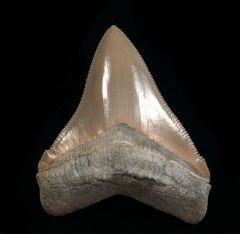
- Otodus chubutensis$0.00
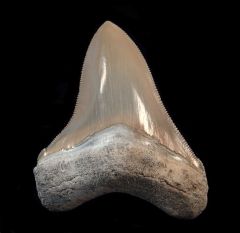
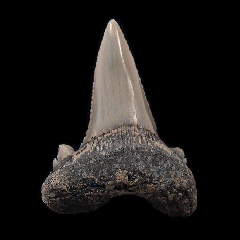
A GEM Lee Creek Carcharocles chubutensis, the C. megalodon tooth predecessor - upper jaw Principal Anterior tooth. The serrations are extra large and razor sharp and perfect with a rare DOUBLE TIP serrations. You rarely see this "V" tip design! The perfect Lee Creek Chubutensis. An exceptional collector's tooth. NO repair! The BEST of the BEST!
LC043 Size: 3-1/4" (2-1/2" W)
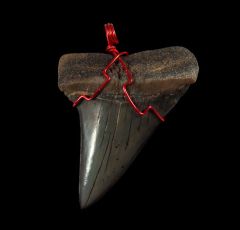
Learn More - Necklace - Peru$75.00
Wire wrapped fossil Great White and Mako shark teeth for necklaces. These teeth have a simple aluminum wire wrap and come with a leatherette necklace cord with a simple clasp. The leatherette necklace cords come in nine colors. These are authentic Miocene or Pliocene fossil shark teeth. Get ready for your summer fun! Note: there are 9 leatherette cord colors available - black, brown, lime, orange, red, blue, pink, magento or purple. After you put your wrapped tooth in the cart, use this link to select your cord and put it in the cart (cord at no cost). --> Necklace Cords
Type: Mako Item: P02J Size: 2-3/8”
Note - Adding 25 Peruvian Great White and Mako necklaces in July 2021. Link to Shark Tooth Necklaces
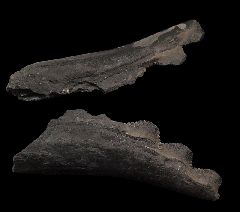
Learn More - Edestus heinrichi$950.00
An ultra rare, Top Quality Edestus heinrichi associted pair of whorls, from Herrin, Illinois. A July Fossil of the Month. This is a Paleozoic shark that lived in swamps that our now underground coal deposits. An ultra rare assoiiated pair of tooth whorls. Note - the crown tips are naturally rounded (polished) which thought to be due to wear from the vertical whipping motion used to slice prey. Excellent preservation, serrations, and serration detail. The Edestus shark would have an upper and lower tooth whorl that are vertically opposed. Research showed that they could use their opposing teeth in a scissor-like motion or a vertical whipping motion to cut prey. It is the first animal to cut vertically. A very strange looking and unique acting shark. Shark recreation image is credited to Julio Lacerdo. These rare teeth are Pennsylvanian age from Illinois. No repair or restoration. Authenticity guaranteed. This is the first associated whorl pait that I have seen.
I02 SIZE: 5" & 4-3/4" w/ root (1-1/4"+ crowns)
Adding 22 Edestus shark teeth in July 2025. Link to Edestus shark.
Learn More - Notorynchus primigenius - Germany$0.00
An ultra rare, EXTRA LARGE early Top Quality Sevengill Cow shark (Notorhynchus primigenius) - a lower jaw symphyseal tooth from Nemuhle, Germany. An August Fossil of the Month. An early Oligocene age tooth (Rupelian - 32 MYA). An excellent tooth for the rare tooth collector! No repair or restoration. No repair or restoration. Near perfect tooth. Authenticity guaranteed. These teeth were found in many closed quarries.
GR401 Size: 5/8"
Note - Adding 12 German Cow shark teeth in August 2022 -> Link to German Shark Teeth
Learn More - Edestus heinrichi$0.00
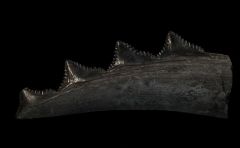
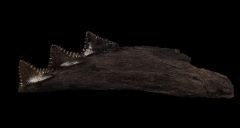
An ultra rare, Top Quality EXTRA LARGE Edestus heinrichi shark whorl section with 4 big crowns, from Sparta, Illinois. An August Fossil of the Month. This is a Paleozoic shark that lived in swamps that our now underground coal deposits. Excellent preservation and serrations. Note - extra long root whorl section with 4 extra large crowns - very rare. The Edestus shark would have an upper and lower tooth whorl that are vertically opposed. Research showed that they could use their opposing teeth in a scissor-like motion to cut prey. It is the first animal to cut vertically. A very strange looking and unique acting shark. Shark recreation image is credited to Julio Lacerdo. These rare teeth are Pennsylvanian age from Illinois. No repair or restoration. Authenticity guaranteed. Four crown whorl sections are extremely rare!
I01 BoP SIZE: 2" teeth (Whorl 6")
Adding 15 Edestus shark specimens in August 2020. Link to Edestus shark.
Learn More - Edestus heinrichi$0.00
An ultra rare, Top Quality EXTRA LARGE Edestus heinrichi shark whorl section with 3 big crowns, from Herrin, Illinois. An April Fossil of the Month. This is a Paleozoic shark that lived in swamps that our now underground coal deposits. Excellent preservation and serrations. Note - extra long root whorl section with 3 extra large crowns - very rare. The Edestus shark would have an upper and lower tooth whorl that are vertically opposed. Research showed that they could use their opposing teeth in a scissor-like motion to cut prey. It is the first animal to cut vertically. A very strange looking and unique acting shark. Shark recreation image is credited to Julio Lacerdo. These rare teeth are Pennsylvanian age from Illinois. Note - Two crown tips were professionally retored. Authenticity guaranteed. Three crown whorl sections are rare!
I01 BoP2 SIZE: 1-3/4" teeth (Whorl 7-1/4")
Adding 15 Edestus shark specimens in April 2021. Link to Edestus shark.
Learn More - Otodus chubutensis$0.00
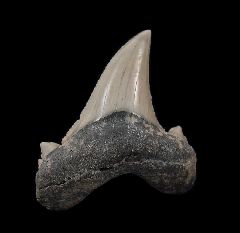
A TOP QUALITY, Classic Lee Creek Chubutensis tooth - upper jaw ANTERIOR tooth. Highest quality enamel. Excellent color! The bourlette is excellent and perfect. The serrations are razor sharp, near perfect, with an excellent tip serration. Excellent serrations - razor sharp! The root is an excellent light tan color with essentially no hydration cracks, very wide, and absolutely complete. Also note the interesting small side cusps - a Miocene Megalodon predecessor trait. This Chubutensis was found in the Pungo River Formation, Lee Creek mine, NC (Miocene age = 14.5 MYA). An excellent example of a classic Lee Creek Chubutensis tooth. A fantastic collector's tooth from the old days at Lee Creek mine! NO repair! Authenticity guaranteed.
LC080 Size: 3"
Learn More - Otodus aksuaticus (Partial serrated)$325.00
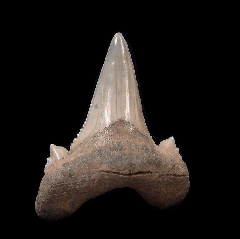
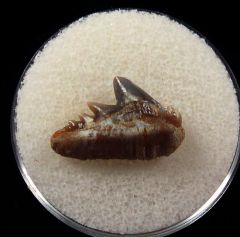
A very rare, early Otodus aksuaticus anterior tooth from Kzil-Orda, Kazakhstan. A transitional tooth leading to O. auriculatus (see detailed discussion below) which leads to Megalodon. The bourlette is complete. This tooth exhibits small serrations along the lower 1/2 of the crown and micro serrations to the tip. These teeth exhibit excellent color, gloss, and preservation. A rare, early (Ypresian) Eocene Auriculatus transition tooth. A very challenging tooth to find when building a Megalodon evolutionary set! No repair or restoration. Authenticity guaranteed. This western Kazakhstan site is one of the few places in the world where the Otodus obliquus to Otodus auriculatus transition can be found in adjacent geologic layers.
K546 SIZE: 1-9/16"
Note - Adding 24 Kazakh Auriuclatus or transition teeth in July 2024. --> Link to Kazakh Auriculatus teeth.
Learn More - Otodus aksuaticus (Partial serrated)$350.00
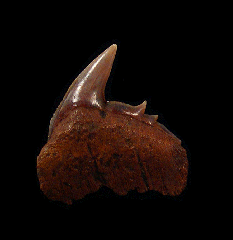
A very rare, early Otodus aksuaticus anterior tooth from Kzil-Orda, Kazakhstan. A transitional tooth leading to O. auriculatus (see detailed discussion below) which leads to Megalodon. The bourlette is complete. This tooth exhibits small serrations along the lower 1/2 of the crown and micro serrations to the tip. These teeth exhibit excellent color, gloss, and preservation. A rare, early (Ypresian) Eocene Auriculatus transition tooth. A very challenging tooth to find when building a Megalodon evolutionary set! No repair or restoration. Authenticity guaranteed. This western Kazakhstan site is one of the few places in the world where the Otodus obliquus to Otodus auriculatus transition can be found in adjacent geologic layers.
K545 SIZE: 1-3/4"
Note - Adding 24 Kazakh Auriuclatus or transition teeth in July 2024. --> Link to Kazakh Auriculatus teeth.
Learn More - Otodus aksuaticus (Partial serrated)$425.00
A very rare, early Otodus aksuaticus lateral tooth from Kzil-Orda, Kazakhstan. A transitional tooth leading to O. auriculatus (see detailed discussion below) which leads to Megalodon. The bourlette is complete. This tooth exhibits small serrations along the lower 1/3 of the crown and micro serrations to the tip. These teeth exhibit excellent color, gloss, and preservation. A rare, early (Ypresian) Eocene Auriculatus transition tooth. A very challenging tooth to find when building a Megalodon evolutionary set! No repair or restoration. Authenticity guaranteed. This western Kazakhstan site is one of the few places in the world where the Otodus obliquus to Otodus auriculatus transition can be found in adjacent geologic layers.
K543 SIZE: 1-7/8"
Note - Adding 24 Kazakh Auriuclatus or transition teeth in July 2024. --> Link to Kazakh Auriculatus teeth.
Learn More - Notidanoides muensteri - Germany$0.00
An EXTRA KARGE ultra rare, Top Quality early Cow shark (Notidanoides muensteri) - a lower jaw anterior tooth from Mohven, Germany. An August Fossil of the Month. A late Jurassic age tooth (Tithonian - 148 MYA). A special tooth for the very rare tooth collector! No repair or restoration. Near perfect tooth. Authenticity guaranteed. These teeth were found in many closed quarries.
GR409 Size: 3/4" On Hold
Note - Adding 12 German Cow shark teeth in August 2022 -> Link to German Shark Teeth
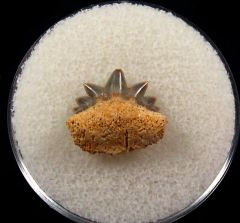
Learn More - Hexanchus griseus - Chile$75.00
A Pathologic, Top Quality Chilean Hexanchus griseus tooth from the Caldera Basin of Chile. This is an upper jaw tooth with three primary cusps, but it should have had 5 cusps. Two cusp did not form. Excellent preservation and fantastic color. Perfect cusps. These tooth was found in the Bahia Inglesa Fm. and is late Miocene to early Pliocene age. A scarce collector's tooth. Authenticity guaranteed. Unfortunately there are no more teeth coming from this site. This rare piece is from an old collection!
C408U Size: 1" Wide
Note - Adding 18 new Chilean Hexanchus teeth in February 2023 -> Link to Hexanchus Teeth
Learn More