Search results for: 'not air my common would site 85'
- Related search terms
- site out enabl cohesive devices
- noty me of new postag by enabl lamna nasus
- not me of new postag by enabl lamna nasus
- not me of new post by enabl lamna nasus
- nothing pinus 3a enabl/
- Edestus heinrichi$195.00
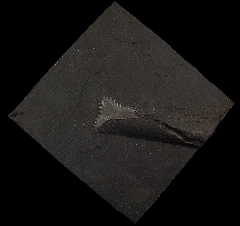
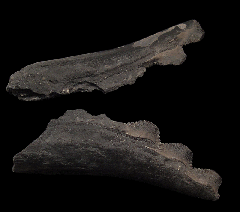
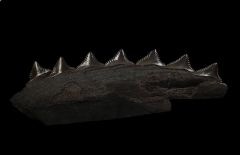
A very rare, Top Quality Edestus heinrichi shark tooth, from Herrin, Illinois. This is a Paleozoic shark that lived in swamps that our now underground coal deposits. An excellent matrix specimen that inludes the opposing tooth mold as well. Excellent preservation, serrations, and serration detail. The Edestus shark would have an upper and lower tooth whorl that are vertically opposed. Research showed that they could use their opposing teeth in a scissor-like motion or a vertical whipping motion to cut prey. It is the first animal to cut vertically. A very strange looking and unique acting shark. Shark recreation image is credited to Julio Lacerdo. These rare teeth are Pennsylvanian age from Illinois. No repair or restoration. Authenticity guaranteed. Note - shipping weight is 1.9 lbs. International "free shipping" will require supplemental postage.
I11 SIZE: 3" w/ root (1-1/2" crown) ; Matrix block is 3.5" x 3.5"
Adding 22 Edestus shark teeth in July 2025. Link to Edestus shark.
Learn More - Edestus heinrichi$175.00
A very rare, LARGE, Top Quality Edestus heinrichi shark tooth, from Herrin, Illinois. This is a Paleozoic shark that lived in swamps that our now underground coal deposits. Note - this tooth has a lot of pyrite and the tip is naturally rounded (polished) which thought to be due to the vertical whipping motion used to slice prey. Excellent preservation, serrations, and serration detail. The Edestus shark would have an upper and lower tooth whorl that are vertically opposed. Research showed that they could use their opposing teeth in a scissor-like motion or a vertical whipping motion to cut prey. It is the first animal to cut vertically. A very strange looking and unique acting shark. Shark recreation image is credited to Julio Lacerdo. These rare teeth are Pennsylvanian age from Illinois. No repair or restoration. Authenticity guaranteed.
I09 SIZE: 4-1/8" w/ root (1-7/8" crown)
Adding 22 Edestus shark teeth in July 2025. Link to Edestus shark.
Learn More - Edestus heinrichi$0.00
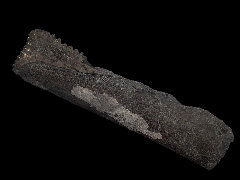
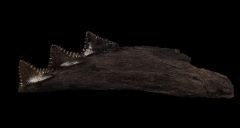
An ultra rare, Top Quality EXTRA LARGE Edestus heinrichi shark whorl section with 4 big crowns, from Sparta, Illinois. An August Fossil of the Month. This is a Paleozoic shark that lived in swamps that our now underground coal deposits. Excellent preservation and serrations. Note - extra long root whorl section with 4 extra large crowns - very rare. The Edestus shark would have an upper and lower tooth whorl that are vertically opposed. Research showed that they could use their opposing teeth in a scissor-like motion to cut prey. It is the first animal to cut vertically. A very strange looking and unique acting shark. Shark recreation image is credited to Julio Lacerdo. These rare teeth are Pennsylvanian age from Illinois. No repair or restoration. Authenticity guaranteed. Four crown whorl sections are extremely rare!
I01 BoP SIZE: 2" teeth (Whorl 6")
Adding 15 Edestus shark specimens in August 2020. Link to Edestus shark.
Learn More - Edestus heinrichi$0.00
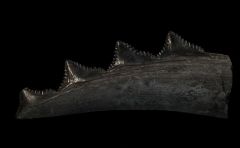
An ultra rare, Top Quality EXTRA LARGE Edestus heinrichi shark whorl section with 3 big crowns, from Herrin, Illinois. An April Fossil of the Month. This is a Paleozoic shark that lived in swamps that our now underground coal deposits. Excellent preservation and serrations. Note - extra long root whorl section with 3 extra large crowns - very rare. The Edestus shark would have an upper and lower tooth whorl that are vertically opposed. Research showed that they could use their opposing teeth in a scissor-like motion to cut prey. It is the first animal to cut vertically. A very strange looking and unique acting shark. Shark recreation image is credited to Julio Lacerdo. These rare teeth are Pennsylvanian age from Illinois. Note - Two crown tips were professionally retored. Authenticity guaranteed. Three crown whorl sections are rare!
I01 BoP2 SIZE: 1-3/4" teeth (Whorl 7-1/4")
Adding 15 Edestus shark specimens in April 2021. Link to Edestus shark.
Learn More - Otodus auriculatus - Kazakhstan$325.00
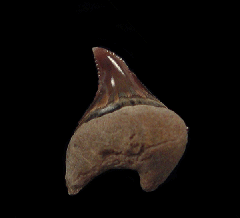
An ultra rare, early Auriculatus parasymphyseal tooth from Kzil-Orda region, Kazakhstan. A July Fossil of the Month. Note - The center teeth would rarely be lost during feeding. So, very few are in the fossil record. The bourlette is complete. Excellent coarse serrations and killer with typical small side cusps. These teeth exhibit fantastic color, gloss, and preservation. A rare early Eocene Auriculatus tooth (Ypresian age - 55 MYA)! No repair or restoration. Authenticity guaranteed. The true early Eocene Auriculatus tooth!
K515 SIZE: 3/4"
Note - Adding 24 Kazakh Auriuclatus or transition teeth in July 2024. --> Link to Kazakh Auriculatus teeth.
Learn More - Edestus heinrichi$950.00
An ultra rare, Top Quality Edestus heinrichi associted pair of whorls, from Herrin, Illinois. A July Fossil of the Month. This is a Paleozoic shark that lived in swamps that our now underground coal deposits. An ultra rare assoiiated pair of tooth whorls. Note - the crown tips are naturally rounded (polished) which thought to be due to wear from the vertical whipping motion used to slice prey. Excellent preservation, serrations, and serration detail. The Edestus shark would have an upper and lower tooth whorl that are vertically opposed. Research showed that they could use their opposing teeth in a scissor-like motion or a vertical whipping motion to cut prey. It is the first animal to cut vertically. A very strange looking and unique acting shark. Shark recreation image is credited to Julio Lacerdo. These rare teeth are Pennsylvanian age from Illinois. No repair or restoration. Authenticity guaranteed. This is the first associated whorl pait that I have seen.
I02 SIZE: 5" & 4-3/4" w/ root (1-1/4"+ crowns)
Adding 22 Edestus shark teeth in July 2025. Link to Edestus shark.
Learn More - Otodus chubutensis$0.00
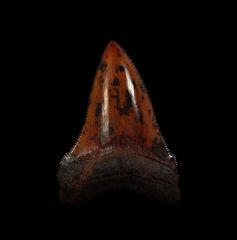
A GORGEOUS, GEM copper red colored Chubutensis tooth - an upper jaw anterior tooth from the Meherrin River in northeastern No. Carolina. The "Leopard Tooth" with incredible rare copper red and black colors! An April 2019 Fossil of the Month. Highest quality enamel. No enamel peel. The bourlette is excellent. The serrations are sharp and large tip serration. Excellent side cusps. The root is gorgeous with few cracks on the face. No repair! An ultra rare Chubutensis collector's tooth with fantastic color. Definitely a top 1% red site Chub considering preservation and color! Museum Quality. Authenticity guaranteed.
NC062 BoP SIZE: 2-9/16"
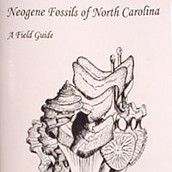
Learn More - Neogene Fossils of North Carolina By Chandler & Timmerman$20.00
My recommendation for the collector's first reference guide to identify their Miocene - Pliocene age collection pieces. A must for the Lee Creek fossil collector - shark teeth and other fossils.
BB08 Size: 5-1/2" x 8-1/2"
Learn More - Edestus heinrichi$0.00
An ultra rare, LARGE Top Quality Edestus heinrichi shark whorl with 7 big crowns, from Herrin, Illinois. An October Fossil of the Month. This is a Paleozoic shark that lived in swamps that our now underground coal deposits. Excellent preservation and serrations. This whorl is incredible teeth detail - the first 5 crowns are all natural and the the last two have some top repair. One of the finest whorls that I have had. The Edestus shark would have an upper and lower tooth whorl that are vertically opposed. Research showed that they could use their opposing teeth in a scissor-like motion to cut prey. It is the first animal to cut vertically. A very strange looking and unique acting shark. Shark recreation image is credited to Julio Lacerdo. These rare teeth are Pennsylvanian age from Illinois. Note - Two crown tips were professionally retored. Authenticity guaranteed. Seven plus crown whorl sections are ultra rare! The BEST.
I01 BoP3 SIZE: 1-3/4" teeth (Whorl : 10-1/4" length)
Adding 11 Edestus shark specimens in October 2021. Link to Edestus shark.
Learn More - Pachycephalosaurus$795.00
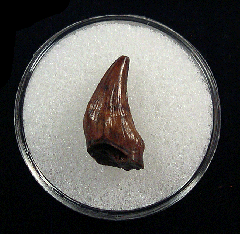
An EXTRA LARGE Ultra Rare, Top Quality Pachychephalosaurus wyomingensis premaxillary tooth from the late Cretaceous of northern North America. A February Fossil of the month. This tooth is often referred to as the Pachy "Fang". There are posterior serrations present on this tooth. There is also a small wear facet on the tooth (quite common). Pachychephalosaurus is the dinosaur which is famous for its large domed head surrounded by spikes. The enamel is excellent quality with great color and patina. No cracks or restoration. An ultra rare Pachy premax tooth! Legally collected on private land in the Hell Creek Fm., Powder River Co., Montana. An excellent collector's quality Pachychephalosaurus premaxillary tooth. Note - tooth comes with the gem case pictured. Authenticity guaranteed. My largest Pachy premaxillary tooth!
DP01 SIZE: 5/8"
Note - Adding 6 new Pachy spikes / teeth in February 2025.. Link to Pachy fossils catalog
Learn More - Cretaceous and Paleogene Fossils of North Carolina By John Timmerman and Richard Chandler$20.00
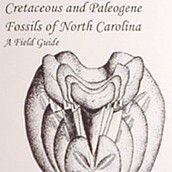
The North Carolina Fossil Club provides an excellent guide to the Cretaceous - Eocene - Paleocene - Oligocene shark teeth from North Carolina. My recommendation for the collector's first reference guide to identify their Cretaceous - Paleocene - Eocene collection pieces.
BB09 Size: 5-1/2" x 8-1/2"
Learn More - Carcharocles megalodon$0.00
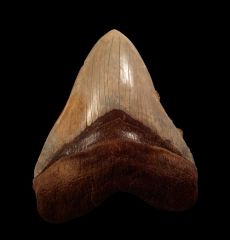
A rare Top Quality, BIG CLASSIC Chile Megalodon tooth from the phosphate layer, Bahia Inglesa Fm., Caldera area, Chile. This tooth is nicely displayed on its original phosphorite matrix. Note - the pebbly phosphorite makes an interesting base which elevates the tip about 15 degress for a great display. A gorgeous light tan colored crown with no enamel peel. High quality enamel with very light mineral staining (as shown). The bourlette is an excellent deep mahogany brown color, large and 85% complete. The serrations are razor sharp and complete with an excellent tip serration. The root is rich red-brown color, extra wide (5") with excellent surface articulation, and 100% complete. Fantastic color. Exceptional "eye appeal". Great symmetry. No repair or restoration. A Museum Quality BIG Chilean Megalodon tooth from the old days! Note - these incredible BIG Chilean collector's Megs simply do not exist any more! Great display. Authenticity guaranteed. A fantastic display. Unfortunately there are no more teeth coming from this site!
C101 BoP Size: 6-3/8" (5" W)
Note - Adding two Chilean Megs in Feb. 2020. -> Link to Chile Megs
Learn More