Search results for: 'dd01 were tooth'
- Did you mean
- dd01 wide tooth
- dd01 wetz tooth
- Related search terms
- were wire size
- were wire size//
- were line in bed of good
- were liop in bed of good
- tooth size biggest
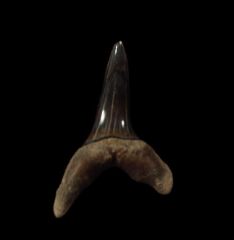
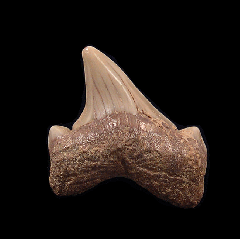
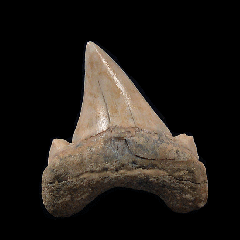
- Macrorhizodus nolfi$0.00
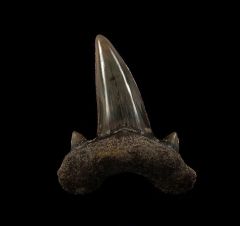
A very rare, early Macrorhizodus nolfi upper jaw, anterior tooth from Aktulagay, western Kazakhstan. Macrorhizodus nolfi is a Lamnidae shark and an early Mako shark (Isurus praecursor) relative in this early Eocene deposit. These teeth exhibit very good color, gloss, and preservation. A rare, early Eocene Macrorhizodus nolfi tooth. No repair. Authenticity guaranteed.
K571 SIZE: 1-3/8"
Note - Adding 18 Kazakh Auriculatus or transition teeth in April 2020. --> Link to Kazakh Auriculatus teeth.
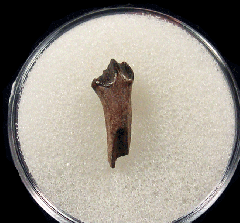
Learn More - Leptoceratops$225.00
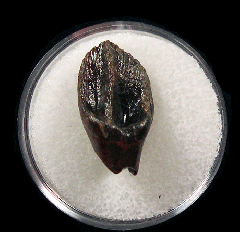
A VERY RARE, Top Quality, rooted Leptoceratops gracilis tooth from the late Cretaceous of western North America. Leptoceratops is a smaller "ceratopsian" dinosaur found in the Hell Creek and Lance formations. There small size and small horns made them relatively easy prey and their population size was quite small compared to other herbivores. The enamel is high quality with nice color and patina. The chewing surface is well preserved with a wear facet. Leptoceratops commonly have wear facets on their teeth. No cracks. No restoration. Legally collected on private land in the Hell Creek Fm., Powder River Co., Montana. Note - this tooth comes with a Riker display frame. Authenticity guaranteed. An excellent rooted Leptoceratops tooth!
DQ08 SIZE: 1/2"
Note - Adding 10 rare Leptoceratops teeth in May 2023. Link to Ceratopian fossils catalog
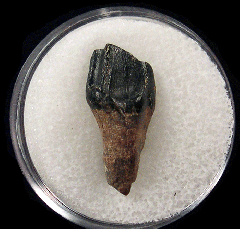
Learn More - Leptoceratops$275.00
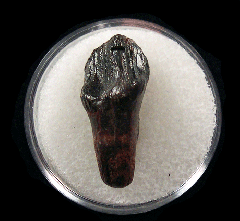
A LARGE, VERY RARE, Top Quality, partially rooted Leptoceratops gracilis tooth from the late Cretaceous of western North America. Leptoceratops is a smaller "ceratopsian" dinosaur found in the Hell Creek and Lance formations. There small size and small horns made them relatively easy prey and their population size was quite small compared to other herbivores. The enamel is high quality with nice color and patina. The chewing surface is well preserved with a wear facet. Leptoceratops commonly have wear facets on their teeth. No cracks. No restoration. Legally collected on private land in the Hell Creek Fm., Garfield Co., Montana. Note - this tooth comes with a Riker display frame. Authenticity guaranteed. An excellent partially rooted Leptoceratops tooth!
DD07 SIZE: 3/4"
Note - Adding 10 rare Leptoceratops teeth in May 2023. Link to Ceratopian fossils catalog
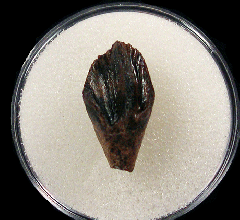
Learn More - Leptoceratops$275.00
A LARGE, VERY RARE, Top Quality, partially rooted Leptoceratops gracilis tooth from the late Cretaceous of western North America. Leptoceratops is a smaller "ceratopsian" dinosaur found in the Hell Creek and Lance formations. There small size and small horns made them relatively easy prey and their population size was quite small compared to other herbivores. The enamel is high quality with nice color and patina. The chewing surface is well preserved with no wear facet. Leptoceratops commonly have wear facets on their teeth. No cracks. No restoration. Legally collected on private land in the Hell Creek Fm., Garfield Co., Montana. Note - this tooth comes with a Riker display frame. Authenticity guaranteed. An excellent partially rooted Leptoceratops tooth!
DD06 SIZE: 5/8"
Note - Adding 10 rare Leptoceratops teeth in May 2023. Link to Ceratopian fossils catalog
Learn More - Leptoceratops$295.00
A LARGE, VERY RARE, Top Quality, partially rooted Leptoceratops gracilis tooth from the late Cretaceous of western North America. Leptoceratops is a smaller "ceratopsian" dinosaur found in the Hell Creek and Lance formations. There small size and small horns made them relatively easy prey and their population size was quite small compared to other herbivores. The enamel is high quality with nice color and patina. The chewing surface is well preserved with no wear facet. Leptoceratops commonly have wear facets on their teeth. No cracks. No restoration. Legally collected on private land in the Hell Creek Fm., Custer Co., Montana. Note - this tooth comes with a Riker display frame. Authenticity guaranteed. An excellent partially rooted Leptoceratops tooth!
DQ04 SIZE: 3/4"
Note - Adding 10 rare Leptoceratops teeth in May 2023. Link to Ceratopian fossils catalog
Learn More - Leptoceratops$350.00
A LARGE, VERY RARE, Top Quality, rooted Leptoceratops gracilis tooth from the late Cretaceous of western North America. Leptoceratops is a smaller "ceratopsian" dinosaur found in the Hell Creek and Lance formations. There small size and small horns made them relatively easy prey and their population size was quite small compared to other herbivores. The enamel is high quality with nice color and patina. The chewing surface is well preserved with a very small wear facet. Leptoceratops commonly have wear facets on their teeth. No cracks. No restoration. Legally collected on private land in the Hell Creek Fm., Garfield Co., Montana. Note - this tooth comes with a Riker display frame. Authenticity guaranteed. An excellent rooted Leptoceratops tooth!
DQ03 SIZE: 7/8"
Note - Adding 10 rare Leptoceratops teeth in May 2023. Link to Ceratopian fossils catalog
Learn More - Cretodus crassidens$250.00
A Top Quality Cretodus crassidens, an extinct Mackerel shark, tooth from Denton Co., Texas. An excellent example of this Lower Cretaceous Eagle Ford Fm. tooth. These massive teeth have a design that includes a large / heavy root with high root face, a narrow crown width, and broad side cusps. This is the big shark tooth in Texas Cretaceous deposits which can reach 2.6". This is a lateral tooth with perfect side cusps. Authenticity guaranteed. Perfect tooth. I don't see many of these teeth.
T184 SIZE: 1-1/2"
Note - Adding 100+ new Texas shark teeth in October 2021. Link to Texas shark teeth
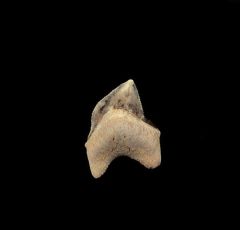
Learn More - Carcharias amonensis$17.50
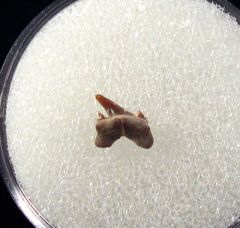
A Top Quality Carcharias amonensis, an extinct Sandtiger shark tooth from Dallas Co., Texas. An excellent example of this Middle Cretaceous Kamp Ranch Fm. shark. A lateral tooth. Great dual side cusps. Authenticity guaranteed. Tip damage.
T326 SIZE: 1/4+"
Note - Adding 100+ new Texas shark teeth in October 2021. Link to Texas shark teeth
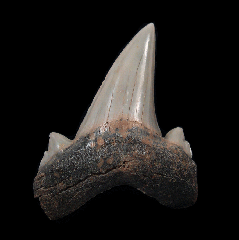
Learn More - Otodus obliquus (not serrated)$95.00
A very rare, early Otodus obliquus anterior tooth from Kzil-Orda Region, Kazakhstan. Otodus obliquus is the ancestor to O. auriculatus (see detailed discussion below) which leads to Megalodon. The bourlette is large and complete. Exhibits no serrations. The starting species to serrated Otodus teeth. These teeth exhibit very good color, gloss, and preservation. A rare, early Eocene (Ypresian) Auriculatus transition tooth. A very challenging tooth to find when building a Megalodon evolutionary set! No repair. Authenticity guaranteed. Note - This western Kazakhstan site is one of the few places in the world where the Otodus obliquus to Otodus auriculatus transition can be found in adjacent early Eocene formation units.
K561 SIZE: 1-1/16"
Note - Adding 24 Kazakh Auriculatus or transition teeth in July 2024. --> Link to Kazakh Auriculatus teeth.
Learn More - Otodus obliquus (not serrated)$135.00
A very rare, early Otodus obliquus anterior tooth from Kzil-Orda Region, Kazakhstan. Otodus obliquus is the ancestor to O. auriculatus (see detailed discussion below) which leads to Megalodon. The bourlette is large and complete. Exhibits no serrations. The starting species to serrated Otodus teeth. These teeth exhibit very good color, gloss, and preservation. A rare, early Eocene (Ypresian) Auriculatus transition tooth. A very challenging tooth to find when building a Megalodon evolutionary set! No repair. Authenticity guaranteed. Note - This western Kazakhstan site is one of the few places in the world where the Otodus obliquus to Otodus auriculatus transition can be found in adjacent early Eocene formation units.
K562 SIZE: 1-1/4"
Note - Adding 24 Kazakh Auriculatus or transition teeth in July 2024. --> Link to Kazakh Auriculatus teeth.
Learn More - Otodus obliquus (not serrated)$200.00
A very rare, early Otodus obliquus anterior tooth from Kzil-Orda Region, Kazakhstan. Otodus obliquus is the ancestor to O. auriculatus (see detailed discussion below) which leads to Megalodon. The bourlette is large and complete. Exhibits no serrations. The starting species to serrated Otodus teeth. These teeth exhibit very good color, gloss, and preservation. A rare, early Eocene (Ypresian) Auriculatus transition tooth. A very challenging tooth to find when building a Megalodon evolutionary set! No repair. Authenticity guaranteed. Note - This western Kazakhstan site is one of the few places in the world where the Otodus obliquus to Otodus auriculatus transition can be found in adjacent early Eocene formation units.
K561 SIZE: 1-1/4"
Note - Adding 24 Kazakh Auriculatus or transition teeth in July 2024. --> Link to Kazakh Auriculatus teeth.
Learn More - Squalicorax kaupi$15.00
A Quality Squalicorax kaupi tooth from Gove Co., Kansas. An excellent example of this Cretaceous shark. Authenticity guaranteed.
KS267 SIZE: 11/16"
Note - Adding new S. kaupi teeth in April 2020. Link to Kansas S. Kaupi teeth
Learn More