Search results for: 'fossil+very+large+teeth/'
- Did you mean
- fossil very larvae teeth
- fossil very larva teeth
- Related search terms
- fossil+very+large+teeth//
- fossil+very+large+teeth///
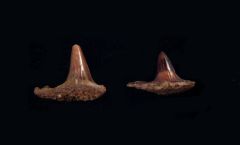
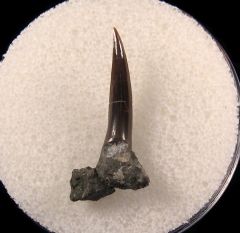
- Hybodus sp.$27.50
A very attractive and rare Hybodus teeth. Complete teeth are very difficult to locate.
K488 (Right) SIZE: 1/4"
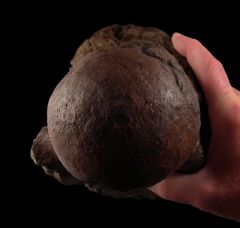
Learn More - Triceratops Occipital Condyle$0.00
A rare EXTRA LARGE, Top Quality Triceratops horridus occipital condyle with brain case attached from the late Cretaceous of northern North America. Triceratops was a large ceratopsian dinosaur found in the Hell Creek and Lance Creek formations which is know for three horns and the large frill protecting its neck. This is a beautiful 4-1/2" occipital condyle with exceptional detail preserved. This large codyle has fantastic color and patina plus a large section of braincase is attached. Note - The occipital condyle was the connection point of the Triceratops massive skull to the vertebrae column, and it allowed for maximum rotation of the head. No repair or restoration. 100% natural specimen. Legally collected on private land in Powder River Co., Montana. Authenticity guaranteed. Note - This massive bone structure weighs 14 pounds. An international shipping supplement is required. Please inquire.
DC53 BoP SIZE: 4-1/2" Condyle diameter ; Specimen size: 11" x 6-1/2" wide
Note - Adding 20 new Triceratops bones in July 2022. Link to Triceratops fossils catalog
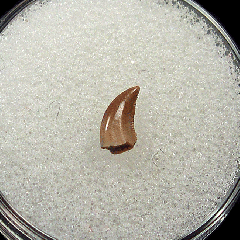
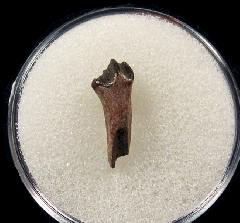
Learn More - Saurornitholestes sp. (Raptor) - New Mexico$0.00
A RARE, Top Quality Saurornitholestes sp. (raptor) tooth from New Mexico. Saurornitholestes is a close relative of Velociraptor. This tooth is 1/4" which is a typical size. The enamel is excellent with a great tan color. This species is known for large posterior serrations that will turn upwards. Excellent posterior (distal) and very good (top 2/3) anterior (mesial) serrations. No repair or restoration. This is a late Campanian age tooth (approx. 76 MYA). Legally collected on private land in the Fruitland Fm., San Juan Co., New Mexico. Authenticity guaranteed. This is your chance to own a rare, top quality Saurornitholestes tooth from New Mexico. Note - A gem jar will be included as photographed.
DNM1 SIZE: 1/4"+
Note - Adding 9 new Saurornitholestes teeth in May 2025 Link to Raptor (Dromaeosaur) catalog.
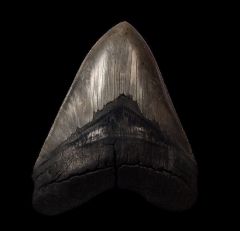
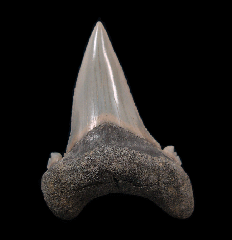
Learn More - Carcharocles megalodon$0.00
An Extra Large, High Quality Megalodon tooth - an upper jaw anterior tooth from So. Carolina. High quality enamel. The black bourlette bourlette is mostly complete. Very sharp serrations with an extra large tip serration. Excellent serrations for a BIG Meg. The root is black and extra wide (4-1/2" W) with typical hydration cracks. No repair or restoration. Authenticity guaranteed. An excellent collector's quality BIG Megalodon tooth. This is a wide and heavy tooth with a great "spade-like" shape!
SC102 Size: 5-11/16" (4-1/2" W)
Learn More - Dykeius garethi$0.00
A Very Rare, EXTRA LARGE Top Quality Dykeius garethi tooth central cusp from Hornby Island, British Columbia, Canada. An August Fossil of the Month. This is a new genius of Frill shark from the Late Cretaceous deep water Northumberland Formation deposit. Another unique species of Chlamydoselachiform shark, the Frill shark. This is the largest Frill shark in the deposit with teeth over 1" tall (28.5 mm). These teeth exhibit classic Frill shark design with a central cusp flanked by two lateral cusps. Dykeius teeth are taller than wide. The crown is complete with the tip reattached. Highest quality enamel. No repair. A very difficult tooth to locate and an excellent collector's tooth. Authenticity guaranteed. This incredible specimen is from a 20 year old collection. An excellent Frill shark specimen!
CD97 SIZE: 7/8" Height
Note - Adding 64 Hornby Island deep water shark teeth. -> Link to all Hornby Island shark teeth.
Learn More - Otodus aksuaticus (Partial serrated)$450.00
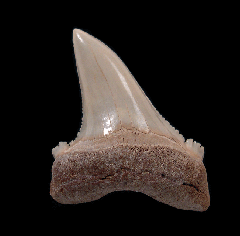
A very rare, early Otodus aksuaticus upper jaw, lateral tooth from Kzil-Orda, Kazakhstan. A transitional tooth leading to O. auriculatus (see detailed discussion below) which leads to Megalodon. A July Fossil of the Month. The bourlette is complete. This tooth exhibits small serrations along the lower 1/3 of the crown and micro serrations to the tip. These teeth exhibit excellent color, gloss, and preservation. A rare, early (Ypresian) Eocene Auriculatus transition tooth. A very challenging tooth to find when building a Megalodon evolutionary set! No repair or restoration. Authenticity guaranteed. This western Kazakhstan site is one of the few places in the world where the Otodus obliquus to Otodus auriculatus transition can be found in adjacent geologic layers.
K547 SIZE: 1-15/16"
Note - Adding 24 Kazakh Auriuclatus or transition teeth in July 2024. --> Link to Kazakh Auriculatus teeth.
Learn More - Otodus aksuaticus (Partial serrated)$425.00
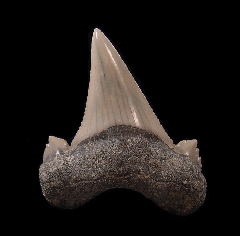
A very rare, early Otodus aksuaticus lateral tooth from Kzil-Orda, Kazakhstan. A transitional tooth leading to O. auriculatus (see detailed discussion below) which leads to Megalodon. A July Fossil of the Month.The bourlette is complete. This tooth exhibits small serrations along the lower 1/2 of the crown and micro serrations to the tip. These teeth exhibit excellent color, gloss, and preservation. A rare, early (Ypresian) Eocene Auriculatus transition tooth. A very challenging tooth to find when building a Megalodon evolutionary set! No repair or restoration. Authenticity guaranteed. This western Kazakhstan site is one of the few places in the world where the Otodus obliquus to Otodus auriculatus transition can be found in adjacent geologic layers.
K544 SIZE: 1-3/4"
Note - Adding 24 Kazakh Auriuclatus or transition teeth in July 2024. --> Link to Kazakh Auriculatus teeth.
Learn More - Otodus aksuaticus (Partial serrated)$550.00
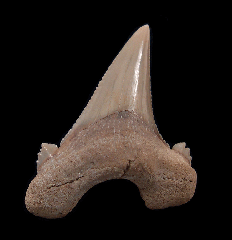
A very rare, early Otodus aksuaticus lateral tooth from Kzil-Orda, Kazakhstan. A transitional tooth leading to O. auriculatus (see detailed discussion below) which leads to Megalodon. A July Fossil of the Month. The bourlette is complete. This tooth exhibits small serrations along the lower 1/2 of the crown and micro serrations to the tip. These teeth exhibit excellent color, gloss, and preservation. A rare, early (Ypresian) Eocene Auriculatus transition tooth. A very challenging tooth to find when building a Megalodon evolutionary set! No repair or restoration. Authenticity guaranteed. This western Kazakhstan site is one of the few places in the world where the Otodus obliquus to Otodus auriculatus transition can be found in adjacent geologic layers.
K542 SIZE: 2-1/8"
Note - Adding 24 Kazakh Auriuclatus or transition teeth in July 2024. --> Link to Kazakh Auriculatus teeth.
Learn More - Otodus aksuaticus (Partial serrated)$525.00
A very rare, early Otodus aksuaticus anterior tooth from Kzil-Orda, Kazakhstan. A transitional tooth leading to O. auriculatus (see detailed discussion below) which leads to Megalodon. A July Fossil of the Month. The bourlette is complete. This tooth exhibits small serrations along the lower 1/2 of the crown and micro serrations to the tip. These teeth exhibit excellent color, gloss, and preservation. A rare, early (Ypresian) Eocene Auriculatus transition tooth. A very challenging tooth to find when building a Megalodon evolutionary set! No repair or restoration. Authenticity guaranteed. This western Kazakhstan site is one of the few places in the world where the Otodus obliquus to Otodus auriculatus transition can be found in adjacent geologic layers.
K542 SIZE: 2-3/16"
Note - Adding 24 Kazakh Auriuclatus or transition teeth in July 2024. --> Link to Kazakh Auriculatus teeth.
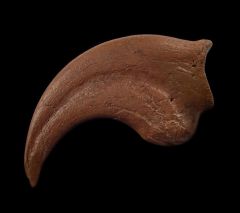
Learn More - Anzu wyliei claw$0.00
A rare, Top Quality, EXTRA LARGE Anzu wyliei hand (manus) claw from the Hell Creek Fm. of SE Montana. Another June 2018 Fossil of the Month. Anzu is referred to as the "Chicken from Hell". An exceptional manus claw. Highest quality rich brown color and patina. This specimen has incredible perservation with exceptional surfaces - no pitting, nicks or wear - superb surface articulation! There is some professional restoration which is typical for a big Anzu wyliei manus claw. The tip has a small section repaired and the proximal edge has a small triangular area repaired which starts at the center of proximal surface (see photo). A high quality, collector's claw from one of my favorite collecting sites. Note - 2014 Anzu wyleii description paper attached below. Check out our selection of top quality Anzu wyliei claws! Legally collected on private land in the Hell Creek Fm., Powder River Co., Montana. Authenticity guaranteed. Museum Quality. One of my favorites! Note - a Riker frame will be included.
DA01 BoP Size: 3-7/8" (always straightline) (Note - 1-7/8" height at the proximal end!)
Note - Adding four Anzu wyliei claws in June 2018. Link to Anzu wyliei claws.
Learn More - Leptoceratops$225.00
A VERY RARE, Top Quality, rooted Leptoceratops gracilis tooth from the late Cretaceous of western North America. Leptoceratops is a smaller "ceratopsian" dinosaur found in the Hell Creek and Lance formations. There small size and small horns made them relatively easy prey and their population size was quite small compared to other herbivores. The enamel is high quality with nice color and patina. The chewing surface is well preserved with a wear facet. Leptoceratops commonly have wear facets on their teeth. No cracks. No restoration. Legally collected on private land in the Hell Creek Fm., Powder River Co., Montana. Note - this tooth comes with a Riker display frame. Authenticity guaranteed. An excellent rooted Leptoceratops tooth!
DQ08 SIZE: 1/2"
Note - Adding 10 rare Leptoceratops teeth in May 2023. Link to Ceratopian fossils catalog
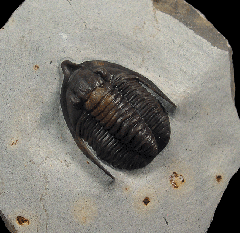
Learn More - Diademaproetus praecursor$350.00
A LARGE, Diademaproetus praecursor (Proetid) trilobite from Morocco. Preparation is German directed with all original colors and no restoration. Scarce species. Exceptional, very fine (small leanses) compound eyes. An Upper Emsian Fm. specimen, Lower Devonian (395 mya) trilobite from the Assa Area, Dra Valley, Morocco. A Top Quality specimen. Exquisite preparation. Authenticity guaranteed.
XM73 Size: 1-11/16" (1-1/4" wide)
Adding 31 quality Moroccan trilobites in April 2025. Link to Moroccan trilobites.
Learn More